

On 12 December 2019, the whole of Breeze Energy's homepage was one sentence: "ranked #1 by citizens advice", above a note looking forward to welcoming new customers. Six days later the company announced it was ceasing to trade.
What ended it was not customer service. It was a bill for renewable electricity that it had already told Ofgem it could pay, and then did not.
What happened to Breeze Energy?
Breeze Energy Supply Limited was a small supplier run from Dobson House in Gosforth, Newcastle upon Tyne. It sold on a single tariff, made a point of its North East base and its "reduce your use" advice, and told customers that "together we can make a positive difference". It did not serve prepayment or Economy 7 meters.
Ofgem announced on 18 December 2019 that Breeze was ceasing to trade, with just under 18,000 domestic customers. British Gas was appointed through the supplier of last resort process and took the customers on with effect from Sunday 22 December. Trade reporting at the time made Breeze the ninth supplier to fail that year.
On credit balances, the outcome was good. Ofgem's safety net protected domestic balances, and British Gas went further than the minimum by honouring money owed to past customers as well as current ones. The one caveat Ofgem published is worth knowing, because it catches people out: the balance you get is net of energy you used but were never billed for, which the administrators have to work out first, and that takes weeks rather than days.
Ranked first, six days before the end
The Internet Archive captured breezeenergy.co.uk on 12 December 2019. There is almost nothing on the page except this.
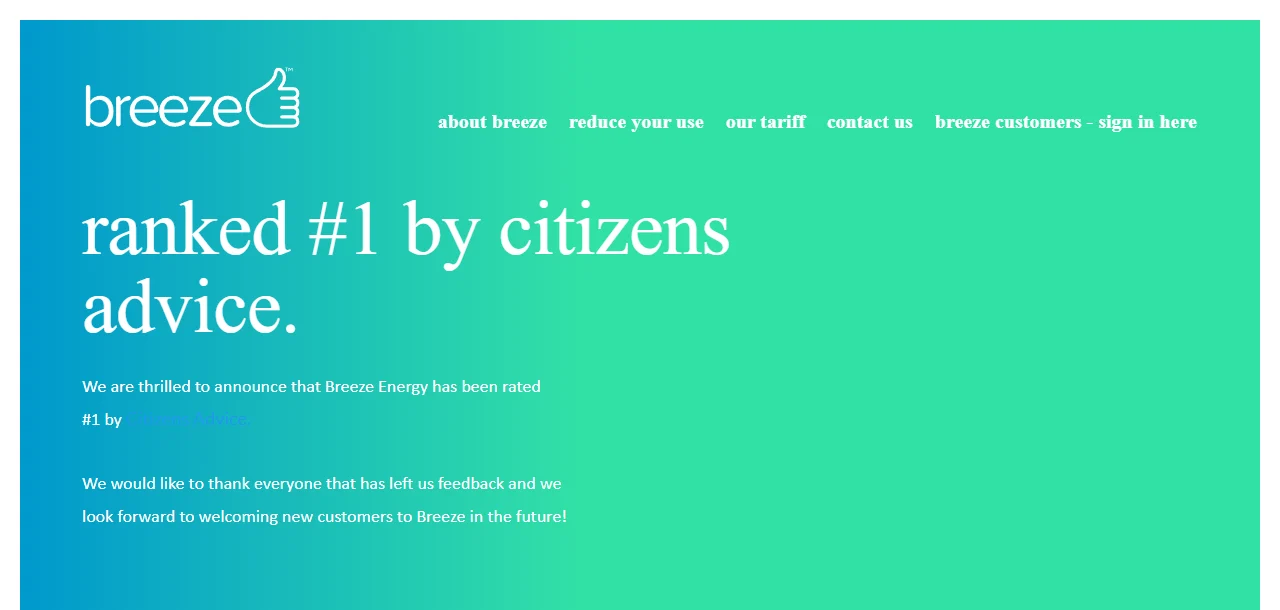
That is the company's own claim and we have not been able to verify it against the published league table. It is worth recording that it is not an isolated one. The directors of GOTO Energy said much the same thing in their closing message nearly two years later, listing a first place in the Citizens Advice rankings among the reasons customers should think well of the company as it went under.
Taken at face value, both tell you something true and slightly bleak. Being good at answering the phone, billing accurately and resolving complaints is a real achievement and it is measured and published. It also has almost nothing to do with whether a supplier survives, because what sinks them is the gap between what they promised to charge and what energy cost to buy. Several of the worst rated suppliers on this record outlasted both of them.
What Breeze actually owed
The figure usually quoted for Breeze is £486,232.06. Ofgem's order shows that is not what the company owed. It is what was left.
Every electricity supplier has to discharge its Renewables Obligation for each year by the following 1 September, either by handing over certificates or by paying cash instead. Breeze missed that date for the year to 31 March 2019. There is then a late payment window running to 31 October, and Ofgem spoke to Breeze in September 2019 to ask for assurances that it would pay within it: a bank guarantee, confirmation of undrawn credit facilities, or support from a parent or investor.
Ofgem's order records what happened next in one flat sentence. Breeze "provided such assurances to the satisfaction of the Authority at the time, but has subsequently refused or failed to make the said payments".
So on 31 October 2019, the last day of the window, Ofgem made a provisional order requiring Breeze to pay £1,986,232.06 forthwith. A footnote to the order records that Breeze made a payment that same day which brought the outstanding amount down to £486,232.06 including interest. In other words the company found roughly one and a half million pounds at the deadline and could not find the rest.
| Breeze’s Renewables Obligation for 2018 to 2019 | Amount |
|---|---|
| Due under the provisional order of 31 October 2019 | £1,986,232.06 |
| Paid on 31 October 2019 | About £1,500,000 |
| Left outstanding, including interest | £486,232.06 |
| Paid before the company ceased trading | None of it |
The order was to lapse on 31 January 2020 unless Ofgem confirmed it. Breeze announced it was ceasing to trade seven weeks after the order was made, so it never came to that.
What the Renewables Obligation really is
This case is widely described as Ofgem fining Breeze for not buying enough renewable electricity. That is not what happened, and the difference matters if you want to understand any of the other failures on this record.
The Renewables Obligation is not a penalty for a brown fuel mix. Under the Renewables Obligation Order, every designated electricity supplier owes a set number of certificates for each megawatt hour it supplies, regardless of where that electricity came from. A supplier meets the obligation in one of two ways: by producing Renewables Obligation Certificates, which are issued to renewable generators and can be bought, or by paying cash to Ofgem instead. The money raised goes to support renewable generation.
So every supplier owes it, green or not. A company that buys no renewable power at all is not breaking the rule; it simply pays rather than presents certificates. Breeze did not break the rule by having a particular fuel mix. It broke the rule by not paying.
You will also see it reported that Breeze sourced only 8.9% of its electricity from renewables against a UK average of 32.8%. We have not been able to verify that. Breeze published a fuel mix page and linked it from every page of its site, but the Internet Archive never captured it, so there is no primary record of what it actually claimed. We have left the number out of the account above for that reason.
What the obligation does do, when a supplier fails without discharging it, is leave a hole. For the mechanics of how that hole gets filled, and by whom, the Renewables Obligation story is set out at greater length on the Orbit Energy page, which goes into how a tariff can be called 100% renewable in the first place.
Key dates
| Date | What happened |
|---|---|
| 1 September 2019 | Deadline passes for Breeze to discharge its Renewables Obligation for the year to 31 March 2019 |
| September 2019 | Ofgem seeks assurances that Breeze can pay within the late payment window. Breeze provides them to Ofgem’s satisfaction |
| 31 October 2019 | The late payment window closes. Ofgem makes a provisional order for £1,986,232.06. Breeze pays about £1.5m the same day, leaving £486,232.06 outstanding |
| 12 December 2019 | Breeze’s homepage is given over to its Citizens Advice ranking and an invitation to new customers |
| 18 December 2019 | Ofgem announces that Breeze Energy is ceasing to trade, with just under 18,000 domestic customers |
| 22 December 2019 | British Gas takes on the customers and agrees to honour credit balances for current and past customers |
| 3 January 2020 | Administration begins |
| 21 December 2023 | The administration concludes |
What it means for a business
Breeze sold to households. Ofgem recorded just under 18,000 domestic customers, the archived site has no business or commercial section anywhere, and the company did not even support prepayment or Economy 7 meters. If you run a business, you were not a Breeze customer.
You paid for it anyway, and this is the clearest small example of how that works.
The £486,232.06 Breeze did not pay was not a fine that vanished when the company did. It was money owed into the scheme that funds renewable generation, and that money still has to arrive. When a failed supplier leaves a Renewables Obligation shortfall, the amount is mutualised, which means it is spread across the suppliers still trading in proportion to their share of the market. They recover it in their prices. Business tariffs carry it exactly as domestic ones do.
So a company running a bakery in Carlisle contributed to the renewables bill of a Newcastle supplier it had never heard of, whose 18,000 customers were all households. That is not a scandal, it is how the scheme is designed to stay whole, but it is worth knowing when people ask why environmental and social costs on a business bill keep creeping up.
The practical reading is the same one that runs through this record. You cannot control what other suppliers do, and you carry a share of it. What you can control is what you are paying on your own contract, and how exposed you are if your own supplier goes.
| An unpaid Renewables Obligation | What happens |
|---|---|
| Written off when the company fails | No |
| Recovered from the failed company | Only whatever the administration returns, usually very little |
| Spread across remaining suppliers | Yes, in proportion to market share |
| Reaches domestic bills | Yes |
| Reaches business bills | Yes |
Where to start
- Business electricity prices and what makes up the unit rate
- Commercial gas costs this month
- Business energy suppliers accepting new accounts
For another supplier that failed owing scheme payments, read what Toto Energy left behind. For the one where the whole cost of a rescue was published, see the GOTO Energy figures.
Breeze Energy FAQs
What happened to Breeze Energy?
Why did Breeze Energy fail?
Was Breeze Energy fined for not using renewable electricity?
Did Breeze Energy customers get their credit balances back?
Did Breeze Energy supply businesses?
Was Breeze Energy really ranked first by Citizens Advice?
Who paid the Renewables Obligation that Breeze did not?
Sources
- Ofgem, Breeze Energy Supply Ltd: Provisional Order, 31 October 2019
- Ofgem, Ofgem protects customers of failed supplier Breeze Energy, 18 December 2019
- Ofgem, Breeze Energy customers: your questions on new supplier British Gas
- breezeenergy.co.uk, homepage of 12 December 2019 and closure notice of 18 December 2019, as captured by the Internet Archive
- Companies House, Breeze Energy Supply Limited, company number 09522929