

Toto Energy took on 43,000 customers from a failing supplier in August 2019 and collapsed eleven weeks later. Those 43,000 people changed energy company twice in under three months, and chose neither move.
Toto ceased trading on 23 October 2019 with 134,000 customers in total, owing £4,555,880 in Renewables Obligation payments it had collected through bills and not handed over.
What happened to Toto Energy?
Toto Energy Limited was incorporated in 2014 under the name Covent Energy and began trading as Toto in 2016. It sold gas and electricity, mostly to households, and grew quickly.
It ceased trading on 23 October 2019. Ofgem ran its competitive process and appointed EDF Energy, which began supplying all 134,000 customers on Sunday 27 October. The company was dissolved on 5 February 2025.
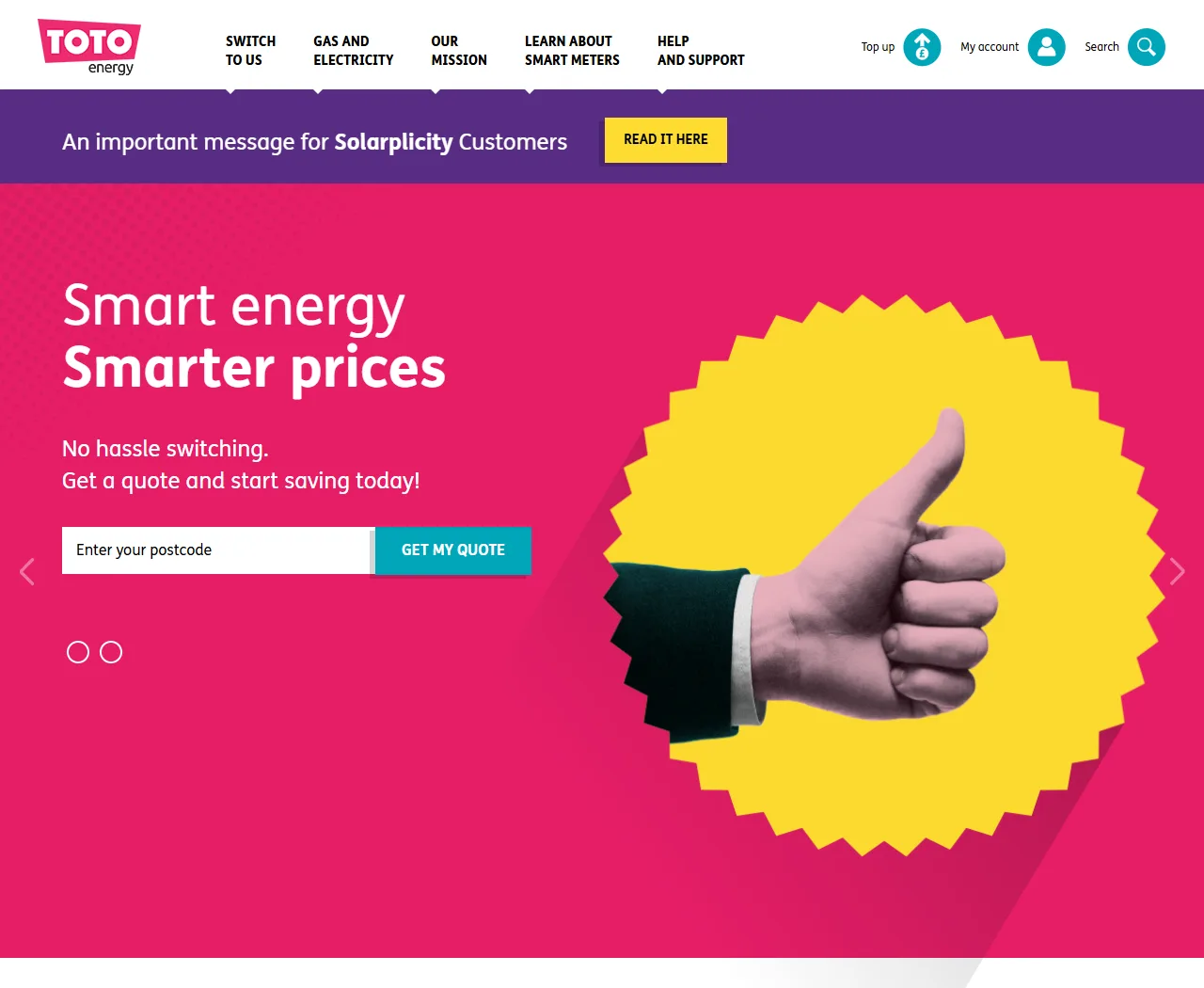
Three days before the end, its homepage was still taking quotes and still carrying a banner addressed to customers it had absorbed from somebody else's collapse.
The customers who failed twice
In late July 2019 Toto Energy agreed to take on 43,000 of Solarplicity's 60,000 domestic accounts, with the customers moving across in early August. Solarplicity was in trouble, and this was the commercial version of a rescue.
Eleven weeks later Toto was gone.
For those 43,000 households that meant two changes of supplier in under three months, neither of them chosen, with two sets of final bills, two account closures and two credit balances to chase. It is the tightest double failure on this record.
Ofgem's guidance to Toto's customers addressed it directly, and the wording is worth quoting because it is the only place on this site where a protection explicitly reaches back through two collapses. EDF, it said, would honour credit balances for current and past customers of Toto "and former customers of Solarplicity who Solarplicity transferred to Toto Energy earlier this year (and who have not yet had their credit balance returned)".
So money owed by a supplier that failed in the summer, inherited by a supplier that failed in the autumn, was picked up by the third company in the chain.
The £4.5 million it never paid
The Renewables Obligation requires a supplier either to present Renewables Obligation Certificates or to pay a cash equivalent into a buy-out fund. The money is recovered from customers through bills across the year and handed over afterwards, which is what makes it such a reliable early warning: a supplier that cannot pay it has usually already spent it.
Toto missed both routes. It did not present certificates by 1 September 2019 and did not make the alternative payment by 31 August. Ofgem published a proposal to make a final order on 1 October requiring payment of £4,555,880 plus interest, with a late payment deadline of 31 October.
The company ceased trading on 23 October, eight days before that deadline. Ofgem's final order, dated 29 October, was never issued: the authority recorded that because Toto had ceased to trade it would instead "engage with TOTO's administrators and seek to recover as much money as possible through that process".
Where it cannot be recovered, the shortfall is mutualised, which means spread across the suppliers that did pay and recovered from their customers. Toto is one of several suppliers on this record whose unpaid environmental obligations ended up on everybody else's bills, alongside Together Energy and AmpowerUK.
What it means for a business
Ofgem published a single figure of 134,000 customers for Toto and no split between domestic and non-domestic, so the public record does not say how many businesses were affected. What it does say is that the credit balance commitment EDF gave was unusually generous in reaching back through the Solarplicity transfer.
The general position has not changed, and is worth repeating because Toto's story is a reminder of how fast a supplier can go from buying customers to losing them:
| When a supplier fails | Household | Business |
|---|---|---|
| Supply continues | Yes | Yes |
| Credit balance guaranteed by the safety net | Yes | No |
| A price cap limits the rate you move to | Yes | No |
| Exit fee to leave afterwards | None | None |
Where to start
- Business electricity rates per unit this month, with the standing charge
- What commercial gas is costing per unit
- Suppliers currently writing non-domestic deals
If you were transferred and never agreed new terms, see how a deemed rate works. For the other supplier that absorbed a failed book and then failed itself, see Together Energy.
Toto Energy FAQs
What happened to Toto Energy?
Why did Toto Energy fail?
What happened to the Solarplicity customers Toto took on?
Did Toto Energy customers lose money?
What happens to unpaid Renewables Obligation when a supplier fails?
Who took over Toto Energy customers?
Sources
- Ofgem, Toto Energy customers: your questions on new supplier EDF Energy, for the transfer date and the Solarplicity credit balance wording
- Ofgem, TOTO Energy Limited: Final Order, 29 October 2019
- Companies House, Toto Energy Limited, company number 09256482
- The company's own website, as archived at totoenergy.com on 20 October 2019