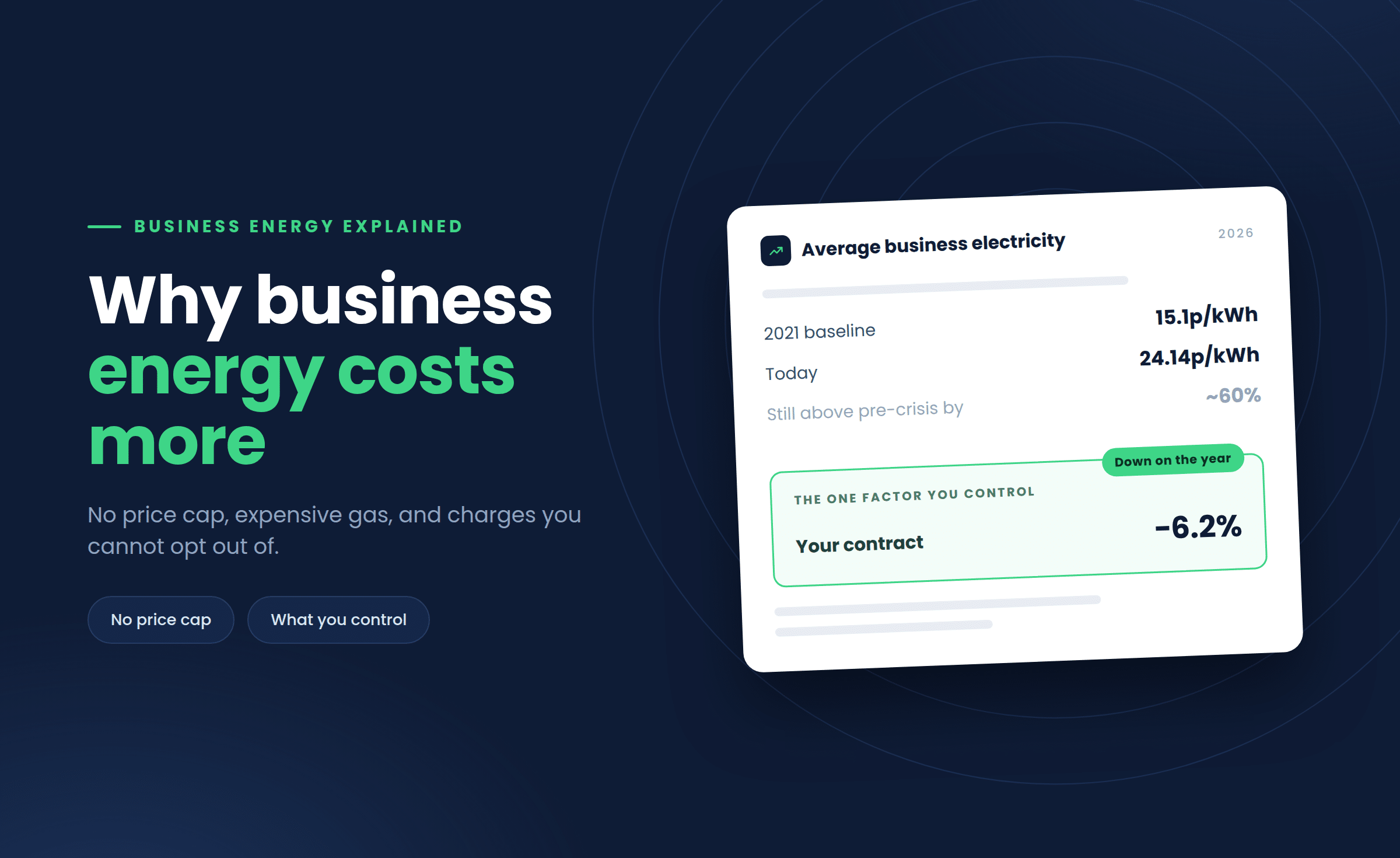

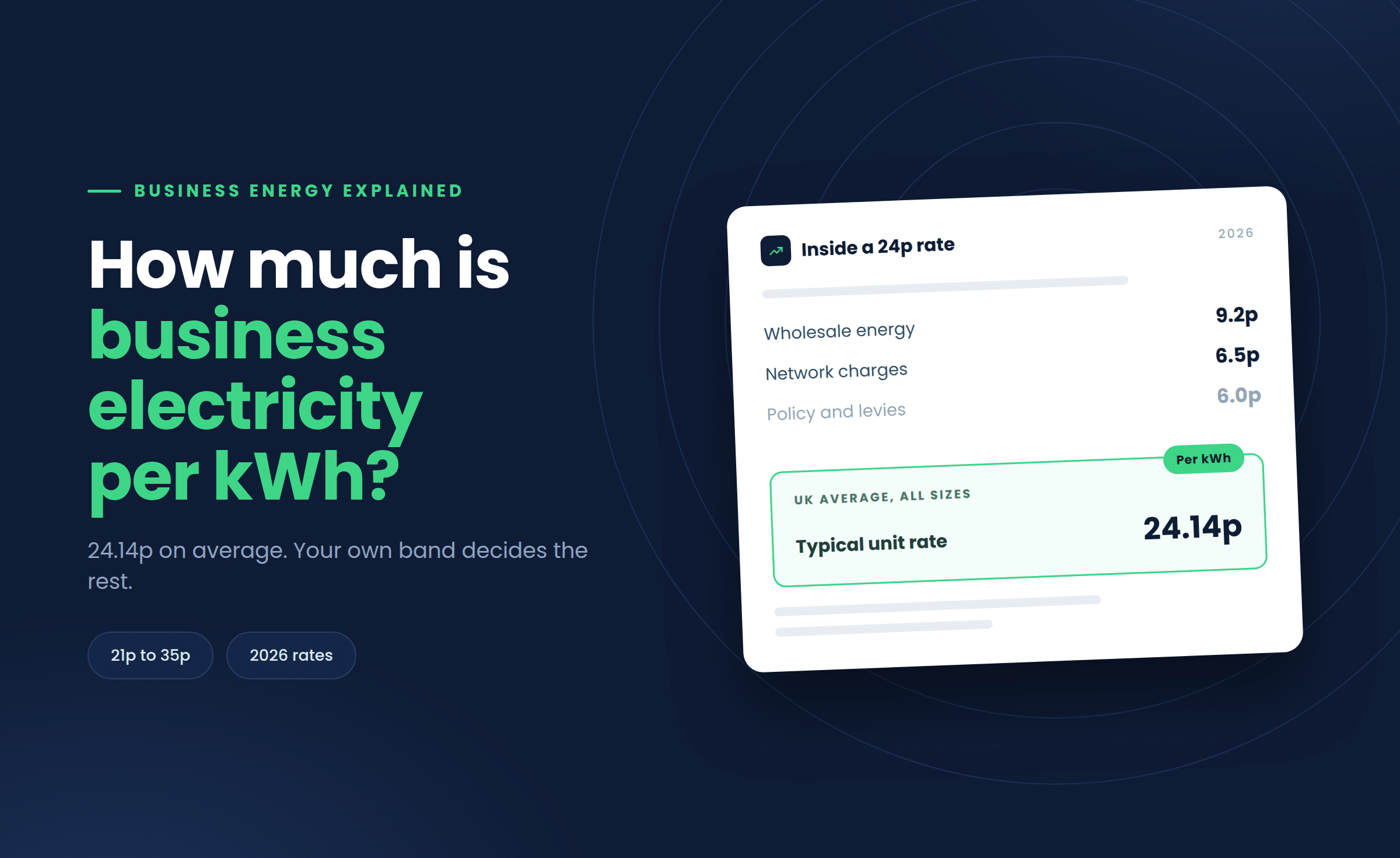
The UK average business electricity rate in 2026 is 24.14p/kWh, but your own figure could sit anywhere from around 21p to over 35p per kWh depending on your size, meter type and region.
Business electricity pricing works differently from the household market, and that catches a lot of owners out. There is no single tariff for everyone: suppliers price you into a band based on how much you use, which is also what decides what counts as a good rate for your size.
This guide sets out the actual business electricity figures, published to Q1 2026, so you can benchmark your own bill properly. These are averages including the Climate Change Levy and excluding VAT, so your own quote will vary.
What is the current UK average electricity rate per kWh?
The current UK average across all business sizes is 24.14p/kWh, though the best 2026 fixed rates start from around 26p/kWh on a two-year deal, varying by usage and standing charge.
Why the average is only a starting point
That 24.14p figure is a blended average. It covers everyone from a single-till shop to a large distribution centre, so it is a useful headline but not a precise benchmark for your own business.
For an accurate comparison you need the rate for your specific usage band, which is set out in full below.
How does the rate change by business size?
Rates fall as annual usage rises, from around 35.02p/kWh for a very small business down to 21.42p/kWh for the largest sites using over 150,000 MWh a year.
The table below gives the average rate by band, correct to Q1 2026 and drawn from DESNZ price data.
| Business size | Annual usage | Rate (p/kWh) |
|---|---|---|
| Very small | 0 to 20 MWh | 35.02p |
| Small | 20 to 499 MWh | 28.76p |
| Small / medium | 500 to 1,999 MWh | 28.08p |
| Medium | 2,000 to 19,999 MWh | 25.00p |
| Large | 20,000 to 69,999 MWh | 23.93p |
| Very large | 70,000 to 150,000 MWh | 21.93p |
| Extra large | Over 150,000 MWh | 21.42p |
What this means in pounds and pence
Turned into an annual electricity spend, those rates land close to the figures in our average business energy bill guide. Our how much business energy costs breakdown shows the same numbers with gas added in.
- Micro (up to 5,000 kWh): around £888 a year for electricity.
- Small (up to 15,000 kWh): around £2,884 a year.
- Medium (up to 25,000 kWh): around £5,563 a year.
- Large (up to 50,000 kWh): around £10,606 a year.
- Extra large (up to 100,000 kWh): around £19,356 a year.
What else is included on top of the unit rate?
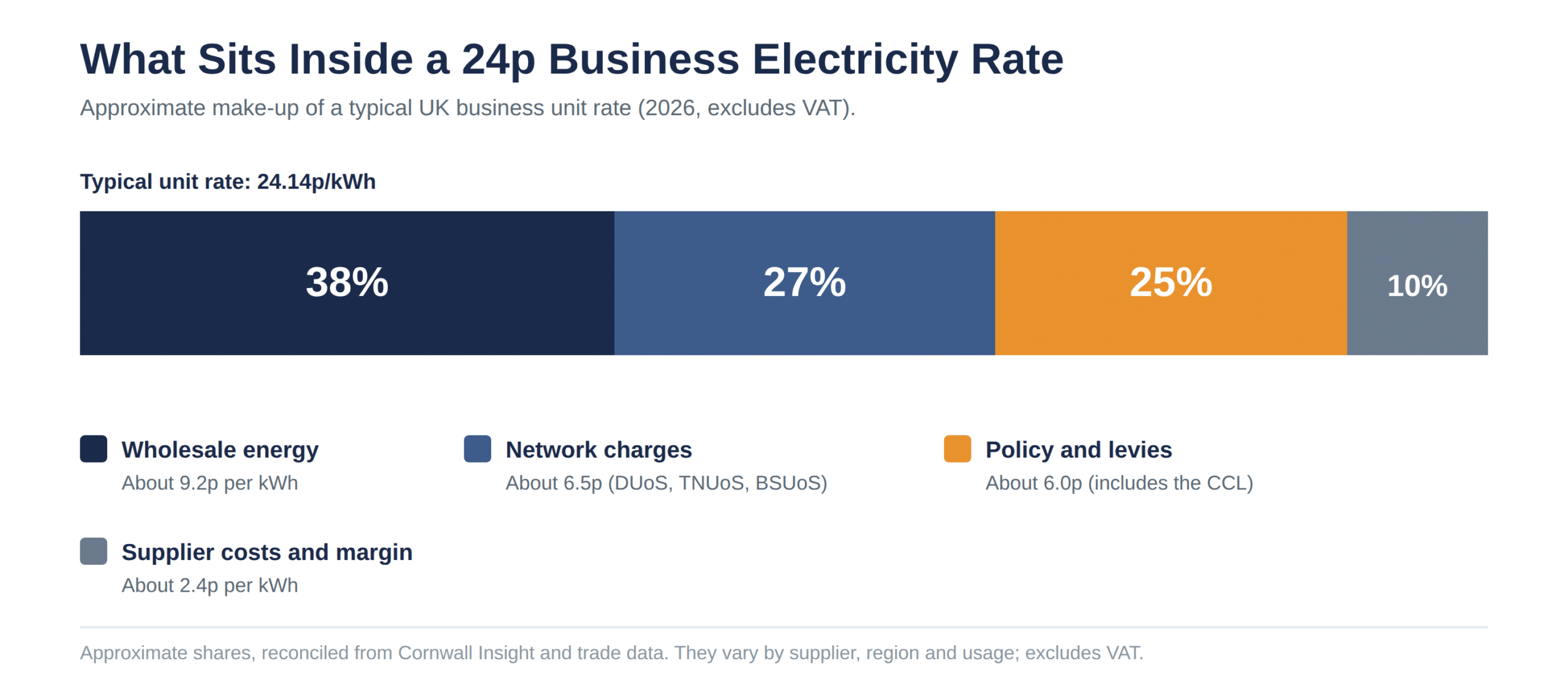
Your bill combines the pence per kWh unit rate with a daily standing charge, network charges and the Climate Change Levy, all before VAT is applied.
It is easy to fixate on the headline p/kWh figure, but that is only part of the picture. Distribution costs, known as DUoS, are set by your regional network operator under Ofgem’s network price controls, whether that is UK Power Networks, SSEN, Northern Powergrid or another.
Charges that sit alongside the unit rate
- Standing charge: a fixed daily cost, regardless of usage.
- DUoS: distribution charges from your local network operator.
- TNUoS and BSUoS: transmission and balancing costs, usually embedded in the unit rate for smaller sites.
- Climate Change Levy: a per-kWh environmental tax, around 0.8p/kWh on electricity from April 2026.
- VAT: usually 20%, though some businesses qualify for the reduced 5% rate.
If you are unsure what is driving your bill up, our guide on how to read a business energy bill breaks each line down in plain English.
Why has the rate changed so much over five years?
UK business electricity is down around 6% year on year, yet still about 60% higher than five years ago, largely because of the wholesale price shock that began in 2021 and 2022.
Where prices sit now
Prices have eased from their 2022 peak but have not returned to pre-crisis levels. A rate that looked good in 2021 would look expensive against a very different market, which is why an old benchmark is worth little today.
What still keeps prices up
Wholesale gas prices heavily influence electricity costs, since gas-fired power stations often set the marginal price in the market. When gas moves, business electricity tends to follow within a few months.
The National Energy System Operator and Ofgem both monitor market stability. Government schemes such as the Energy Bill Discount Scheme softened the impact during the crisis, but that support has since ended.
How do you work out your actual annual cost?
Multiply your annual usage in kWh by your unit rate, then add your standing charge multiplied by the days in the year, plus the Climate Change Levy and VAT.
A worked example
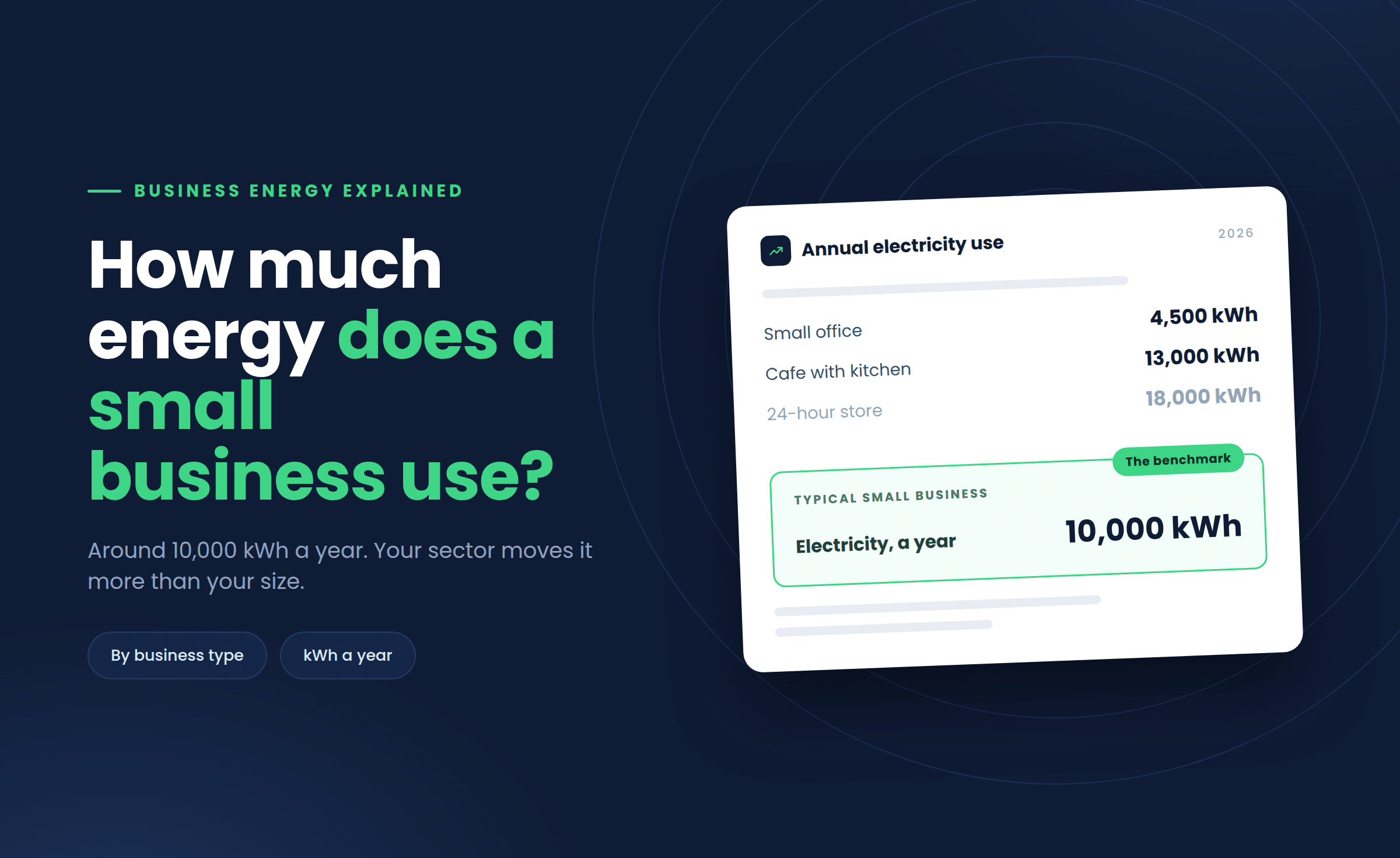
A business using 10,000 kWh a year at the small business average of 28.76p/kWh pays roughly £2,876 before standing charges, VAT and CCL.
Add those on and you land close to the £2,884 average electricity figure quoted earlier. A live comparison does this automatically, matching your real usage against current supplier rates rather than a published average.
| Step | What to do | Example (10,000 kWh) |
|---|---|---|
| 1. Energy cost | Usage × unit rate | 10,000 × 28.76p = £2,876 |
| 2. Standing charge | Daily charge × 365 | Around £250 a year |
| 3. Climate Change Levy | Usage × 0.8p | 10,000 × 0.8p = £80 |
| 4. VAT | 20% on the total, or 5% if you qualify | Added last |
How can you get a lower rate per kWh?
Compare a panel of suppliers against a recent bill before you renew, since your incumbent’s renewal offer is rarely their sharpest rate.
Steps to a sharper rate
-
Have your details ready
Your MPAN number, annual usage and a recent bill.
-
Time it right
Start around your renewal date, ideally three to six months out.
-
Compare widely
Check a panel of business energy suppliers, not just one renewal letter.
-
Fix if it suits you
A fixed term locks in the rate, protecting you from wholesale rises.
Utility Saving Expert compares a panel of 30+ trusted UK suppliers and has helped businesses save an average of £1,952 when switching.