
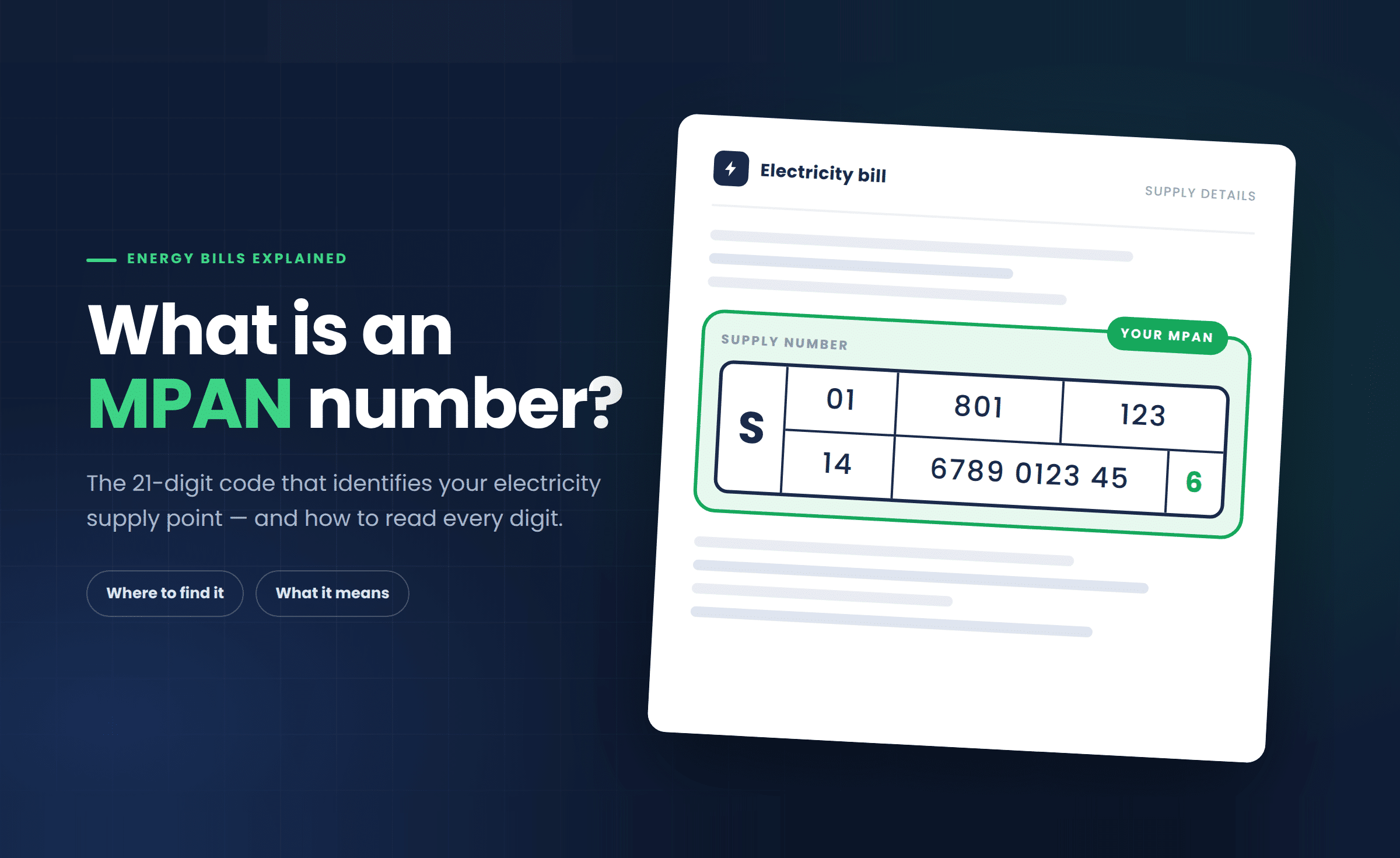
An MPAN, or Meter Point Administration Number, is the unique 21-digit reference for your electricity supply point, printed on your bill with a leading letter S. It identifies your property’s connection to the grid, so it never changes when you switch supplier.
You may also hear it called your supply number or S-number. Gas has its own version, the MPRN, and this guide covers both.
Knowing these numbers makes switching quicker and quotes more accurate. When you are ready, you can compare business energy suppliers and have your MPAN ready to speed things up.
What does an MPAN number look like?
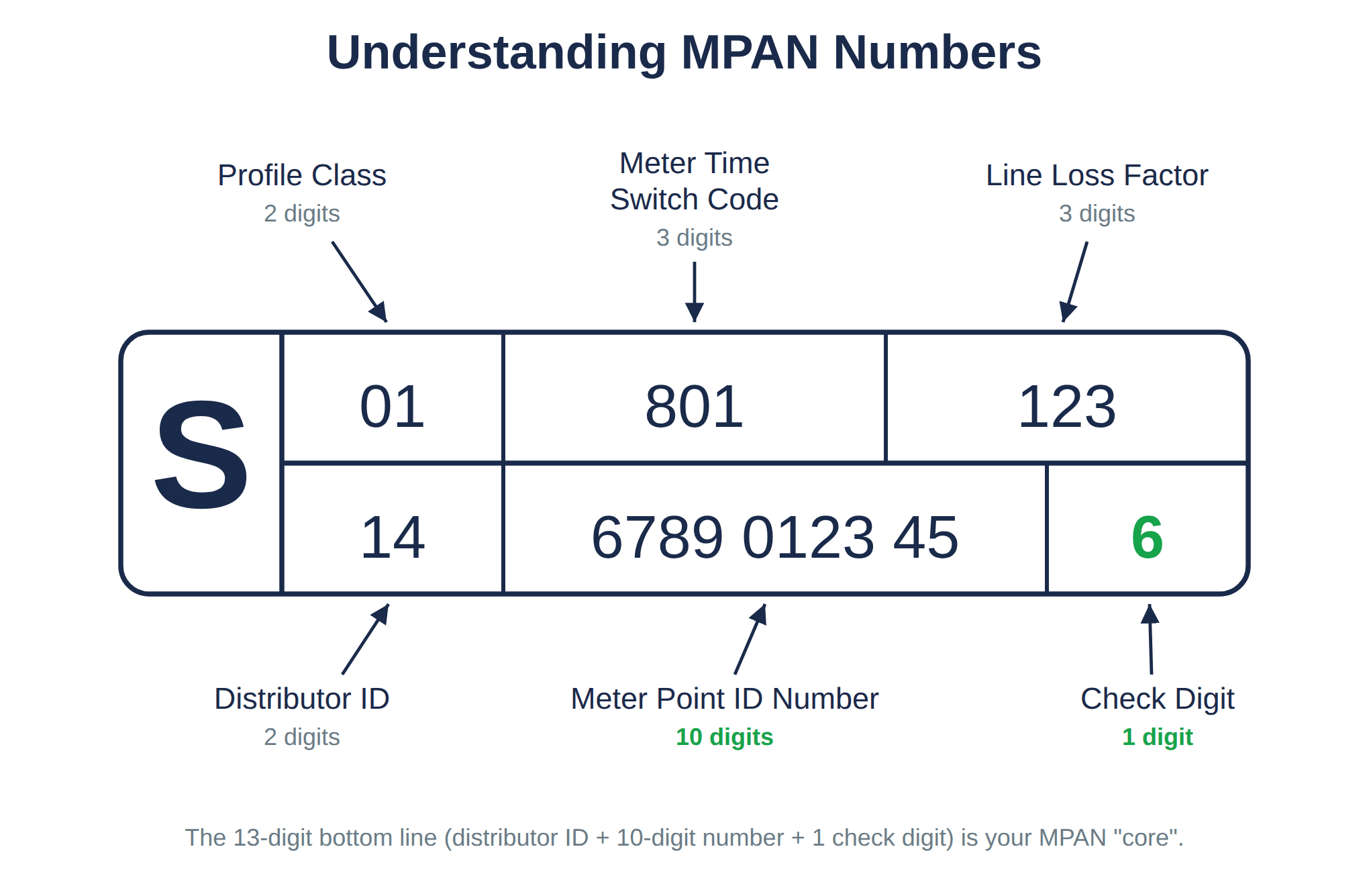
An MPAN is 21 digits long and printed as a grid in two rows, with a large S in front. The top row holds eight digits of technical data, and the bottom row holds the 13-digit core that identifies your meter point.
The top line
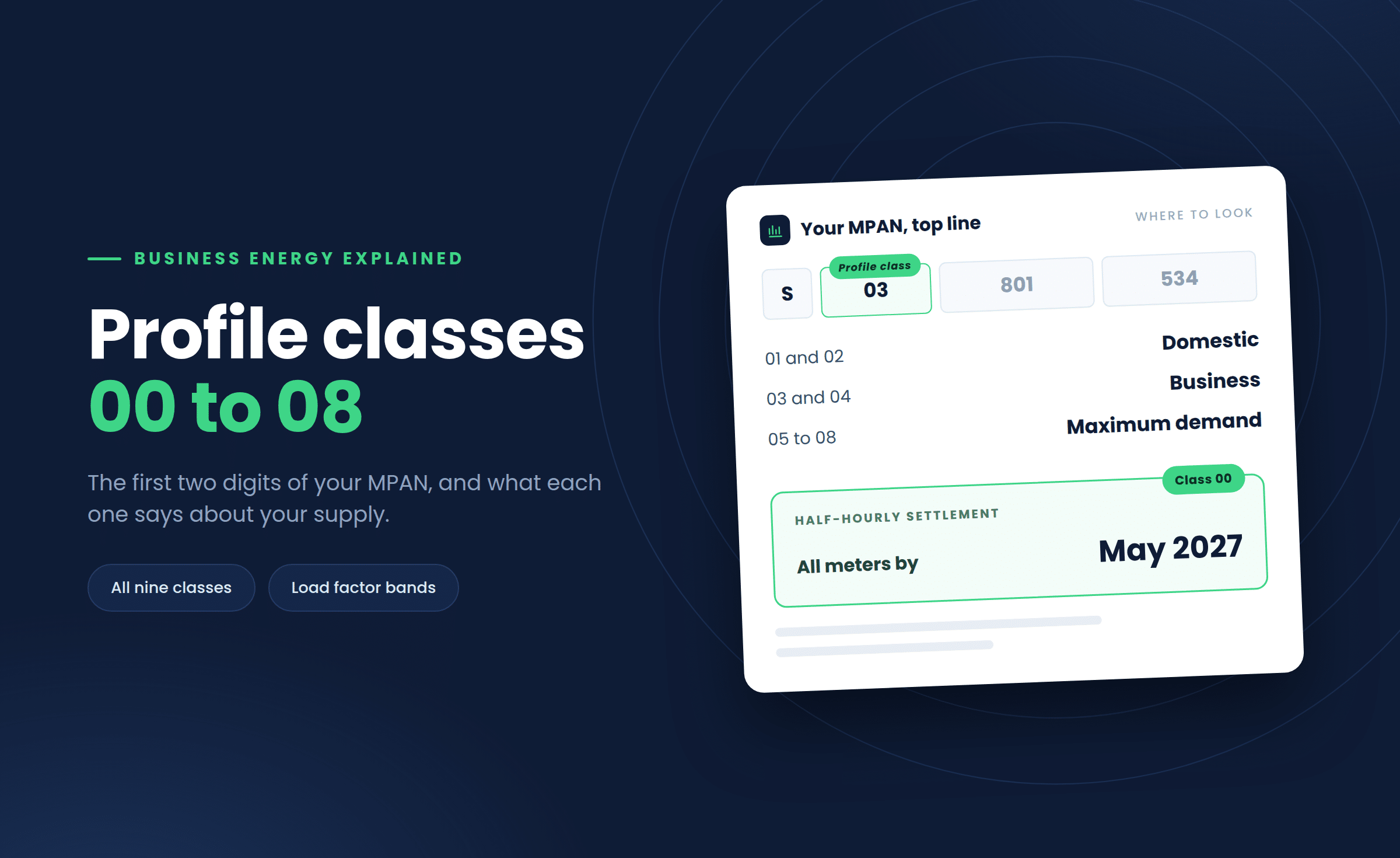
The top line is made up of three fields: the profile class, the meter time-switch code and the line loss factor class. These describe how your supply is settled rather than identifying it.
You rarely need to quote the top line yourself, as it is mainly used by the industry for billing and settlement. It can also change over time without your meter point changing.
The bottom line, or MPAN core
The bottom line is the 13-digit core, and it is the part suppliers usually ask for. It splits into a two-digit distributor ID, a ten-digit unique number and a single check digit that validates the whole thing.
| Line | Field | Digits | What it tells you | Example |
|---|---|---|---|---|
| Top | Profile class | 2 | How you use electricity, such as domestic or business | 01 |
| Top | Meter time-switch code (MTC) | 3 | The meter type and any time-of-use switching | 801 |
| Top | Line loss factor class (LLFC) | 3 | Energy lost delivering power to your area | 123 |
| Core | Distributor ID | 2 | Your regional distribution network operator | 14 |
| Core | Unique identifier | 10 | The number unique to your meter point | 6789012345 |
| Core | Check digit | 1 | A checksum that validates the number | 6 |
So a full MPAN reads like S 01 801 123 14 6789012345 6. Many guides wrongly split the core as an eight-digit number plus a three-digit check, but the check digit is always a single digit.
What do the digits on an MPAN mean?
The first two digits are your profile class, and the first two digits of the core are your distributor ID. Together they tell you how your supply is metered and which network owns your local wires.
Profile class (the first two digits)
The profile class shows the type of supply and how it is settled. Codes 01 and 02 are domestic, 03 to 08 are business, and 00 is a larger half-hourly supply, as our guide to profile classes explains in more detail.
| Code | Type | Meaning |
|---|---|---|
| 00 | Half-hourly | Larger supplies settled half-hourly, usually demand above 100 kW |
| 01 | Domestic | Domestic unrestricted, a single rate |
| 02 | Domestic | Domestic Economy 7, two rates |
| 03 | Business | Non-domestic unrestricted, a single rate |
| 04 | Business | Non-domestic Economy 7, two rates |
| 05 | Business | Non-domestic maximum demand, load factor under 20% |
| 06 | Business | Non-domestic maximum demand, load factor 20 to 30% |
| 07 | Business | Non-domestic maximum demand, load factor 30 to 40% |
| 08 | Business | Non-domestic maximum demand, load factor over 40% |
Export supplies, such as solar sold back to the grid, follow separate conventions. If your bill shows an unexpected class, your supplier can confirm why.
Distributor ID (your network operator)
The first two digits of the core identify your distribution network operator, the company that owns the cables in your region. This is who you call about a lost MPAN or a power cut, not your supplier.
| ID | Region | Network operator | Phone |
|---|---|---|---|
| 10 | Eastern England | UK Power Networks | 0800 029 4285 |
| 11 | East Midlands | National Grid Electricity Distribution | 0800 096 3080 |
| 12 | London | UK Power Networks | 0800 029 4285 |
| 13 | Merseyside & North Wales | SP Energy Networks | 0330 10 10 444 |
| 14 | West Midlands | National Grid Electricity Distribution | 0800 096 3080 |
| 15 | North East England | Northern Powergrid | 0800 011 3332 |
| 16 | North West England | Electricity North West | 0800 195 4141 |
| 17 | North Scotland | Scottish & Southern Electricity Networks | 0800 048 3516 |
| 18 | South Scotland | SP Energy Networks | 0330 10 10 444 |
| 19 | South East England | UK Power Networks | 0800 029 4285 |
| 20 | Southern England | Scottish & Southern Electricity Networks | 0800 048 3516 |
| 21 | South Wales | National Grid Electricity Distribution | 0800 096 3080 |
| 22 | South West England | National Grid Electricity Distribution | 0800 096 3080 |
| 23 | Yorkshire | Northern Powergrid | 0800 011 3332 |
The four ex-Western Power Distribution regions became National Grid Electricity Distribution in 2022. IDs of 24 and above belong to independent network operators.
The numbers above are for general enquiries. For a power cut, call the free 105 line from any phone, which connects you to your local network.
What is the difference between an MPAN and an MPRN?
An MPAN identifies an electricity supply, while an MPRN identifies a gas supply. You will have an MPAN if you have an electricity meter, and an MPRN if you have a gas meter.
What is an MPRN?
An MPRN, or Meter Point Reference Number, is the gas equivalent of an MPAN, sometimes called an M-number. It is usually 6 to 10 digits with no leading letter, and it can appear on the gas meter as well as on your business gas bill.
MPAN versus meter serial number
Your meter serial number is stamped on the meter itself and changes whenever the meter is replaced. The MPAN stays with the property, so a new or smart meter does not change it.
| Feature | MPAN | MPRN |
|---|---|---|
| Fuel | Electricity | Gas |
| Full name | Meter Point Administration Number | Meter Point Reference Number |
| Length | 21 digits (13-digit core), starts with S | 6 to 10 digits, no letter |
| On the meter? | No, on your bill | Sometimes, and on your bill |
| Holds usage data? | Yes (profile class, network) | No, it is a plain reference |
Where do you find your MPAN or MPRN number?
Your MPAN is on your electricity bill, usually in a boxed grid marked with an S, and your MPRN is on your gas bill. Neither is printed on the electricity meter itself.
On your energy bill
Look for the supply number grid on your electricity bill, often near the top or in a supply-details box. A smart meter in-home display can also show it, and the same bill will list the units you have used if you want to check what a kWh is.
If you cannot find a bill
If you have no bill to hand, you have three options. Ask your current supplier, contact your regional network operator using the Energy Networks Association lookup, or call the free power-cut line on 105, which connects you to that network.
You can also use the industry Find My Supplier tool, which returns your MPAN and current supplier from your postcode. Not sure who supplies you? Our guide to who supplies your electricity and gas walks you through it.
Why do you need your MPAN number?
You need your MPAN to switch supplier, get an accurate quote, set up a new connection or move premises. It makes sure the right meter point is registered to the right account.
Switching and getting quotes
Suppliers and brokers ask for your MPAN so they can price your exact supply, which is why having it ready speeds up a switch. You can compare business electricity rates and line up a new energy supplier in minutes with it to hand.
A quick way to start is to compare business energy with your MPAN ready, then switch to the best rate.
New connections and moving premises
For a brand-new supply, your network operator creates the MPAN before you can arrange a supplier. When you move, the new premises has its own MPAN, so you register that rather than taking your old one with you.
Getting the MPAN right at move-in also protects you from inheriting the previous occupier’s debt or tariff. Always give a meter reading on the day you take over the supply.
What if your MPAN is missing or wrong?
If a new supply has no MPAN yet, your network operator arranges one before a supplier can register you. If two suppliers claim your meter, that is an erroneous transfer, and you should report it straight away.
New builds and new connections
A new property needs an MPAN created by the local network operator, which can take a few weeks. Once it exists, you can choose a supplier and set up your account against it.
Erroneous transfers and wrong records
If you are switched by mistake or your bill shows the wrong MPAN, contact your supplier first, as there is an industry process to correct erroneous transfers. If it is not put right, Ofgem explains how to escalate the complaint.
Duplicate or crossed MPANs are most common in flats, converted buildings and new builds. Quoting your full supply number when you call helps your supplier find the correct record quickly.
Do MPAN and MPRN numbers change when you switch supplier?
No, your MPAN and MPRN stay the same when you switch supplier, because they belong to the property, not the company. Only your account number changes, since that is set by each supplier.
What stays the same, and what changes
Your MPAN and MPRN also survive a meter swap, so a smart-meter upgrade does not change them. It is worth having them ready before you switch your business energy supplier so nothing slows the transfer down.
The meter serial number is the one identifier that does change, because it is tied to the physical meter. If your meter is replaced, note the new serial number for your records.
How is the MPAN changing under MHHS?
Under Market-wide Half-Hourly Settlement, the top line of the MPAN is being restructured, while the 13-digit core stays exactly the same. The change affects how supplies are settled, not how you are identified.
What is changing on the top line
The MHHS programme replaces the meter time-switch code with a standard settlement configuration and updates the line loss factor fields. Profile classes are being retired for most supplies as everyone moves to half-hourly settlement.
When it happens
Suppliers are expected to be qualified for the new system during 2026, with full migration through to around 2027. You do not need to do anything, and your core MPAN will not change.