
Switching business energy means comparing quotes, agreeing a new contract and letting your new supplier handle the transfer, with no interruption to your supply. The catch is that business contracts are binding the moment you agree them, even by phone, so timing and detail matter.
Business switching does not work like a domestic switch. There is no cooling-off period, no price cap and no five-day switching guarantee, so a little preparation pays off.
This guide walks through the process, what you need, how long it takes and how to avoid the costly mistakes. When you are ready, you can compare business energy and line up a better deal.
What are the benefits of switching business energy?
Switching can lower your bills, lock in a predictable rate and move you to greener energy or better service. The biggest wins usually come from leaving an expensive default rate for a fixed deal.
Lower bills and budget certainty
A fixed contract protects you from mid-contract price rises, which makes budgeting easier. Moving off out-of-contract or deemed rates is where most businesses see the largest saving.
Better service and greener options
Switching is also a chance to choose a supplier with stronger service or a renewable tariff. Many suppliers now offer green business electricity backed by certificates at little or no extra cost.
How does switching business energy work?
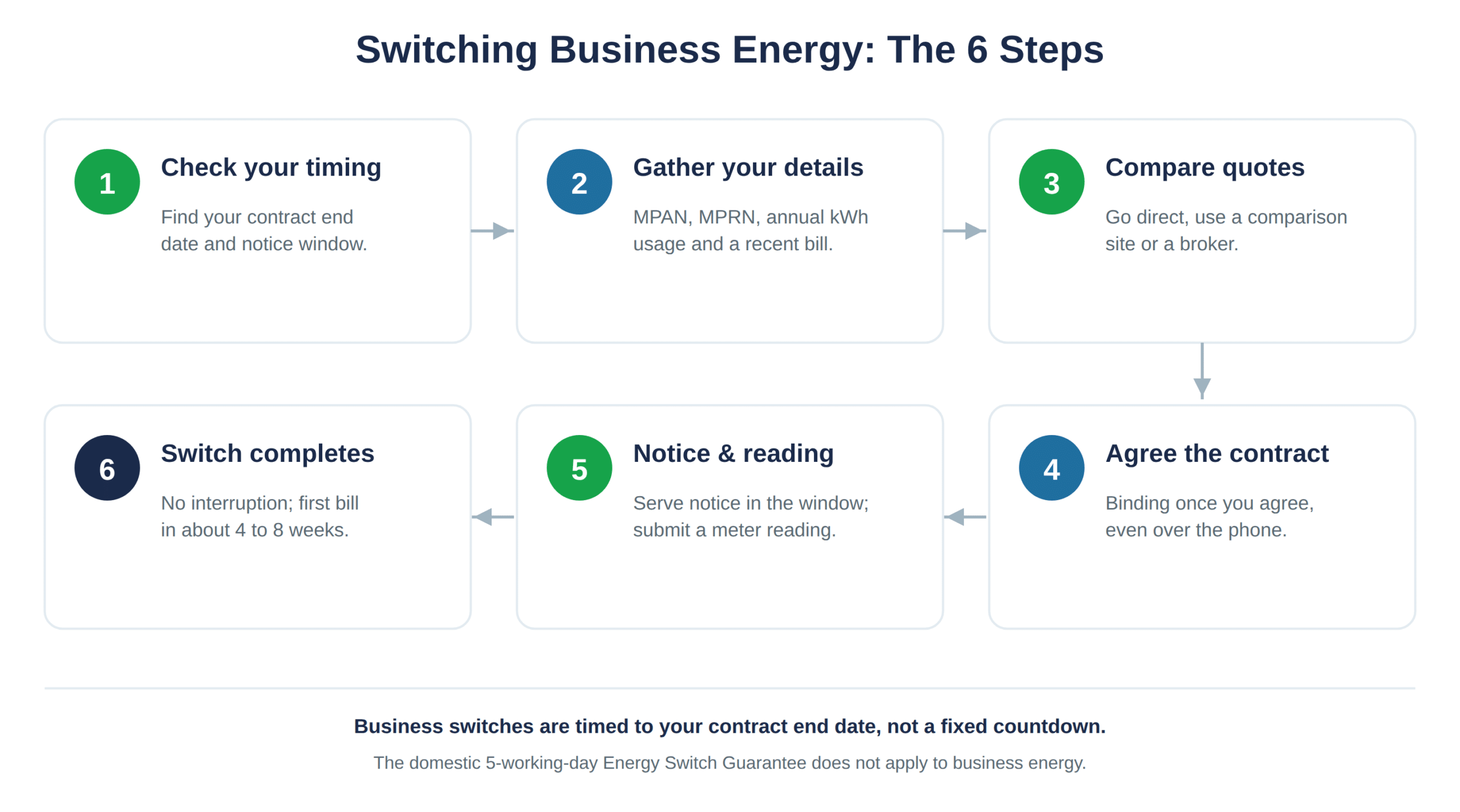
Switching follows six steps: check your timing, gather your details, compare quotes, agree a contract, give notice and provide a meter reading. Your new supplier then arranges the transfer behind the scenes.
The step-by-step process
-
Check your timing
Check your contract end date and notice window so you switch at the right time.
-
Gather your details
Gather your supply details and usage from a recent bill.
-
Compare quotes
Compare quotes directly, through a comparison site or through a broker.
-
Agree your new contract
Agree your new contract, remembering it is binding once you say yes.
-
Give notice and a reading
Serve notice on your current supplier and submit a meter reading.
-
The switch completes
The switch completes with no interruption, and your first new bill follows in weeks.
What happens after you switch
Your gas and electricity never stop, because only the company billing you changes. Your old supplier sends a final bill, and your new supplier’s first bill usually arrives within four to eight weeks.
It helps to set up your online account and Direct Debit early, and to note your new contract end date. That way you are ready to review again before the next renewal.
What information do you need to switch?
You need your supply numbers, your annual usage and your contract end date, all of which are on a recent bill. Having them ready gives you an accurate quote and a faster switch.
The details on your bill
Your electricity supply is identified by its MPAN, and your gas supply by its MPRN. Your annual usage in kWh and your profile class help a supplier price your quote correctly.
| Detail | Why it is needed | Where to find it |
|---|---|---|
| Business name and address | Identifies the supply point | Your bill |
| MPAN (electricity) | The electricity supply number | Bill, in the box marked with an S |
| MPRN (gas) | The gas meter point number | Gas bill or gas meter |
| Annual usage in kWh | Prices your quote accurately | Bill or annual statement |
| Current supplier and tariff | Confirms who to give notice to | Your bill |
| Contract end date | Sets your switching window | Bill or renewal letter |
If you cannot find your details
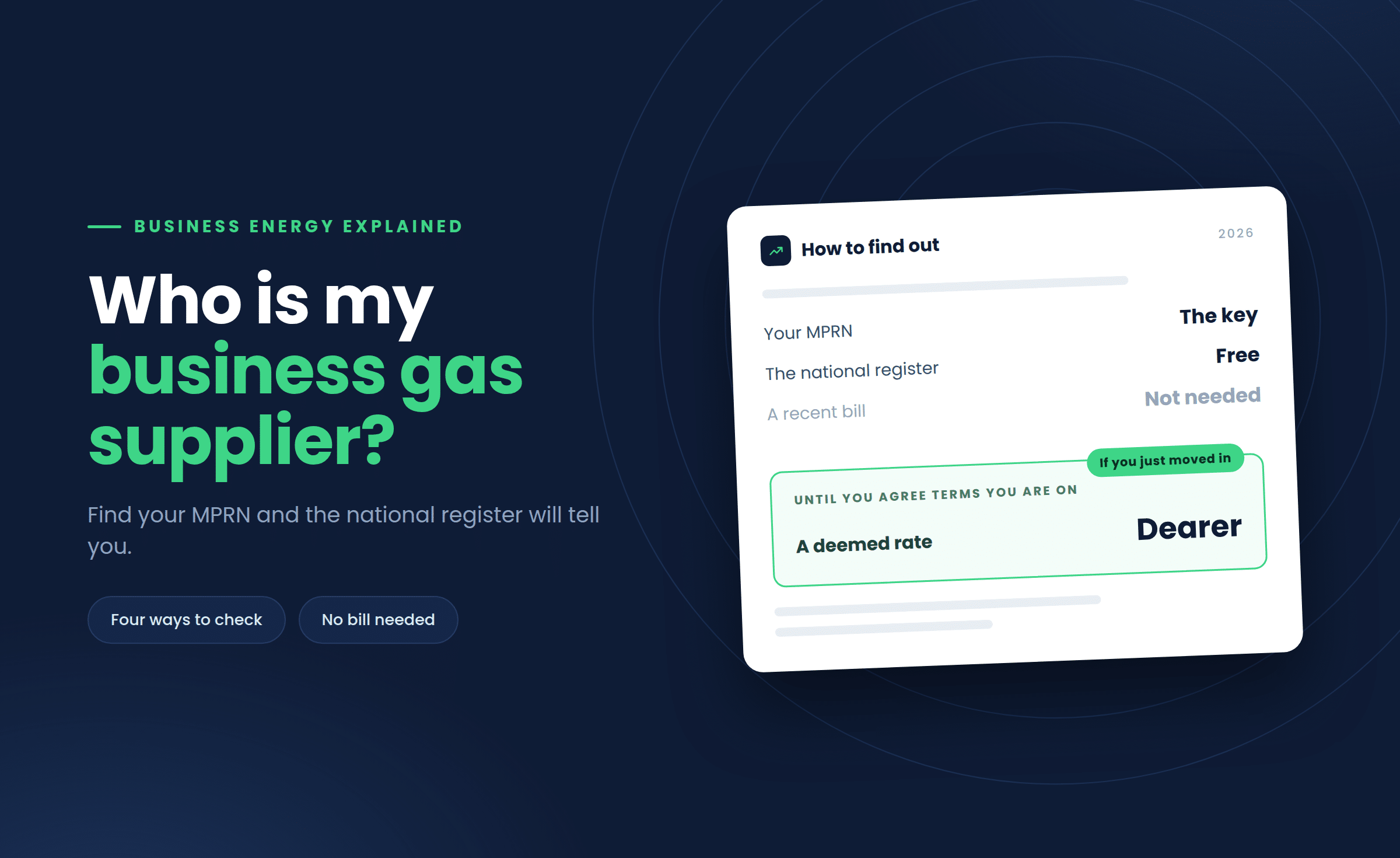
If you have lost your bill, your current supplier can give you these details. If you are not even sure who supplies you, our guide to who supplies your electricity and gas shows you how to check.
How long does it take to switch business energy?
The switch itself can take as little as five working days for electricity, and around two to three weeks for gas. In practice the timeline is set by your contract end date, because a business switch is arranged to start then.
Electricity versus gas timing
Electricity switches are usually quicker than gas, which can take a couple of weeks longer. You can compare business electricity rates and business gas rates separately, and many businesses move both at the same time.
| Stage | Typical time |
|---|---|
| Getting quotes and agreeing a deal | Same day to a few days |
| Electricity switch, once started | About 5 working days |
| Gas switch, once started | About 2 to 3 weeks |
| First bill from your new supplier | About 4 to 8 weeks |
Why the timeline follows your contract end date
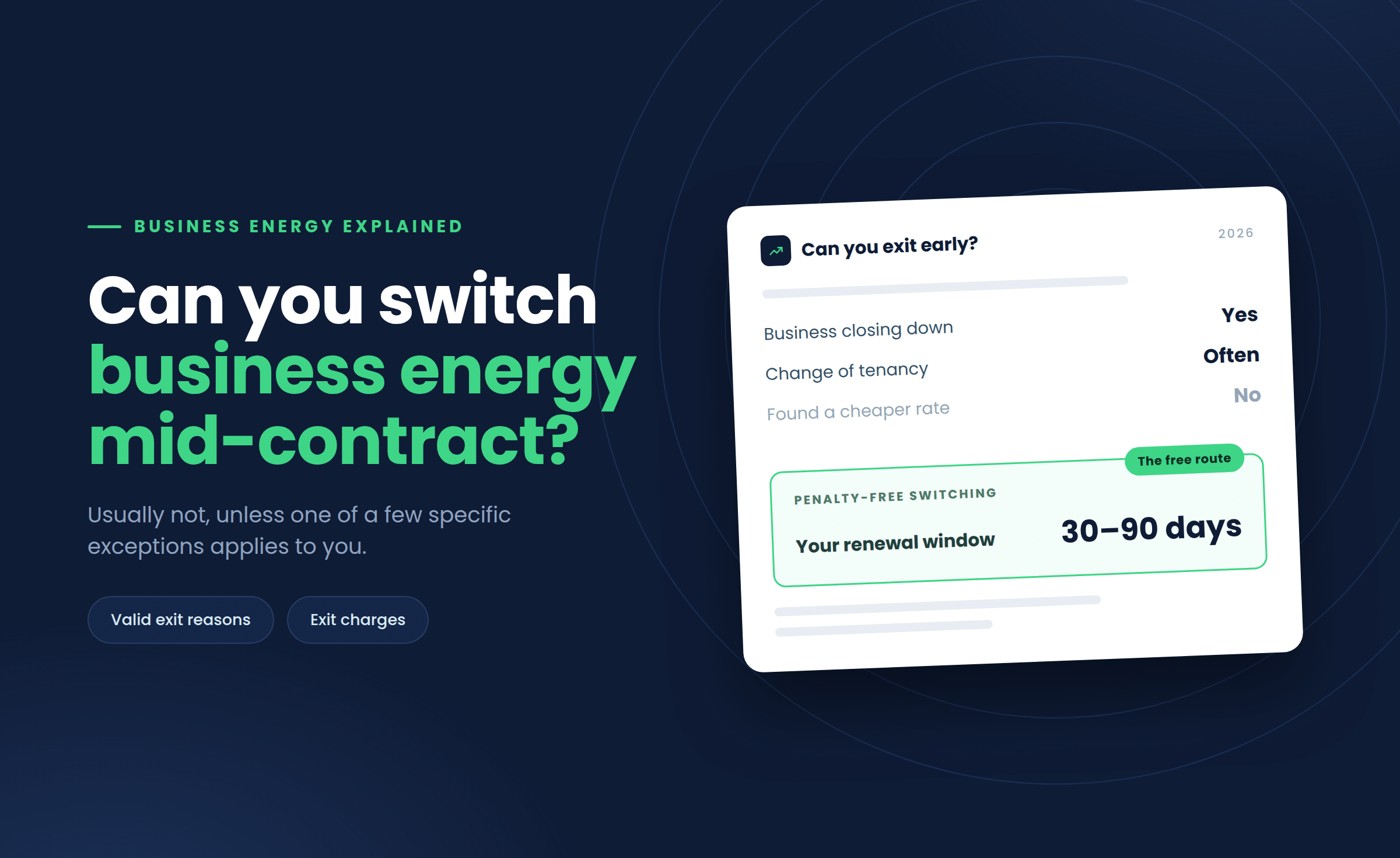
You cannot usually leave a fixed business contract early, so your switch is timed to begin when it ends. Note that the domestic Energy Switch Guarantee, which promises a five-day switch, does not cover business energy.
What can delay your switch?
A switch can be held up by an outstanding debt, a disputed meter reading or an objection from your current supplier. Clearing any debt and giving an accurate reading keeps things moving.
When can you switch, and what is the renewal window?
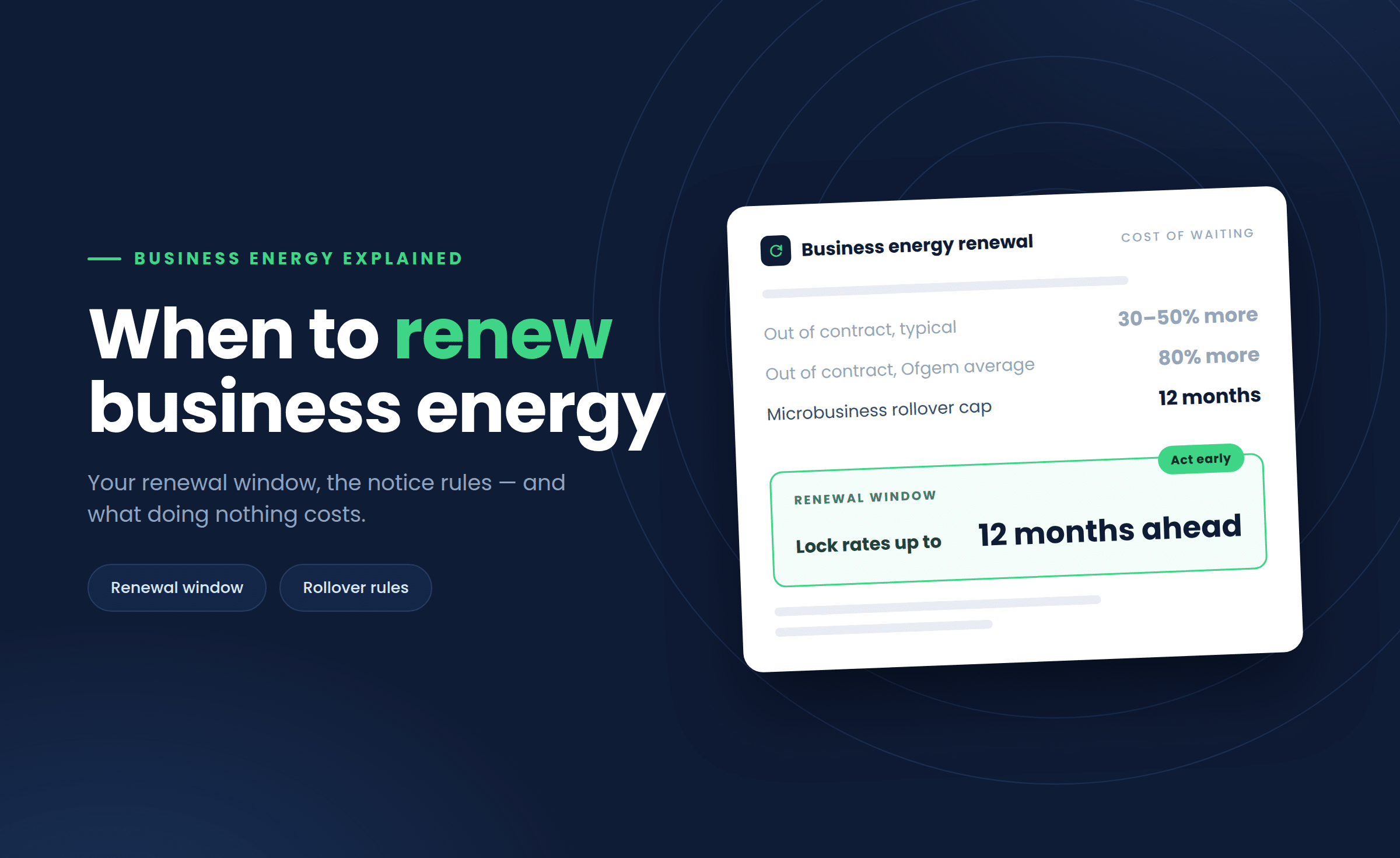
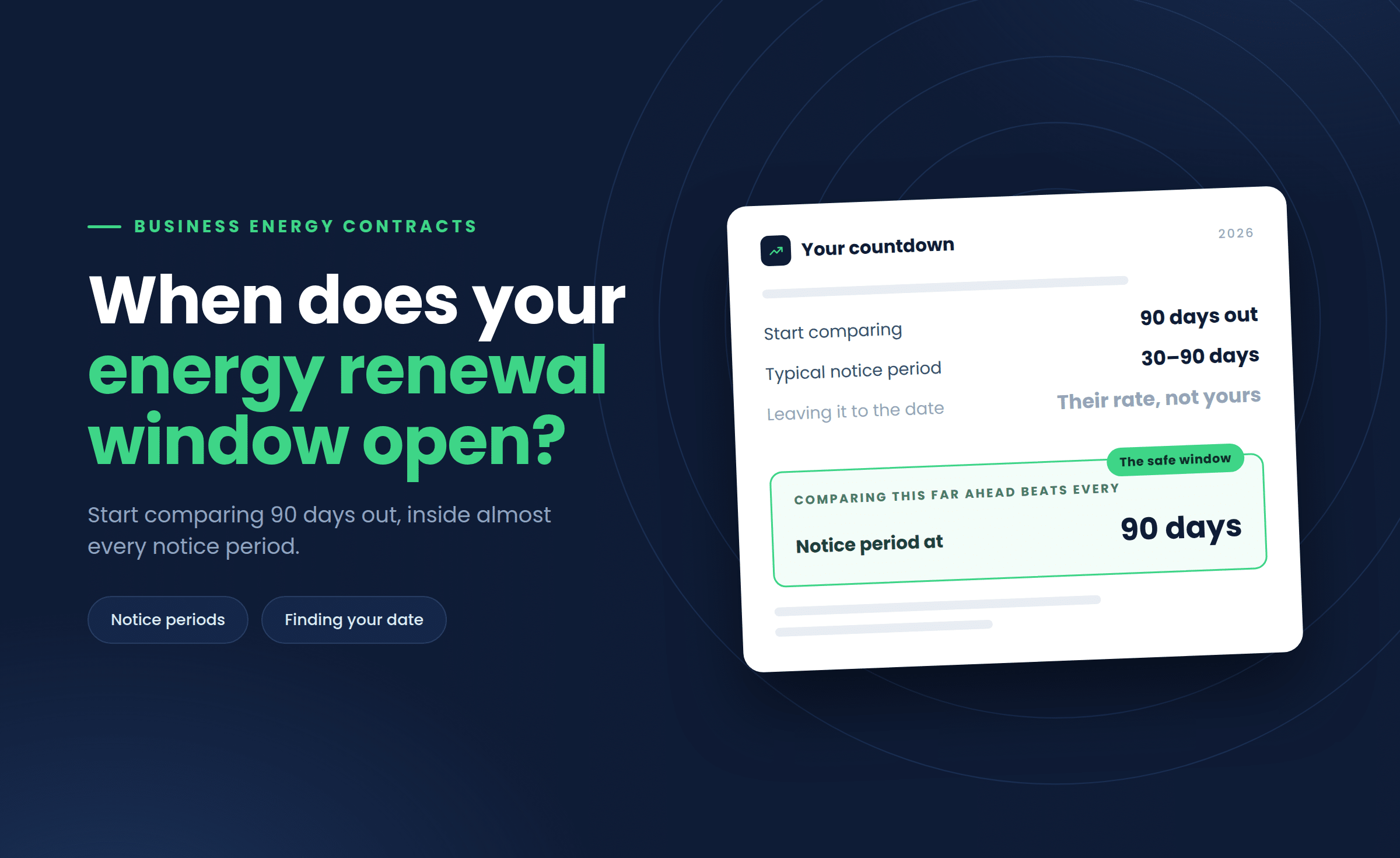
You can usually agree a new deal up to six months before your contract ends, and you must give notice within your switching window. Miss it, and you roll onto expensive default rates.
Notice periods and the switching window
For a microbusiness, the maximum notice a supplier can require is 30 days, and most businesses arrange a new deal three to six months ahead. Ofgem’s rules make it easier to review your options at the end of a contract, but check yours and serve notice to be safe.
What happens if you miss the window
If you do nothing, you move onto out-of-contract, deemed or rollover rates, which Ofgem describes as usually very expensive. A microbusiness rollover cannot last longer than 12 months, and you should not face exit fees for leaving one.
What types of business energy contract are there?
The main types are fixed, variable, deemed, out-of-contract, rollover and flexible. Fixed contracts are the most popular, because they lock your rate for the term.
Fixed and variable
A fixed contract locks your unit rate and standing charge for one to five years, so only your usage varies. A variable contract moves with the market, which can help if prices fall but exposes you if they rise.
Most businesses choose fixed for the certainty it brings to budgeting. A longer fix holds your rate for longer, but gives up the chance to benefit if wholesale prices drop.
Deemed, out-of-contract and rollover
Deemed and out-of-contract rates apply when you use energy without an agreed deal, and both are expensive. A rollover is where a supplier renews you automatically, which is worth avoiding by acting before your end date.
Flexible and pass-through
Larger sites can use flexible or pass-through contracts, where wholesale energy is bought in tranches and other costs are billed separately. Our energy procurement support helps higher-usage businesses manage these.
| Contract type | How it works | Best for |
|---|---|---|
| Fixed | Unit rate and standing charge locked for the term | Budget certainty |
| Variable | Unit price moves with the market | Betting on falling prices |
| Deemed | Default rates when you use energy with no contract | No one, leave quickly |
| Out of contract | Rates after a fixed deal ends without renewal | No one, renew or switch |
| Rollover | Supplier renews you onto a new term automatically | Avoid, capped at 12 months for micro |
| Flexible / pass-through | Wholesale bought in tranches, extra costs passed on | Larger, higher-usage sites |
What should you compare before you switch?
Compare the full cost and terms, not just the headline unit rate. The standing charge, contract length, exit terms and green options all change how good a deal really is.
Beyond the unit rate
- Unit rate, the price per kWh you use.
- Standing charge, the fixed daily cost of the connection.
- Contract length, from one to five years.
- Exit or termination fees for leaving early.
- Green or renewable options, if sustainability matters to you.
- Payment terms, including any Direct Debit discount.
- Service and billing quality, based on reviews.
How is business energy different from domestic?
Business energy has no cooling-off period, no price cap and no five-day switching guarantee. Contracts are also binding as soon as you agree them, including over the phone.
No cooling-off period
Unlike a home switch, there is no automatic 14-day cooling-off period once you agree a business contract, as Ofgem confirms. Some suppliers offer a short window as goodwill, but it is not a right, so only say yes when you are sure.
No price cap
The domestic price cap does not apply to business energy, so rates vary widely between suppliers. That makes it well worth taking time to compare business energy suppliers rather than accepting a renewal.
How much can you save by switching?
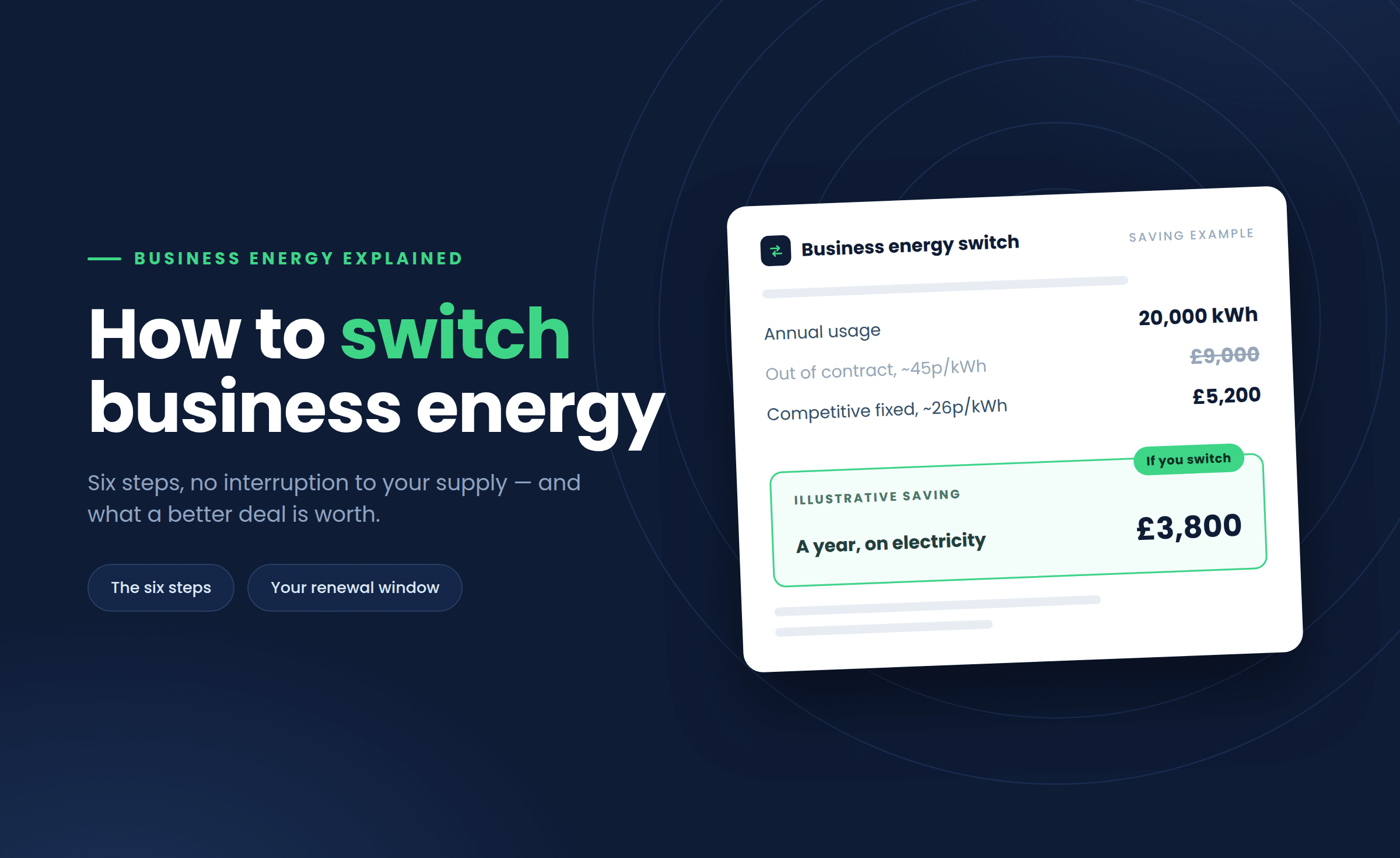
Savings vary widely, but the biggest come from leaving out-of-contract or deemed rates for a competitive fixed deal. The example below shows how large that gap can be.
Where the savings come from
Default rates can be far higher than a negotiated fixed rate, so your saving depends mostly on what you are leaving. The figures below are illustrative and exclude VAT and standing charges.
| Small business, 20,000 kWh a year | Unit rate | Illustrative annual cost |
|---|---|---|
| Out-of-contract electricity | ~45p/kWh | ~£9,000 |
| Competitive fixed electricity | ~26p/kWh | ~£5,200 |
| Illustrative saving | ~£3,800 |
Your own saving depends on your usage, meter type and the market when you fix. Always compare quotes for your actual consumption rather than relying on headline figures.
Should you use a broker, comparison site or go direct?
You can switch directly with a supplier, through a comparison site, or through a broker who negotiates for you. New rules mean brokers must now be more transparent about their fees.
Your options
Going direct means dealing with one supplier, while a comparison lets you weigh several business energy suppliers at once. A broker does the legwork, which suits businesses without time to compare.
Broker rules and your protections
Since October 2024, suppliers must disclose a broker’s commission in a microbusiness contract, and from December 2024 they can only use brokers signed up to a redress scheme. The government has also confirmed that Ofgem will become the statutory broker regulator, though that is not yet law.
If something goes wrong, microbusinesses and now many small businesses can escalate to the Energy Ombudsman after eight weeks or a deadlock letter.
| Business size | Qualifies if (any one) | Key protection |
|---|---|---|
| Microbusiness | Under 10 staff and turnover or balance sheet under £2m; or under 100,000 kWh electricity; or under 293,000 kWh gas | 30-day max notice, 12-month rollover cap, Ombudsman access |
| Small business | Under 50 staff and turnover under £6.5m or balance sheet under £5m; or under 200,000 kWh electricity; or under 500,000 kWh gas | Energy Ombudsman access from December 2024 |
Can you switch with a debt or multiple sites?
You can usually still switch with a small debt, though a supplier may object until it is cleared. Businesses with several sites can move every meter, often on one contract.
Switching with a debt
If you owe your current supplier, they can block the switch until the balance is paid, especially on a prepayment or disputed account. Clearing or agreeing the debt first keeps your switch on track.
Switching multiple premises
Businesses with several sites can compare and move all of them together, sometimes under a single supply contract. This is common for retail chains, offices and franchises with more than one meter.
What mistakes should you avoid when switching?
The costliest mistakes are missing your renewal window and agreeing a deal on the phone without checking it. Both can leave you paying far more than you need to.
Common switching mistakes
- Letting your contract lapse onto out-of-contract or deemed rates.
- Missing your notice window, so you cannot switch on time.
- Saying yes to a phone offer before checking the unit rate and standing charge.
- Comparing on unit rate alone and ignoring the standing charge and exit terms.
- Forgetting to give a meter reading on the switch date.
Checking both the unit rate and the standing charge gives you the true cost of a deal, not just the headline price.