
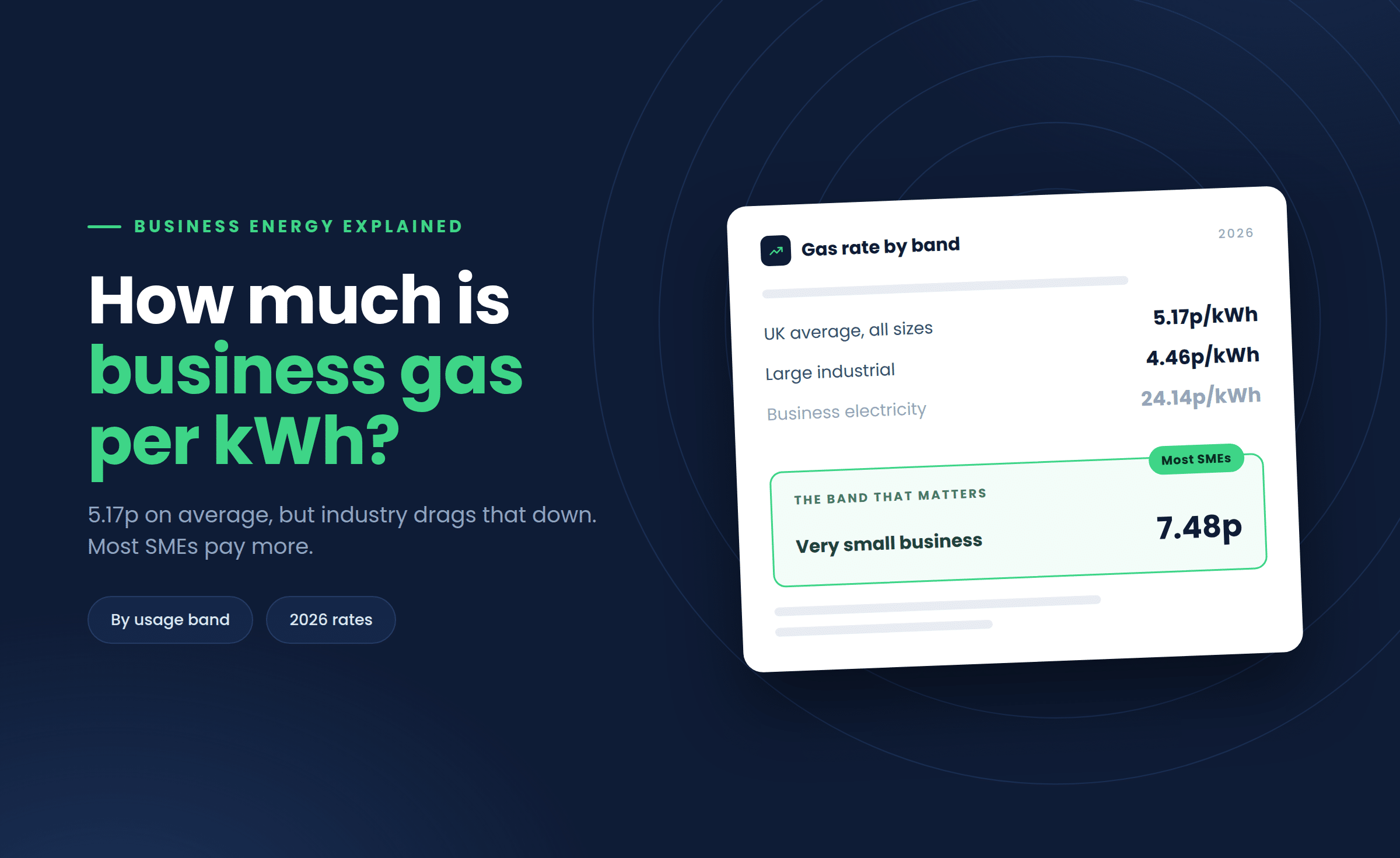
The UK average business gas rate is 5.17p/kWh, but that figure is skewed low by industry: a typical small business pays closer to 7.48p/kWh, while large industrial users pay nearer 4.46p/kWh.
Gas pricing follows a similar logic to electricity, but the numbers and the drivers are different enough to catch out anyone assuming the two work the same way. Commercial business gas unit rates are much lower than electricity, but volatility in the wholesale gas market feeds straight through.
If you are trying to work out whether your current contract is fair, comparing against the wrong benchmark, or against a domestic tariff, will send you to the wrong conclusion. This guide sets out the current averages, what causes the price to swing by band, and how to check your own bill properly.
What is the current average business gas rate per kWh?
The UK average business gas rate stands at 5.17p/kWh, with the best 2026 fixed deals starting from around 8p/kWh on a two-year fix, depending on usage and standing charge.
Why the average understates most SMEs
That headline average blends every size, from a single catering hob to a large plant running industrial burners. Because a handful of huge industrial users pull enormous volumes at low rates, the DESNZ average sits well below what a normal small business actually pays.
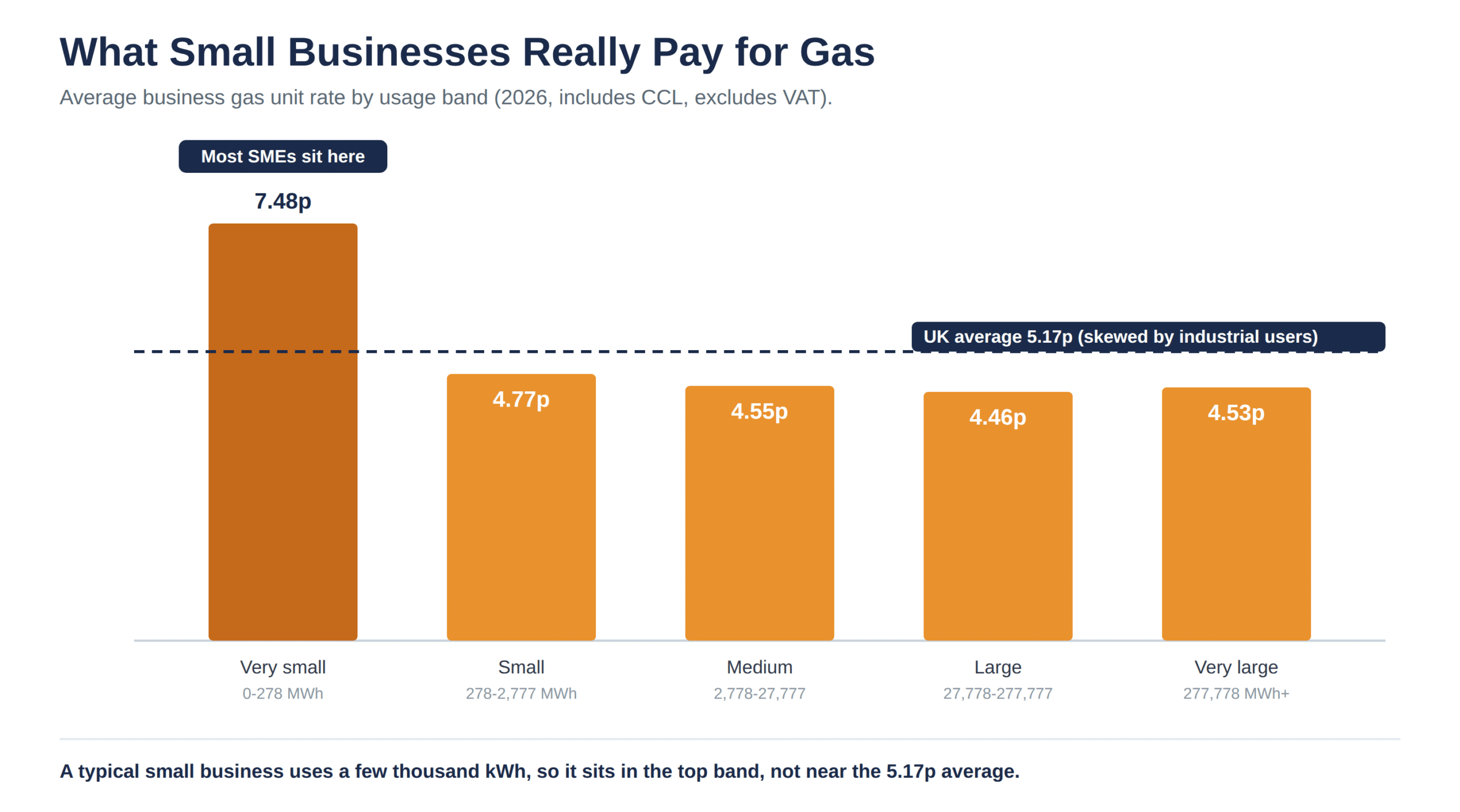
A typical small business uses only a few thousand kWh a year, which places it in the highest-priced band at around 7.48p/kWh. So do not assume you are overpaying simply because your rate is above 5.17p.
Wholesale volatility also feeds through faster than many owners expect. When the gas market moves, fixed deals on offer reprice within weeks, so the rate you are quoted today may not be there next month.
How does the rate differ by business size?
Very small businesses pay the highest average rate at 7.48p/kWh, while rates drop sharply for larger users before levelling out around 4.46p to 4.55p/kWh for large and very large consumers.
The table below gives the full breakdown, correct to Q1 2026 government data.
| Business size | Annual usage | Rate (p/kWh) |
|---|---|---|
| Very small | 0 to 278 MWh | 7.48p |
| Small | 278 to 2,777 MWh | 4.77p |
| Medium | 2,778 to 27,777 MWh | 4.55p |
| Large | 27,778 to 277,777 MWh | 4.46p |
| Very large | 277,778 to 1,111,112 MWh | 4.53p |
The exception for very large users
Notice the rate for very large users ticks back up slightly against large users. The biggest industrial consumers, often covered by Climate Change Agreements or the Energy Intensive User Group, negotiate bespoke pricing where a simple band average is less predictive.
Why is gas priced so differently from electricity?
Gas has a simpler supply chain than electricity, with fewer conversion losses and lower network costs, which keeps the pence per kWh figure much lower across every band.
Electricity generation often uses gas as its marginal fuel, so wholesale gas prices influence electricity prices, not the other way round. That is part of why electricity rates per kWh sit so much higher, even though the commodity link is real.
Gas travels through the National Gas Transmission network and regional distribution networks rather than the DNO structure used for electricity, and that infrastructure carries different cost characteristics.
Meter identifiers work differently too
- Gas meters use an MPRN, not an MPAN, as the supply identifier.
- AQ (Annual Quantity) is the gas usage estimate used for billing, measured in kWh.
- IGT-supplied sites (independent gas transporters) may see slightly different standing charges.
What is a realistic annual gas bill for my business?
A typical small business using around 2,500 kWh a year should expect roughly £336 in gas, rising to about £1,566 for a medium business using around 25,000 kWh.
Gas and electricity side by side
The table below shows annual gas costs against the electricity figure for each size, matching our average business energy bill guide. Remember these exclude VAT, which our VAT on business energy guide explains in full.
| Business size | Electricity / year | Gas / year |
|---|---|---|
| Micro (up to 5,000 kWh) | £888 | £336 |
| Small (up to 15,000 kWh) | £2,884 | £876 |
| Medium (up to 25,000 kWh) | £5,563 | £1,566 |
| Large (up to 50,000 kWh) | £10,606 | £2,837 |
| Extra large (up to 100,000 kWh) | £19,356 | £5,440 |
A typical small business spends roughly £3,290 a year on gas and electricity combined. A medium business, using around 25,000 kWh of electricity and 10,000 kWh of gas, lands closer to £7,129 a year.
Gas costs are also seasonal, since most of the usage is heating. Expect your winter bills to run well above the annual average split evenly across twelve months, which matters if you budget monthly.
How do you make sure you are not overpaying?
Compare your commercial gas unit rate against the average for your usage band using a recent bill, then check whether you have fallen onto a deemed rate, which runs 40% to 80% above a negotiated contract.
Your quick overpaying check
-
Find your rate
Check your MPRN and current unit rate on your latest bill.
-
Benchmark it
Compare against the band average above, not the 5.17p headline.
-
Compare the market
Get a live quote from a panel of business energy suppliers before your renewal date.
-
Fix if it suits you
Consider a one to three year term if the rate looks competitive.
Gas contracts are as easy to let lapse as electricity ones, so if your business moved premises recently without formally taking over the gas contract, check our guide on change of tenancy energy contracts before you assume you are covered.
It is also worth reading Ofgem’s business energy advice on your rights before you sign anything.