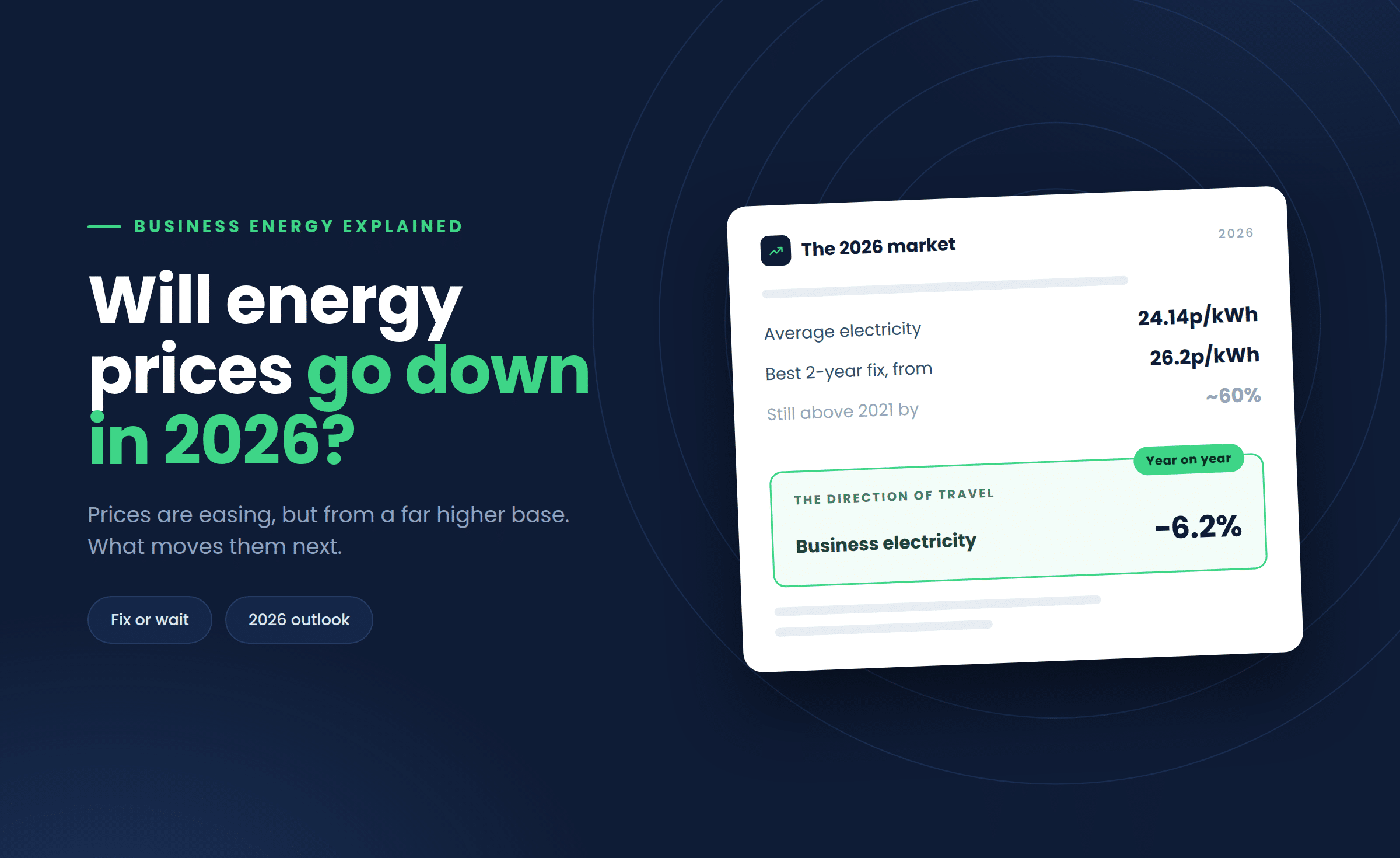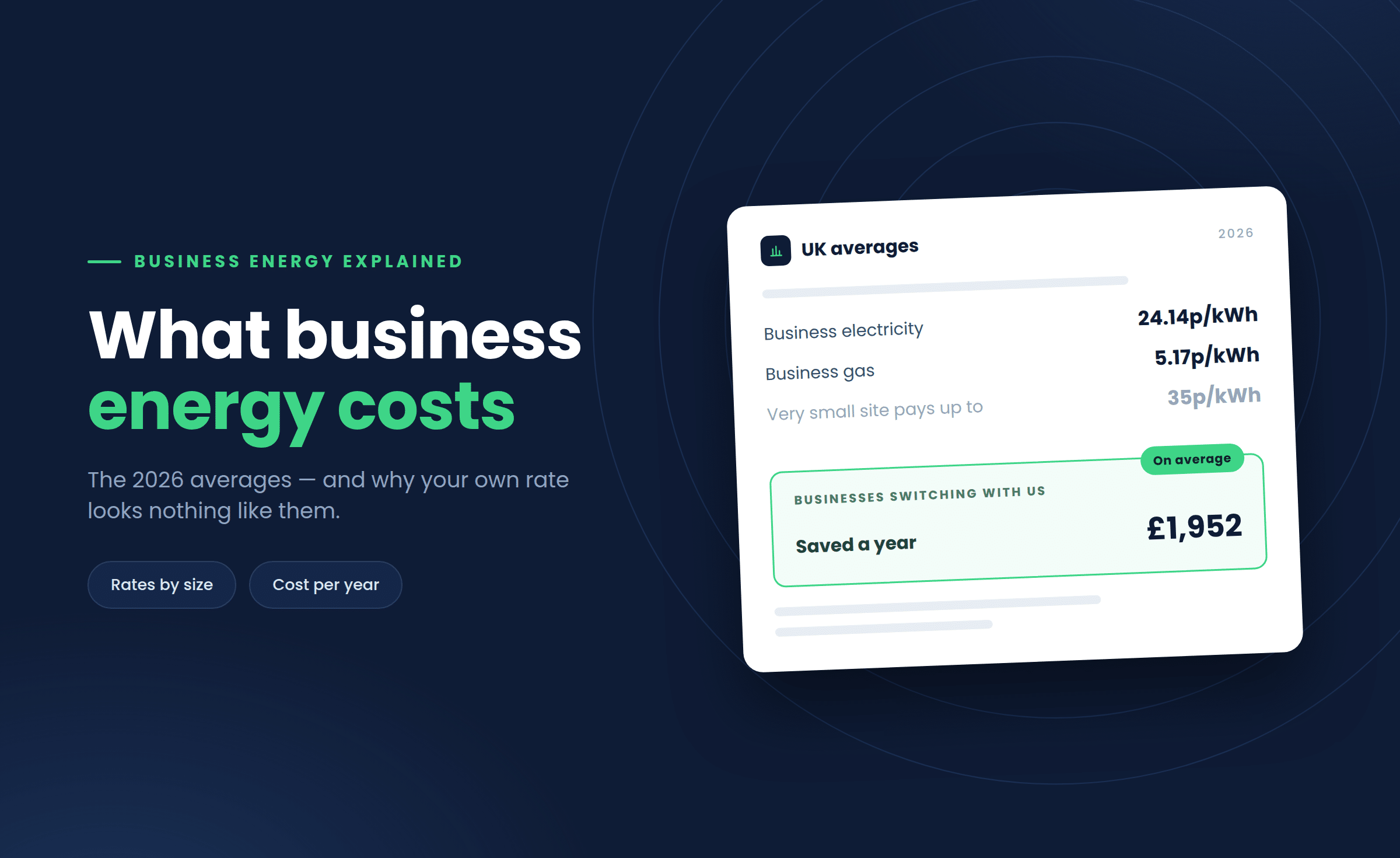

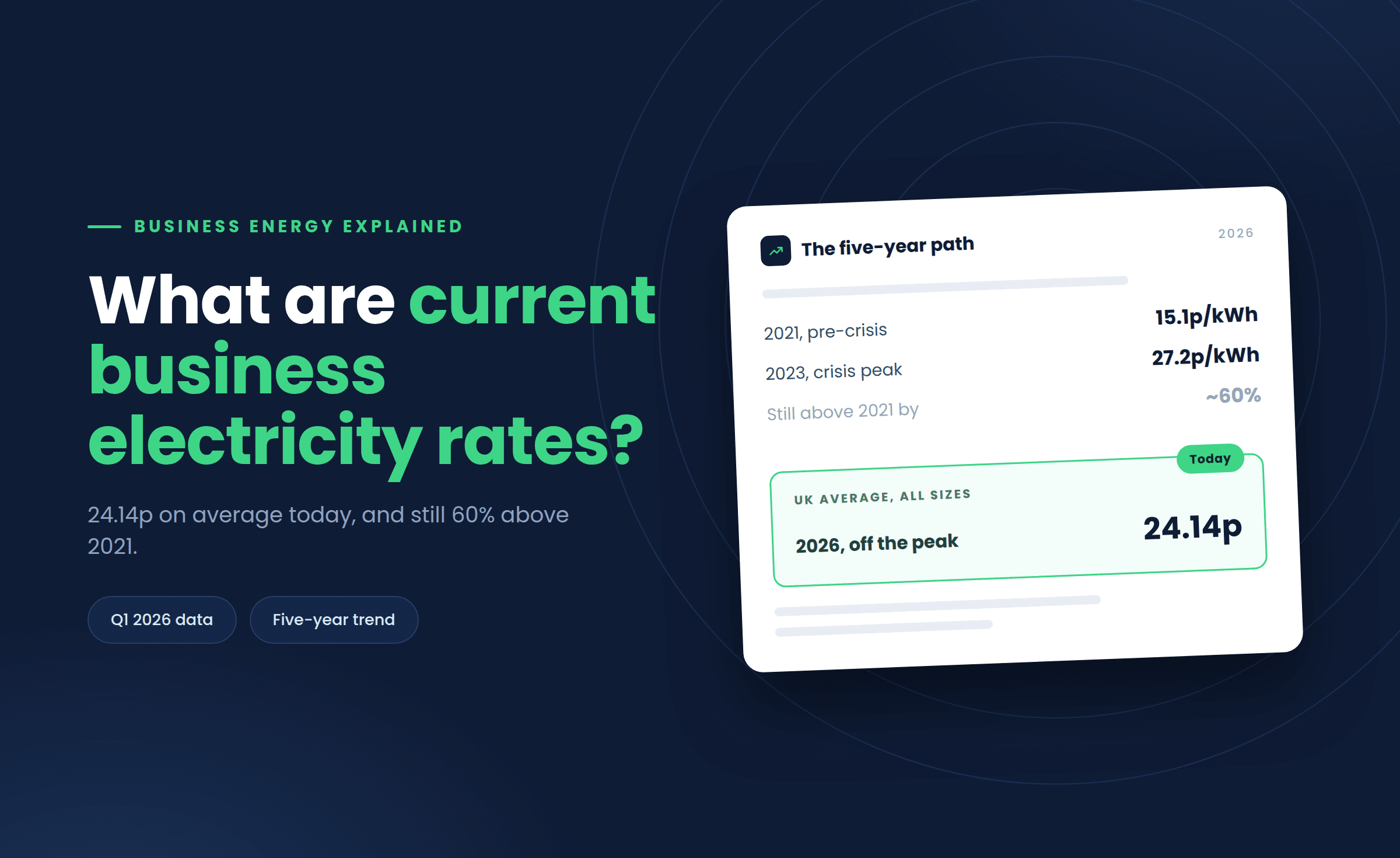
Current UK business electricity rates average 24.14p/kWh across all sizes, with the best fixed deals starting from around 26p/kWh on a two-year term, based on government data to Q1 2026.
Businesses checking today’s rates are usually doing one of two things: coming up to renewal, or trying to prove they are paying too much. Either way you need a genuine, up-to-date benchmark for business electricity prices, not a figure pulled from an old news article.
Rates move constantly, and averages from even a year ago can mislead. This guide uses the current published figures, so treat every number here as a benchmark rather than a quote, since your own rate varies by region, meter type, consumption and supplier.
What are today’s electricity rates by business size?
Today’s average rates range from 35.02p/kWh for very small businesses down to 21.42p/kWh for extra large sites using over 150,000 MWh a year.
Current average rate by usage band
This table reflects the current UK averages, including the Climate Change Levy and excluding VAT, from DESNZ price data.
| Business size | Annual usage | Current average rate |
|---|---|---|
| Very small | 0 to 20 MWh | 35.02p/kWh |
| Small | 20 to 499 MWh | 28.76p/kWh |
| Small / medium | 500 to 1,999 MWh | 28.08p/kWh |
| Medium | 2,000 to 19,999 MWh | 25.00p/kWh |
| Large | 20,000 to 69,999 MWh | 23.93p/kWh |
| Very large | 70,000 to 150,000 MWh | 21.93p/kWh |
| Extra large | Over 150,000 MWh | 21.42p/kWh |
| UK average | All businesses | 24.14p/kWh |
For the same picture on the gas side, our figures for business gas prices per kWh follow the same usage-band structure. To judge whether a quote is fair, our guide to a good unit rate for business electricity sets the benchmark by band.
The spread is wide for a reason. Very small sites pay almost 14p/kWh more than the largest users, because fixed network and supply costs are shared across far less consumption.
How do current rates compare to a few years ago?
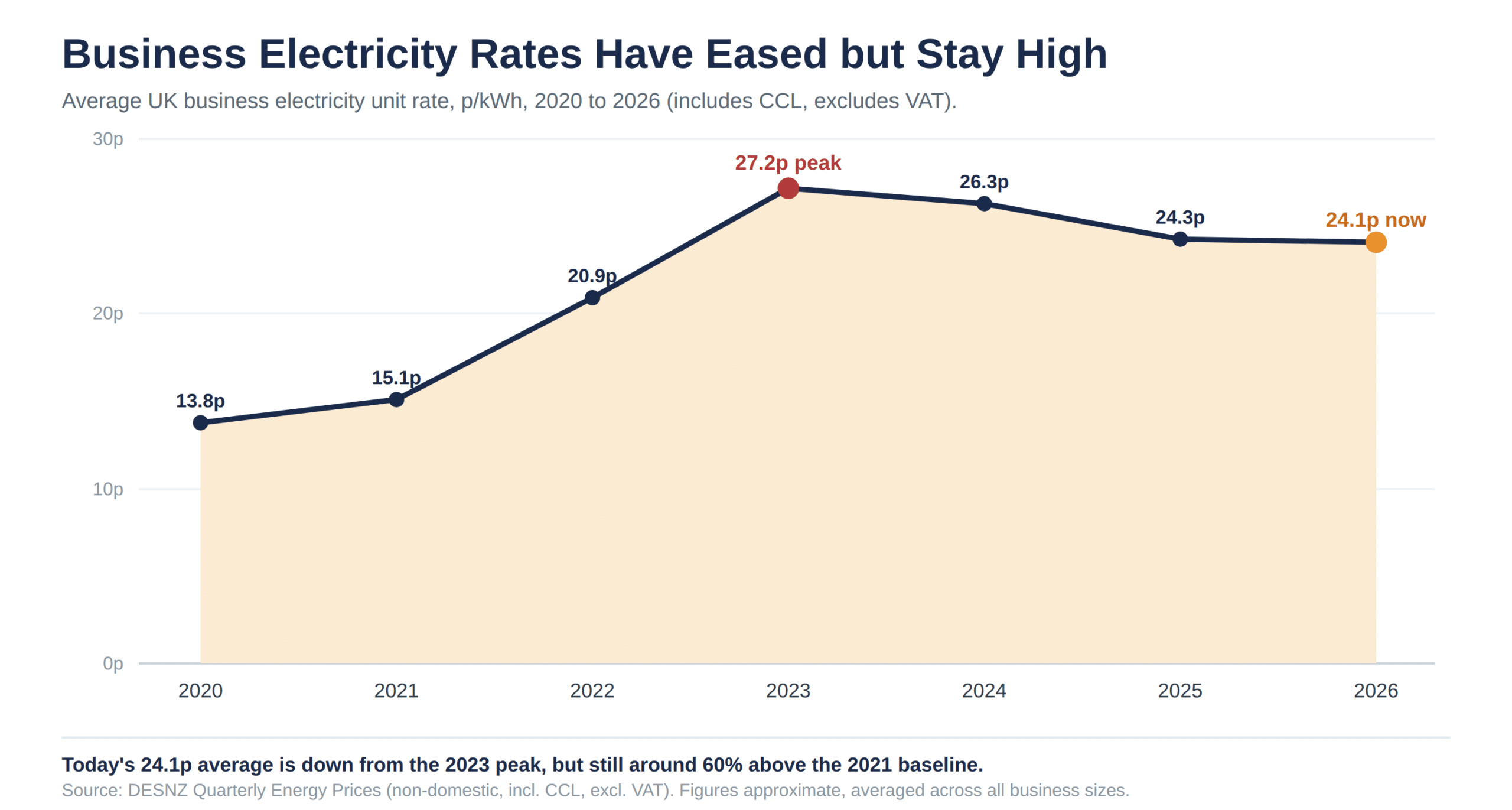
Today’s average is broadly flat year on year and easing slightly, but it is still around 60% higher than it was in 2021, so rates remain elevated by historical standards.
The 2021 to 2023 wholesale energy crisis pushed business rates to record highs. The market has calmed since, but prices have not returned to where they sat before the spike, which matters if you are comparing a quote against what you paid pre-2021.
A five-year snapshot
The table below tracks the average all-business rate year by year. It shows the crisis ramp, the 2023 peak and the slow easing since.
| Year | Average rate (p/kWh) | What happened |
|---|---|---|
| 2020 | 13.8p | Pre-crisis baseline |
| 2021 | 15.1p | Pre-crisis baseline |
| 2022 | 20.9p | Wholesale crisis ramps up |
| 2023 | 27.2p | Crisis peak |
| 2024 | 26.3p | Gradual easing |
| 2025 | 24.3p | Continued cooling |
| 2026 | 24.1p | Broadly flat, off the peak |
Some small businesses renewing at the worst of 2022 and 2023 saw their rates more than double. That is why a quote judged against a pre-2021 memory almost always looks alarming, even when it is competitive for today’s market.
Government support such as the Energy Bill Discount Scheme helped some businesses through the worst of the spike, but that scheme has since ended, so most current contracts carry none of it.
What is driving today’s rates?
Wholesale gas prices, network charges set by regional DNOs, the Climate Change Levy and supplier margin all combine to set today’s business electricity rate.
Why wholesale gas drives the price
Gas-fired generation frequently sets the marginal electricity price in the UK, so movements in the wholesale gas market feed through to electricity bills even for businesses that use no gas at all.
The National Energy System Operator balances supply and demand in real time, and the cost of that balancing, BSUoS, forms part of the wider price you ultimately pay.
- Wholesale market: the biggest single driver, moving with the gas price.
- Network charges: DUoS from your regional operator, under Ofgem’s price controls.
- Climate Change Levy: a per-kWh tax, reduced under a Climate Change Agreement if you qualify.
- Supplier margin: risk pricing and operating costs on top.
Are business electricity rates likely to fall further?
No one can predict rates precisely, but most analysts expect only gradual easing rather than a sharp return to pre-crisis levels, since wholesale gas remains the key swing factor.
Should you fix now or wait?
Waiting for a lower rate is a gamble, because a fixed contract trades a little upside for certainty. If your current rate sits above the average for your band, locking in a competitive fix now usually beats holding out on a variable tariff.
The forward market can move either way on gas supply and weather, so the sensible play is to compare when your renewal window opens and fix if the numbers are right, rather than trying to time the very bottom.
How do you find your own current rate?
Your current rate is printed on your most recent electricity bill as pence per kWh, alongside your standing charge and your MPAN number.
Where to look on your bill
If your bill is unclear or your supplier has not sent one recently, you can request usage and rate data using your MPAN number, which any new supplier also needs for an accurate comparison.
Not sure how to read the layout? Our guide on how to read a business energy bill walks through each section, and how much business electricity costs per kWh explains what each charge on it means.
What should you do if your rate looks out of date?
If your rate is noticeably above the current average for your usage band, get a live comparison before your contract renews, rather than waiting for your supplier’s renewal letter.
Time it around your renewal
Renewal letters are rarely a supplier’s sharpest offer. They are often priced on the assumption that inertia keeps you on board without checking the wider market.
A business switch takes about 4 to 6 weeks from signing to go-live, so starting the process about three months before your renewal date gives you room to compare properly.
Compare a panel of business energy suppliers against a recent bill, rather than a single renewal quote, and our guide on how to switch business energy supplier walks through the steps.