

CNG Energy Limited and CNG Electricity Limited stopped trading on 3 November 2021, with around 41,000 customers and not one of them a household. Ofgem appointed Pozitive Energy, which began supplying on 7 November. Supply continued throughout, and Pozitive agreed to honour the credit balances it had no obligation to honour.
This is the only supplier covered on this site whose entire book was business. It is also the clearest demonstration of what the safety net does and does not do, because Ofgem said in the same breath that credit balances were protected for domestic customers "however this cannot be guaranteed for non-domestic customers", about a company with no domestic customers at all. If you buy energy for a business, you can see which suppliers are quoting for commercial sites.
What happened to CNG Energy?
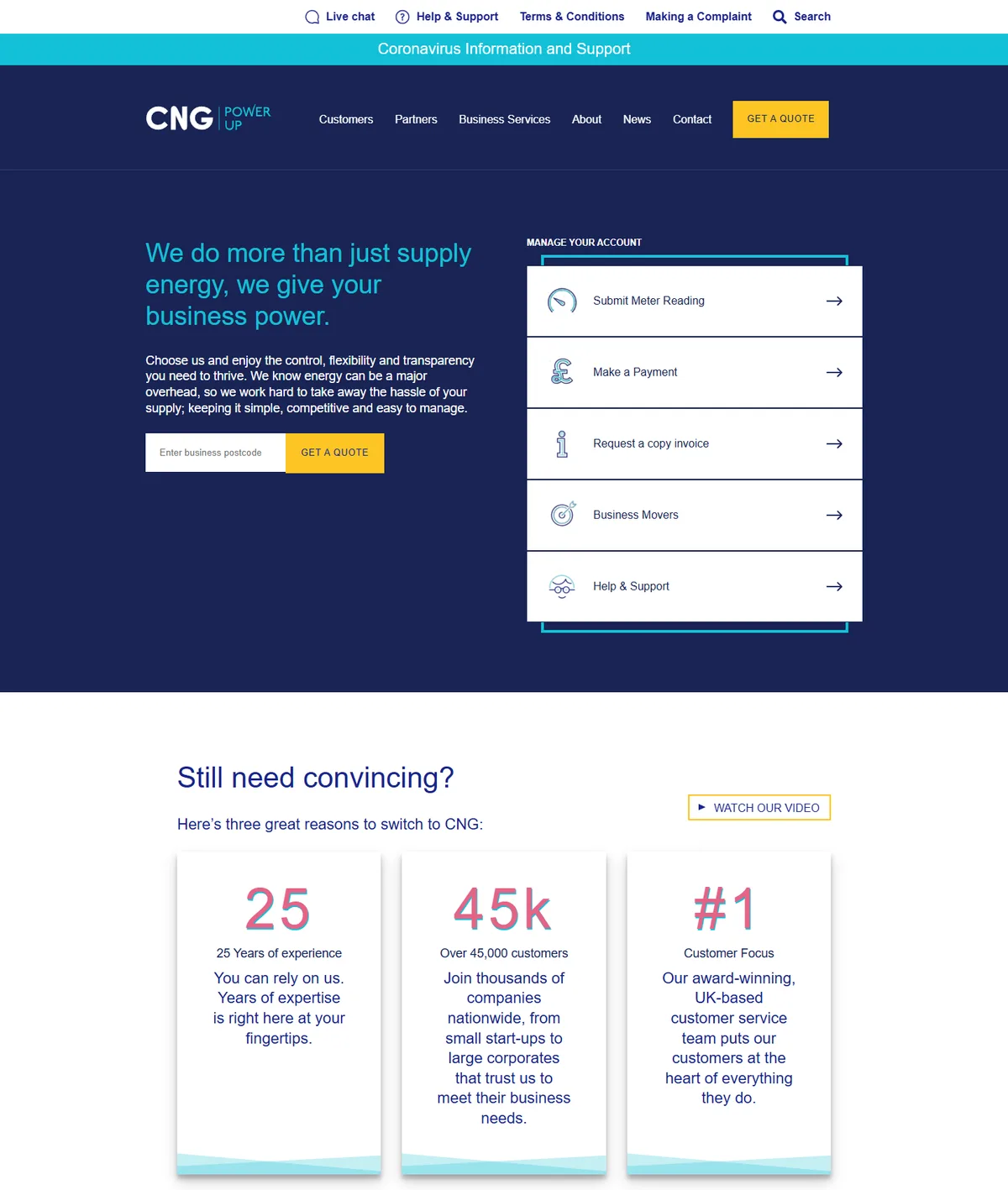
CNG sold energy to businesses and only to businesses. Its homepage headline was "We do more than just supply energy, we give your business power", its quote field asked you to "Enter business postcode", and its pitch was aimed at "companies nationwide, from small start-ups to large corporates". Its account tools included one called Business Movers. There was no domestic offer anywhere on the site.
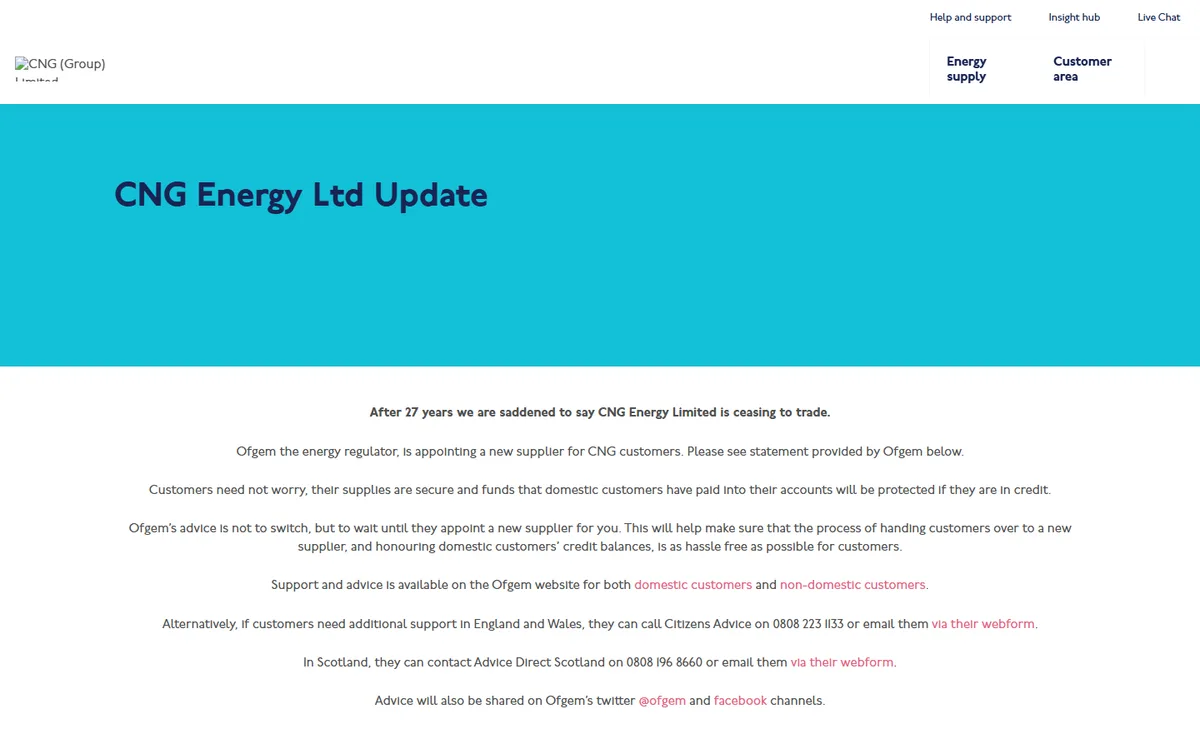
It was also old. Its closing notice began "After 27 years we are saddened to say CNG Energy Limited is ceasing to trade", which puts its start in the mid 1990s. Every other supplier covered here launched between 2015 and 2019. CNG had traded through three decades of the market before the 2021 crisis reached it.
On 3 November 2021 Ofgem announced that CNG Energy Limited and CNG Electricity Limited were ceasing to trade, with around 41,000 non-domestic customers between them. Pozitive Energy Ltd was appointed supplier of last resort for both the gas and the electricity book, and began supplying on 7 November. It sits on our record of the suppliers that have left the UK market since 2016.
Why did it collapse?
CNG went on 3 November 2021, in the middle of the run of failures that took more than twenty suppliers out of the market that autumn. Wholesale gas prices had risen faster than suppliers could buy ahead, and a business supplier is exposed to that in a particular way: non-domestic contracts are typically fixed for one to three years at a price agreed before the market moved, and the supplier has to buy the energy to honour them whatever it costs.
Ofgem said it appointed Pozitive Energy because its offer "represented the best deal overall for both customers of CNG Energy and all consumers", which is the standard formula for a competitive supplier of last resort process rather than a forced assignment.
What its own numbers said
Its figures do not quite line up, and we are not going to reconcile them. In July 2021 its homepage claimed "25 Years of experience" and "Over 45,000 customers". In November its closing notice said 27 years. Ofgem counted around 41,000 at the point of failure. Each of those is attributed to whoever published it.
The credit balances nobody had to honour
This is the part worth reading twice, because it is the difference between what a business assumes it has and what it actually has.
When Ofgem announced the failure on 3 November, it used its usual wording: "Funds that domestic customers have paid into their accounts will be protected, where they are in credit, however this cannot be guaranteed for non-domestic customers." That sentence appeared in an announcement about a company whose customers were all non-domestic. The protection being described covered nobody on CNG's books.
CNG then published the same boilerplate on its own website. Its closure page told its 41,000 business customers that "funds that domestic customers have paid into their accounts will be protected if they are in credit", and that Ofgem's process would handle "honouring domestic customers' credit balances" as smoothly as possible. Read by the people it was addressed to, it was reassurance about a protection none of them had.
And then they were honoured anyway
Five days later, on 8 November, Ofgem confirmed the appointments and added something the safety net does not require. Non-domestic credit balances for CNG Energy and CNG Electricity, along with those of Bluegreen Energy and MA Energy, "will be honoured by British Gas, SmartestEnergy and Pozitive Energy". CNG's business customers got their money back in full, because the incoming supplier chose to pay it.
In the same announcement, about the same process, on the same day: "Part of the credit balances of non-domestic customers of Ampower will be honoured by Yü Energy." Part.
| Failed supplier | Non-domestic credit balances | Honoured by |
|---|---|---|
| CNG Energy and CNG Electricity | Honoured | Pozitive Energy |
| Bluegreen Energy | Honoured | British Gas |
| MA Energy | Honoured | SmartestEnergy Business |
| Ampower | Part honoured | Yü Energy |
What its customers got
Supply never stopped. Pozitive Energy took over both the gas and the electricity accounts and began supplying on 7 November 2021, four days after the announcement.
The money
Credit balances were honoured in full by Pozitive, as set out above. Anyone in debit still owed what they owed, which is the same on every failure covered here: the debt survives the supplier.
The rate
Nobody kept their CNG contract. Business customers moved to Pozitive on new terms, and this is where a business is in a materially worse position than a household. There is no price cap on a non-domestic rate, so there is no ceiling on what the incoming supplier can charge. In November 2021 wholesale prices were at the level that had just bankrupted the previous supplier, and that is the market the new rates were set in.
What a business does have is the freedom to leave. Deemed and out-of-contract rates carry no exit fee, so a business moved onto one can go to the market immediately rather than waiting out a term.
Key dates
| Date | What happened |
|---|---|
| 3 November 2021 | Ofgem announces CNG Energy and CNG Electricity are ceasing to trade, around 41,000 non-domestic customers |
| 4 November 2021 | CNG publishes its own notice: "After 27 years we are saddened to say CNG Energy Limited is ceasing to trade" |
| 7 November 2021 | Pozitive Energy begins supplying both the gas and electricity accounts |
| 8 November 2021 | Ofgem confirms the appointment and says CNG’s non-domestic credit balances will be honoured |
What it means for a business
CNG failed in a week that took six suppliers out at once, and the announcement covering them is the most useful single document on this site for a business, because it puts domestic and non-domestic outcomes side by side:
| Supplier | Customers | New supplier |
|---|---|---|
| CNG Energy and CNG Electricity | ~41,000 non-domestic | Pozitive Energy |
| Zebra Power | 14,800 domestic | British Gas |
| Omni Energy | 6,000 domestic, prepayment | Utilita |
| Bluegreen Energy | 5,900 domestic, plus a small non-domestic book | British Gas |
| Ampower | 600 domestic and 2,000 non-domestic | Yü Energy |
| MA Energy | 300 non-domestic | SmartestEnergy Business |
The households in that table were covered by the safety net and by the price cap. The businesses were covered by neither, and depended on what each incoming supplier agreed to do:
| When your supplier fails | Household | Business |
|---|---|---|
| Supply continues | Yes | Yes |
| Ofgem protects your credit balance | Yes, under the safety net | No |
| A cap limits the rate you move onto | Yes | No |
| You are charged to leave that rate | No | No |
Where to start
- Business electricity costs, unit rate and standing charge, as they stand this month
- The price a business pays for gas per kWh, set in a separate market
- Who is taking on commercial contracts right now, if you want the field first
Our guide explains the contract you end up on when your supplier disappears.
For the other side of the same announcement, see Ampower, whose business customers got part of their money, and Zebra Power, which went the same week with a household book.
CNG Energy FAQs
What happened to CNG Energy?
Who took over CNG Energy customers?
Did CNG Energy supply households?
Were CNG Energy business credit balances protected?
Did customers keep their CNG contract?
Why did CNG Energy go bust?
How long had CNG Energy been trading?
Sources
- Ofgem, Ofgem protects customers of CNG Energy Limited, 3 November 2021
- Ofgem, Ofgem appoints new suppliers for customers of CNG Energy and CNG Electricity, MA Energy, Omni Energy, Bluegreen Energy, Zebra Power and Ampower, 8 November 2021
- Ofgem, Direction to appoint Pozitive Energy Ltd as Gas Supplier of Last Resort to CNG Energy Limited
- Ofgem, Direction to appoint Pozitive Energy Ltd as Electricity Supplier of Last Resort to CNG Electricity Limited
- Internet Archive, cngltd.co.uk as captured on 28 July 2021 and on 4 November 2021