
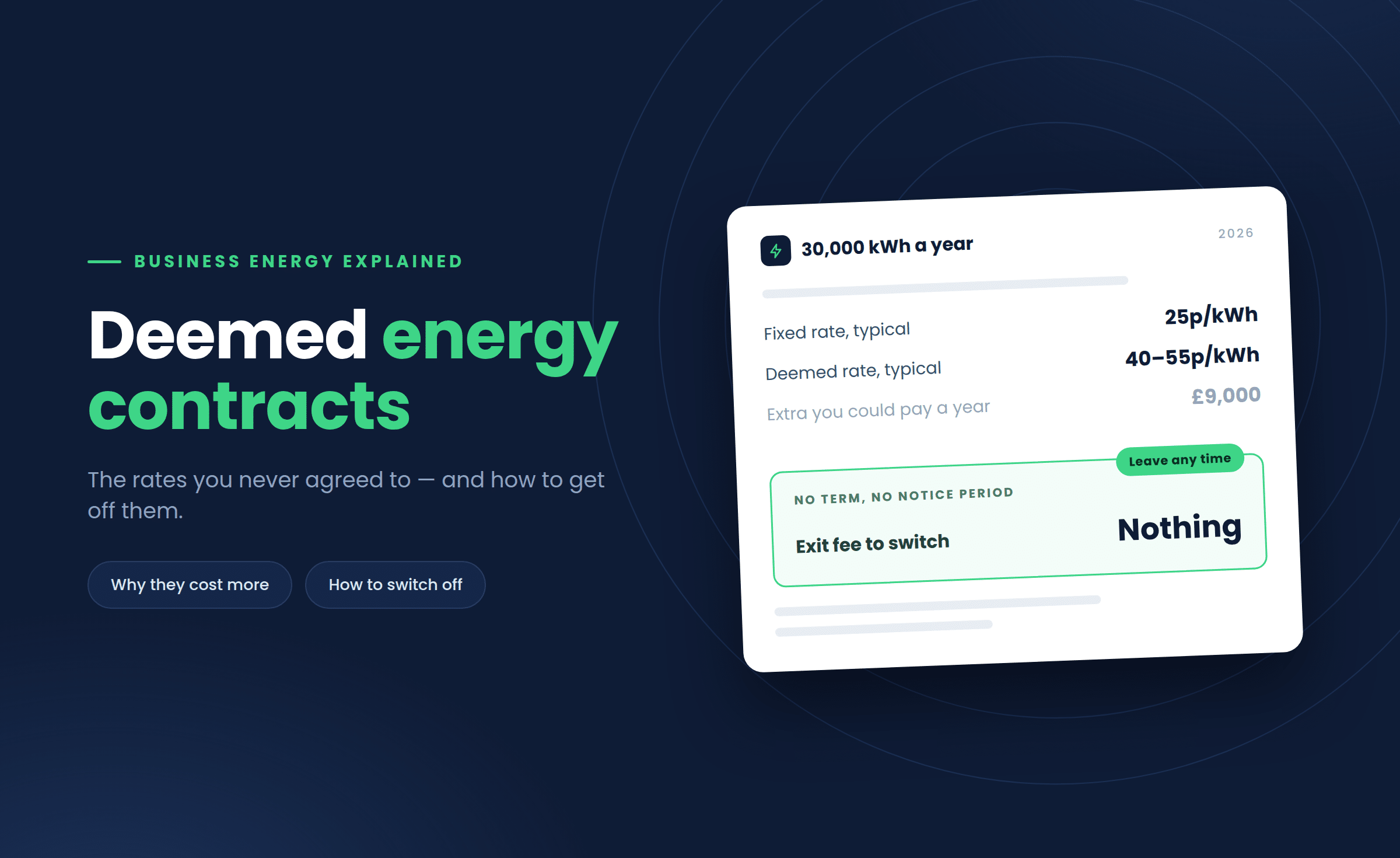
A deemed energy contract is the arrangement you fall onto when your business uses gas or electricity at a property with no agreed contract in place. It is legally binding without a signature, and it is the most expensive way to buy business energy.
Most firms land on a deemed contract by accident, usually after moving premises. This guide explains how they arise, what they cost, the Ofgem rules that apply, and how to get off one quickly.
The fastest way out is almost always to agree a fixed deal. You can compare business energy suppliers and switch off deemed rates without any exit fee.
What is a deemed energy contract?
A deemed energy contract applies when an occupier uses a gas or electricity supply without agreeing terms with the supplier. It is a statutory arrangement, so it binds you even without a signed agreement.
It binds you without a signature
You do not have to sign anything, or even speak to the supplier, to be on a deemed contract. Using the supply is enough to create one under law.
The arrangement is backed by statute, including Schedule 6 to the Electricity Act 1989 and the equivalent provisions for gas. The terms are whatever the supplier publishes as its deemed rates.
You still pay per unit
A deemed contract still charges a unit rate per kWh and a daily standing charge, just like any tariff. The difference is that the rates are set by the supplier and tend to be high.
What is the difference between deemed and out-of-contract rates?
Deemed rates apply when you have never agreed a contract at the premises, while out-of-contract rates apply when a fixed contract has ended with no new one arranged. Ofgem treats them as two different things.
Two situations, two sets of rates
The distinction matters because the rates can differ, and Ofgem confirms they are not the same arrangement. The table below sets out how deemed, out-of-contract and rollover terms compare.
| Arrangement | When it applies | Rates | Exit fee |
|---|---|---|---|
| Deemed | You use energy with no contract ever agreed | High, supplier-set | None |
| Out of contract | A fixed contract ended with no new deal | High, supplier-set | None |
| Rollover | A fixed contract auto-renewed for a set term | Fixed but uncompetitive | Usually yes |
Why suppliers separate them
Both deemed and out-of-contract rates are default rates you have not chosen. A rollover is different again, because it is a fixed term the contract rolled you into automatically.
How do you end up on a deemed contract?
You end up on a deemed contract whenever energy is used at a property with no agreed deal. The most common trigger is moving into new premises and using the supply before arranging a contract.
The three common triggers
Deemed contracts almost always arise by default rather than by choice. These are the situations that create one.
| Scenario | What happens |
|---|---|
| Moving into new premises | You use the existing supply before agreeing your own contract |
| Serving notice with no new deal | You leave a contract but arrange nothing to replace it |
| A landlord using an empty unit | Power is used in an unlet property, so the owner is liable |
It applies even if you never knew
A deemed contract binds you even if you have had no contact with the supplier and do not know the terms. Suppliers often write to “The Occupier” because they do not yet have your name.
How much do deemed energy rates cost?
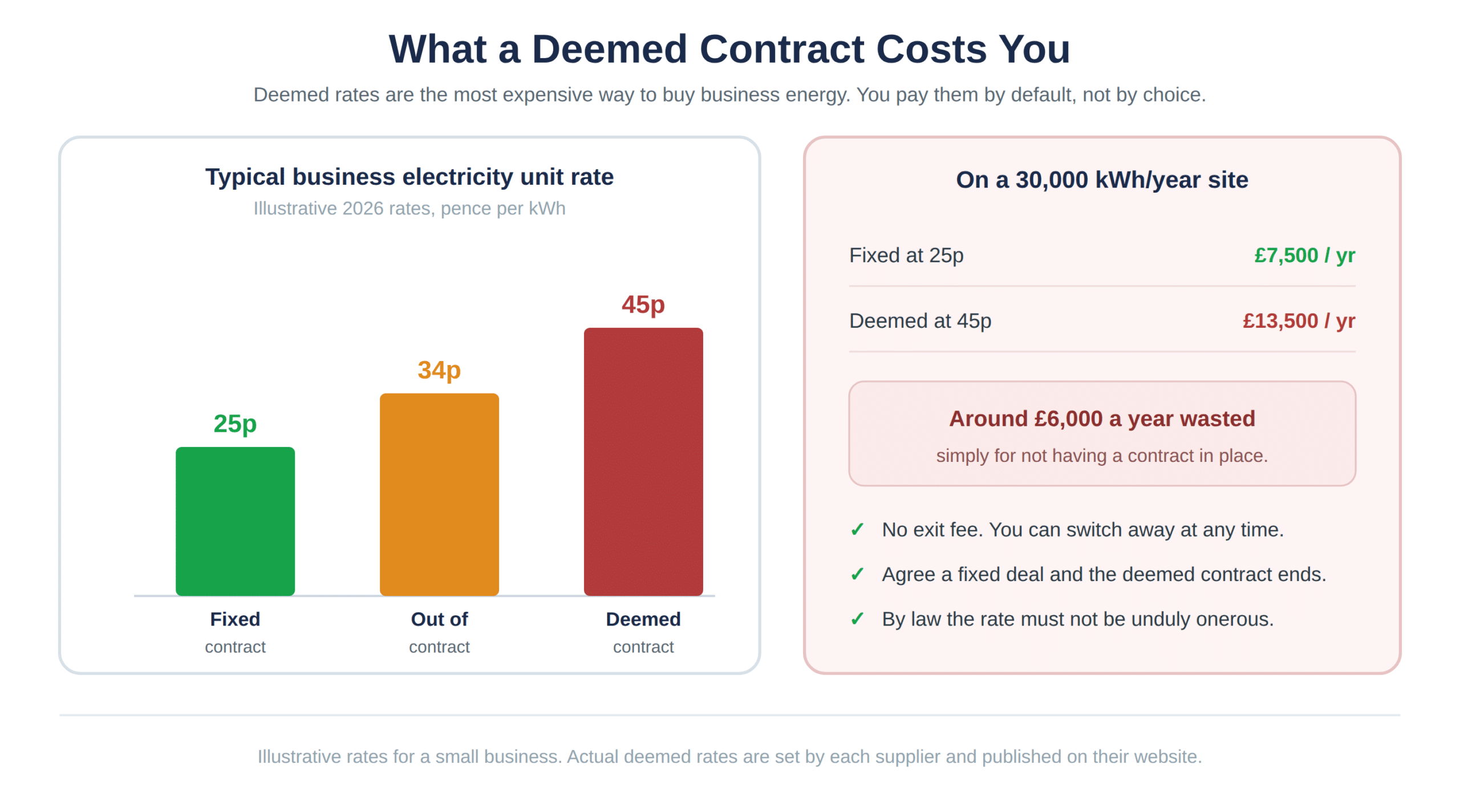
Deemed rates are the most expensive way to buy business energy. Deemed electricity commonly runs at 40p to 55p per kWh in 2026, well above a fixed rate of around 25p, so the cost adds up fast.
A cost comparison
The gap between a deemed and a fixed rate is stark on any real usage. The graphic below shows what it means for a typical small business.
Half-hourly sites are more complex
Larger sites with a half-hourly meter face extra deemed charges, including distribution costs and agreed capacity. Your MPAN and network region both feed into the final price.
Why are deemed energy rates so expensive?
Deemed rates are high because the supplier carries more risk. It does not know your usage, may not know who you are, and cannot rely on you staying, so it prices in that uncertainty.
Three reasons for the premium
Suppliers buy energy in advance based on expected demand. A deemed customer breaks that model in three ways.
- Unknown consumption. With no contract, the supplier cannot forecast how much energy the site will use, so it cannot buy ahead efficiently.
- Higher credit risk. The occupier is often unknown, which raises the chance of unpaid bills and pushes the price up.
- No commitment. You can leave at any time, so the supplier cannot plan around your custom and charges more to cover that.
What are the rules on deemed contracts?
Ofgem regulates deemed contracts under Standard Licence Condition 7. Rates must not be unduly onerous, suppliers must publish their terms, and you can leave at any time with no exit fee.
The protections that apply
Under Ofgem’s deemed contract rules, a supplier’s deemed terms must not be unduly onerous and its revenue must not sit far above its costs. Suppliers must also keep their deemed rates easy to find.
As soon as a supplier spots energy being used with no contract, it must take reasonable steps to tell the occupier. That is why deemed letters arrive addressed to the property rather than a person.
Microbusiness safeguards
A microbusiness on a deemed contract keeps the usual safeguards, including the 12-month back-billing rule and access to the Energy Ombudsman for unresolved disputes.
How do you get off a deemed contract?
You leave a deemed contract by agreeing a fixed deal, either with your current supplier or a new one. There is no exit fee and no notice period, so you can act the moment you are ready.
Two routes off deemed rates
The quickest fix is a fixed contract with your current supplier, which can start almost immediately. Shopping around and switching to a new supplier usually takes two to four weeks but often finds a cheaper rate.
If you are not sure who supplies the property, our guide to finding your electricity and gas supplier walks through how to check. From there you can compare business electricity and business gas quotes.
Take a meter reading on switch day
Give a meter reading on the day your new contract goes live. That draws a clean line under the deemed rates and keeps your first fixed bill accurate.
What are the risks of staying on a deemed contract?
Staying on a deemed contract wastes money, exposes you to rate changes, and can lead to large backdated bills. The longer you leave it, the more it costs.
Cost, uncertainty and backdating
Deemed rates are the highest a supplier charges, so every week on them is money lost. They are also variable, so the price can rise at short notice.
Missed meter readings are the other risk, because an estimated account can produce a large catch-up bill later. Running a business energy comparison and reviewing your energy procurement removes all three problems at once.