

Daligas stopped trading on 14 October 2021, supplying gas to around 9,000 domestic and non-domestic customers. Ofgem appointed Shell Energy Retail, which began supplying every account on 17 October. Supply continued throughout and nobody was charged an exit fee.
Of every failure covered on this site, this is the one a business should read. Daligas was gas only, it sold to small and midsized firms as openly as it sold to households, and Ofgem's own announcement counts its business customers in the headline number and then leaves them out of both protections it goes on to describe. If you buy gas for a business, you can see how business gas is priced now.
What happened to Daligas?
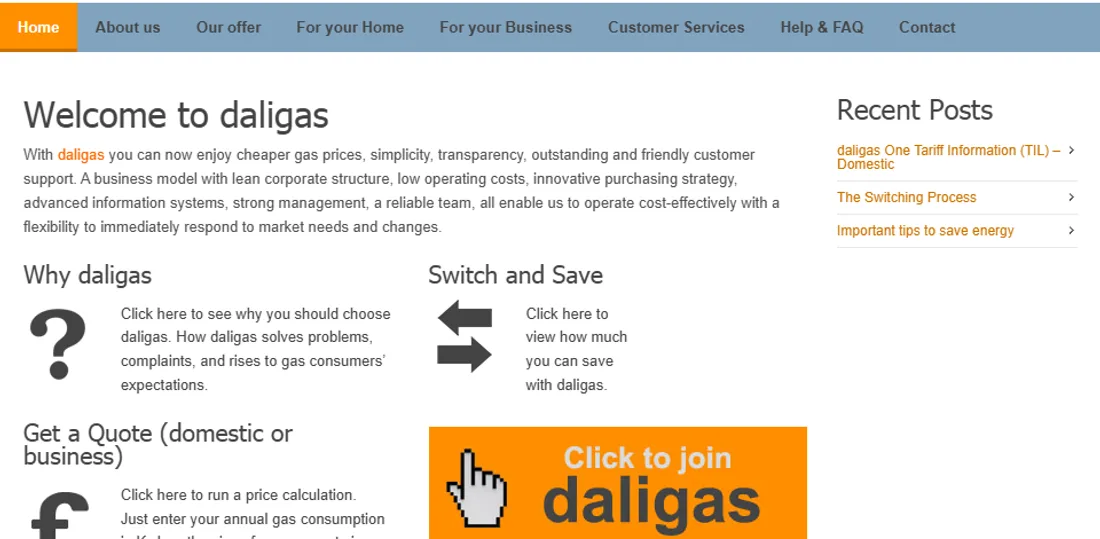
Daligas Limited sold one thing. Its strapline was "think gas, think daligas" and its offer was deliberately narrow: "Keep it simple. One product. One price. One payment method." It promised "cheaper gas prices, simplicity, transparency" on the back of "a business model with lean corporate structure, low operating costs, innovative purchasing strategy".
It sold to households and to firms in the same breath. Its navigation carried "For your Home" and "For your Business" next to each other, one of its three homepage panels read "Be smart! Gas prices tailored to your small & midsized business", and its quote tool was labelled "Get a Quote (domestic or business)".
On 14 October 2021 Ofgem announced it was ceasing to trade. Shell Energy Retail Limited was appointed gas supplier of last resort, and the direction took effect at 05:01 on 17 October 2021. Ofgem confirmed the appointment publicly on 18 October, in an announcement that also covered Pure Planet and Colorado Energy. It sits on our record of the other UK suppliers that have failed since 2016.
Why did it collapse?
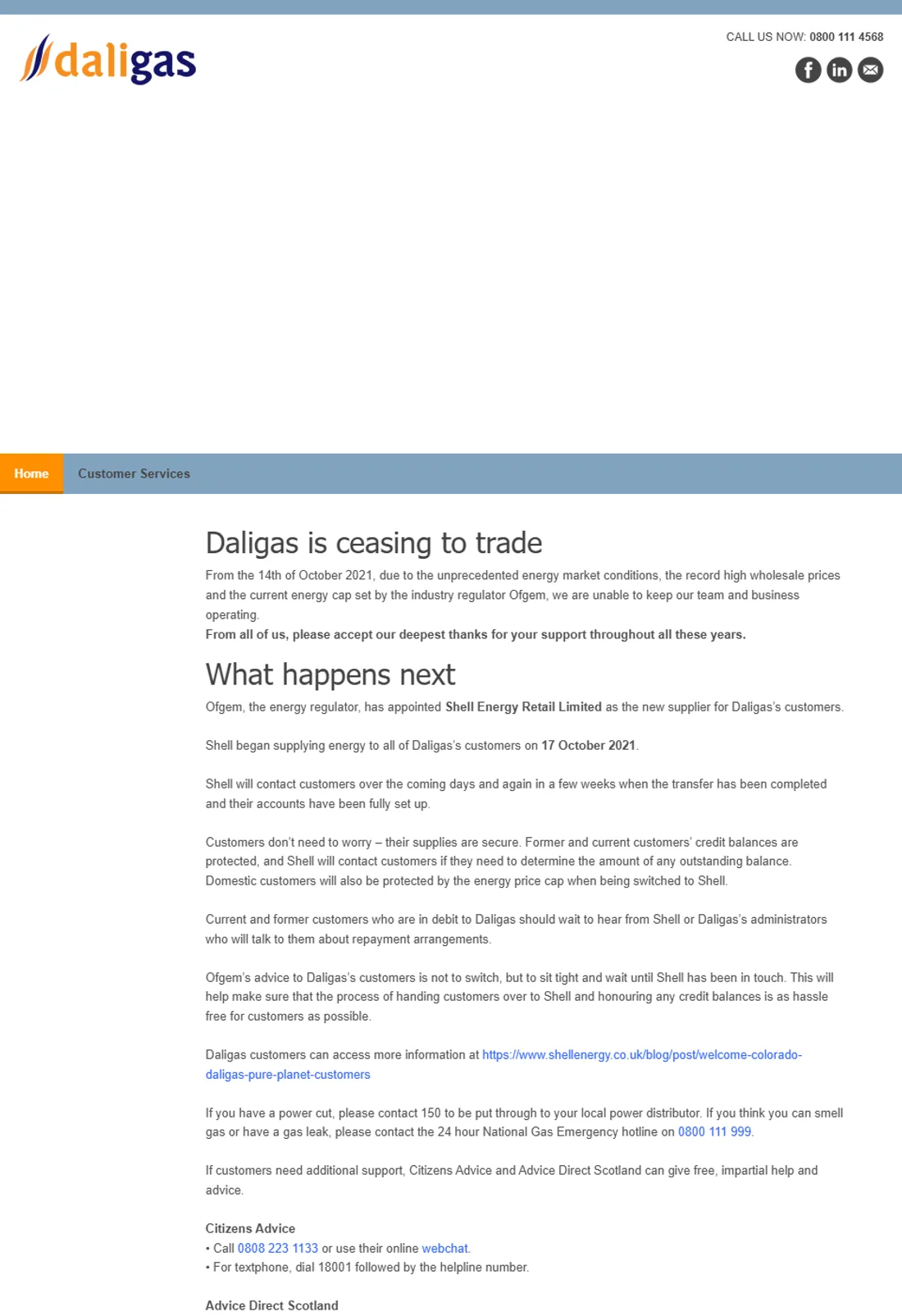
Daligas said why itself, on its own homepage, and it named the thing it blamed. Under the heading "Daligas is ceasing to trade" it told customers: "From the 14th of October 2021, due to the unprecedented energy market conditions, the record high wholesale prices and the current energy cap set by the industry regulator Ofgem, we are unable to keep our team and business operating. From all of us, please accept our deepest thanks for your support throughout all these years."
The first two reasons are the ones that took most of the class of 2021. Wholesale gas prices rose through the autumn faster than a small supplier on thin margins could buy ahead, and Daligas had built its whole proposition on being cheap.
The cap it blamed did not cover all its customers
The third reason is the interesting one. The energy price cap limits what a supplier can charge a domestic customer on a default tariff. When wholesale costs run above the cap, a supplier selling to households loses money on every unit and cannot price its way out.
That is a real squeeze, and it is the one Daligas pointed at. It is also worth noting that the cap never applied to its non-domestic customers, who were free to be repriced at any point their contracts allowed. The company named the cap; the public record does not set out how much of its book the cap actually touched.
The only gas-only supplier here
Every other supplier covered on this site held both licences and sold dual fuel. Daligas held a gas supply licence and nothing else, which is why Ofgem's appointment of Shell was a gas supplier of last resort direction, made to run for six months from the moment it took effect.
For a household that distinction is mostly academic. For a business it is not, because gas and electricity are bought in separate markets on separate contracts, and a firm whose gas supplier fails can find its gas moved to a new supplier on new terms while its electricity contract carries on untouched, or the other way round.
That is worth knowing before it happens. Our pages on business gas unit rates and standing charges and what business electricity adds on top are priced separately for exactly that reason.
What its customers got
Supply never stopped. Shell Energy Retail began supplying every Daligas account on 17 October 2021 and contacted customers over the following days and weeks.
Credit balances
Ofgem's position was the standard one: "funds that current and former domestic customers of the suppliers have paid into their accounts will be protected, where they are in credit". That is the safety net, and it is written for domestic accounts.
Daligas's own notice, published after Shell was appointed, put it more broadly: "Former and current customers' credit balances are protected, and Shell will contact customers if they need to determine the amount of any outstanding balance." It dropped the domestic qualifier on that sentence, then used it again in the next one about the price cap.
What its business customers actually got back is not on the public record. We are not going to guess, and a business reading this should take the safety net at its written scope rather than at the more generous wording on a closing supplier's website.
Rates and exit fees
Customers did not keep their Daligas price. Domestic accounts moved to Shell and were, in Ofgem's words, "protected by the energy price cap with their new supplier". Non-domestic accounts had no such ceiling. Nobody was locked in: Ofgem confirmed customers "will not be charged exit fees if they decide to switch to another supplier".
Anyone in debit still owed the money. Current and former customers in debit were told to wait to hear from Shell or from Daligas's administrators about repayment arrangements.
Key dates
| Date | What happened |
|---|---|
| 14 October 2021 | Ofgem announces Daligas is ceasing to trade, with around 9,000 domestic and non-domestic customers |
| 14 October 2021 | Daligas publishes its own statement blaming market conditions, wholesale prices and the price cap |
| 17 October 2021 | Shell Energy Retail appointed gas supplier of last resort, effective 05:01, for six months |
| 18 October 2021 | Ofgem confirms the appointment, alongside Pure Planet and Colorado Energy |
What it meant for its business customers
Across the three suppliers Shell took on that week, Ofgem counted approximately 252,000 domestic customers and 600 non-domestic customers. The protections it set out in the same announcement covered the first group.
That is the general rule, and Daligas is the clearest illustration of it on this site because its business customers are named in the headline figure rather than absent from it:
| When your supplier fails | Household | Business |
|---|---|---|
| Supply continues | Yes | Yes |
| Ofgem protects your credit balance | Yes, under the safety net | No |
| A cap limits the rate you move onto | Yes | No |
| You are charged to leave that rate | No | No |
The practical consequence is that a business carrying a large credit balance with a struggling supplier is carrying an unsecured risk, and a business moved to a new supplier lands on whatever that supplier quotes. The one protection that does apply is the last line: you can leave that rate without paying to go.
Where to start
- Business gas unit rates and standing charges, the market Daligas sold into
- What business electricity adds on top, bought and priced separately
- Which suppliers quote for gas and electricity together, if you would rather hold one contract
Our guide explains the rate you get when nobody has agreed a contract.
For other outcomes from the same process, see Ampower, where business accounts were also in the numbers, and ENSTROGA, which went a fortnight earlier.
Daligas FAQs
What happened to Daligas?
Who took over Daligas customers?
Did Daligas supply businesses?
Were business credit balances protected?
Did customers keep their Daligas tariff?
Why did Daligas go bust?
Was Daligas a gas-only supplier?
Sources
- Ofgem, Ofgem protects customers of Daligas Limited, 14 October 2021
- Ofgem, Ofgem appoints Shell Energy Retail Limited to take on customers of Pure Planet Limited, Daligas Limited and Colorado Energy Limited, 18 October 2021
- Ofgem, Direction to appoint Shell Energy Retail Limited as Gas Supplier of Last Resort to Daligas Limited
- Internet Archive, daligas.co.uk as captured on 20 September 2021 and on 18 October 2021