

Igloo Energy ceased trading on 29 September 2021 with 179,000 households, eight days after Ofgem ordered it to pay £316,582.44 into a government renewables scheme. It was one of three suppliers to go that day.
The unpaid sum was not a Renewables Obligation bill, which is what did for several other suppliers that autumn. It was a Feed-in Tariff levelisation payment, a less familiar obligation that works rather differently, and the order is the clearest public signal of trouble that exists for this company.
What happened to Igloo Energy?
Igloo Energy Supply Limited was run from Southampton and sold to households through an app, with heat pumps and smart home products alongside the energy. The company was incorporated in October 2015 under the name Pioneer Energy Limited.
It ceased trading on 29 September 2021, the same day as ENSTROGA and Symbio Energy. Its gas and electricity licences were revoked on 3 October, and E.ON Next, appointed by Ofgem after a competitive process, began supplying its 179,000 domestic customers the same day.
Eight days before the end it was still advertising for new customers, with a line promising savings of £71 a year.
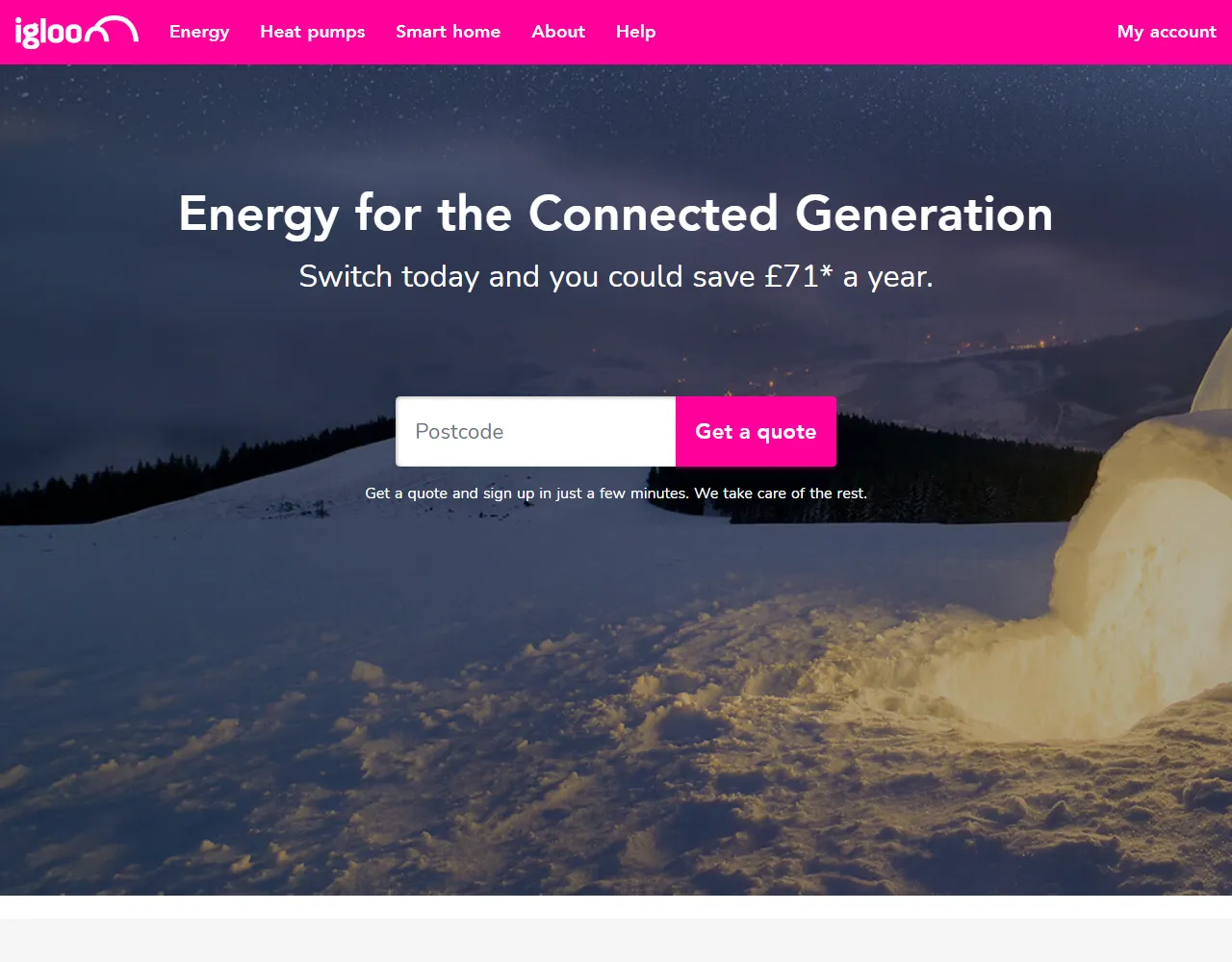
The payment it did not make
On 21 September 2021 Ofgem issued a provisional order against Igloo Energy Supply Limited. The reason was a Feed-in Tariff levelisation payment: Igloo owed £316,582.44 for Feed-in Tariff Year 11, due on 17 September, and had not paid it.
What levelisation actually is
The Feed-in Tariff pays people who generate their own renewable electricity, typically with solar panels. Those payments are made by energy suppliers, but no supplier has exactly its fair share of generators on its books. Levelisation is the mechanism that squares that up: every licensed supplier contributes in proportion to the electricity it supplies, suppliers that paid out more than their share are reimbursed, and suppliers that paid out less pay in.
Igloo was one of the ones that had to pay in, and the deadline passed. Eight days after Ofgem formally ordered it to pay, the company stopped trading.
It is worth separating this from the Renewables Obligation defaults that took several other suppliers in the same period. Both are environmental scheme payments collected across the year and handed over afterwards, and both are therefore tempting to a company short of cash, but they are different schemes with different deadlines. Igloo is the Feed-in Tariff case on this list.
The part that did not fail
Igloo was not only an energy supplier. It also installed air source heat pumps, and that business was a separate operation that carried on.
The notice that replaced the homepage said so directly: "Igloo Energy Supply Ltd. has ceased trading and administrators have been appointed... Igloo Works, our heat pump installation business continues to operate as normal." The site then went back to selling heat pumps, with installations advertised from £4,000.
It is a useful reminder when reading any list of failed suppliers, this one included. What fails is a licensed supply company. Other parts of the same group, with the same brand on them, can carry on trading normally, and a name disappearing from the energy market does not always mean the business behind it has gone.
What its customers got
Supply continued and customers moved to E.ON Next on 3 October. Ofgem confirmed that E.ON Next would honour credit balances for both current and past customers of Igloo who were owed money, and there were no exit fees for leaving afterwards.
One drafting point is worth flagging, because this site reads these notices closely. Ofgem's customer guidance for Igloo describes the protection without the usual "domestic" qualifier, saying simply that funds former and current customers have paid in will be protected. Its press release for the same failure does carry the qualifier: funds that domestic customers had paid in were protected. The safety net itself has only ever covered domestic balances, and Ofgem published a domestic customer count for Igloo and no non-domestic one, so the looser sentence reads as drafting rather than wider cover.
Key dates
| Date | What happened |
|---|---|
| 7 October 2015 | Incorporated as Pioneer Energy Limited, later renamed Igloo Energy Supply Limited |
| 17 September 2021 | Deadline passes for its Feed-in Tariff Year 11 levelisation payment of £316,582.44 |
| 21 September 2021 | Ofgem issues a provisional order requiring payment |
| 29 September 2021 | Igloo ceases trading, along with ENSTROGA and Symbio Energy |
| 3 October 2021 | Licences revoked; E.ON Next begins supplying 179,000 domestic customers |
What it means for a business
Igloo sold to households. Its navigation covered energy, heat pumps and smart home products, with no business section, and Ofgem published a domestic figure and no non-domestic count.
The transferable part is the warning sign. Ofgem's enforcement notices are public, searchable and specific, and a missed Feed-in Tariff or Renewables Obligation payment is one of the few things that becomes visible from outside before a supplier fails. For a household on a variable tariff that is interesting. For a business about to commit to a three-year fixed contract it is genuinely useful due diligence, and it takes a minute.
If a supplier does go, the position remains what it is throughout this record:
| When a supplier fails | Household | Business |
|---|---|---|
| Supply continues | Yes | Yes |
| Credit balance protected by the safety net | Yes | No |
| A price cap limits the rate you move to | Yes | No |
| Exit fee to leave afterwards | None | None |
Where to start
- Business electricity prices and standing charges today
- Gas prices for business customers
- Which suppliers are quoting for businesses now
If you inherited a rate you never agreed, read how deemed contracts work. For the two suppliers that failed on the same day, see ENSTROGA.
Igloo Energy FAQs
What happened to Igloo Energy?
Why did Igloo Energy fail?
What is a Feed-in Tariff levelisation payment?
Did Igloo Energy customers lose money?
Did Igloo Energy supply businesses?
Does Igloo still exist?
Who took over Igloo Energy customers?
Sources
- Ofgem, Igloo Energy Supply Limited: Provisional Order, 21 September 2021
- Ofgem, Ofgem protects customers of failed suppliers ENSTROGA, Igloo Energy Supply Limited and Symbio Energy
- Ofgem, Igloo Energy Supply Limited customers: your questions on new supplier E.ON Next
- Companies House, Igloo Energy Supply Limited, company number 09812716
- The company's own notice, as archived at igloo.energy in October 2021