

Neon Reef Limited stopped trading on 16 November 2021. Ofgem appointed British Gas to take over its customers, and around 30,000 households moved across on Sunday 21 November. Nobody lost supply, and credit balances were protected.
Neon Reef was a small green electricity supplier, not a business energy supplier. This page sets out what happened to it, why it failed, and what its collapse means if you are a household or a business whose own supplier goes under. If you run a business and want off a deemed rate now, you can see which business energy suppliers are worth a look in a few minutes.
What happened to Neon Reef?
Neon Reef Limited ceased trading on 16 November 2021, during the worst year the UK energy market has had. It was one of 28 suppliers to fail that year, a run that moved more than four million customers to new suppliers. You can see every failed energy company in the UK since 2016 and who picked up their customers.
Ofgem ran its Supplier of Last Resort process and appointed British Gas to take on the customers of both Neon Reef and Social Energy Supply Ltd, about 35,500 domestic accounts between them. Ofgem announced the appointment on 22 November 2021, and customers had already been switched across on Sunday 21 November.
Neon Reef's electricity and gas supply licences were later revoked, and the company no longer exists as a supplier. Its old website, neonreef.co.uk, is gone.
What Neon Reef sold
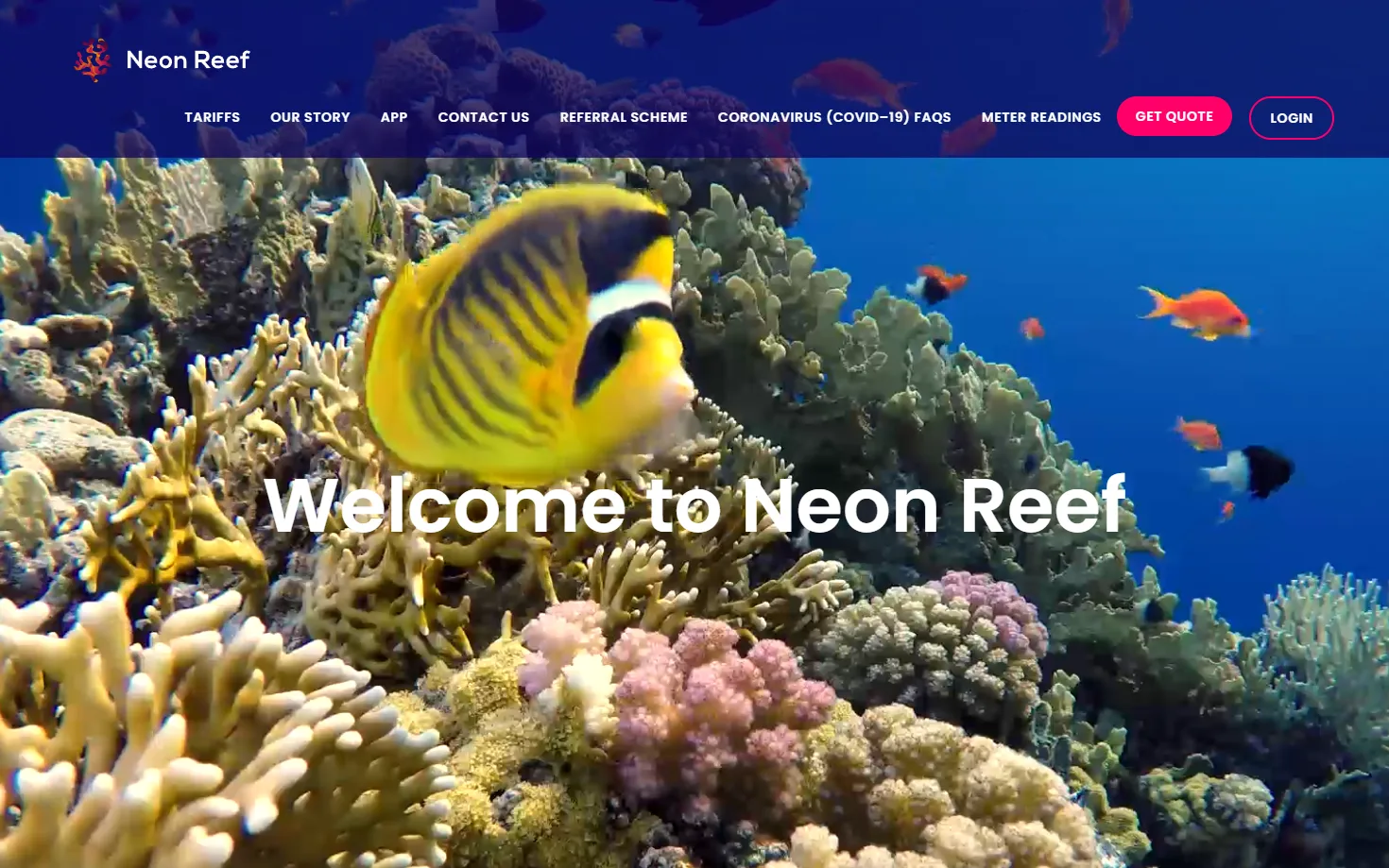
Neon Reef was a domestic supplier with a green pitch. Its site offered household tariffs, an app, meter readings and a referral scheme, and it supplied only renewable electricity. It had no business energy arm, so if you are looking for a supplier for business premises, start with the business energy suppliers that do serve them instead.
Why did Neon Reef fail?
Two things ended Neon Reef: a bill it could not pay, and a wholesale market that made it impossible to trade out of trouble.
The Renewables Obligation shortfall
Suppliers of renewable electricity have to meet the Renewables Obligation each year, either by presenting certificates or by paying into a buy-out fund. Neon Reef did not meet its obligation for the year running 1 April 2020 to 31 March 2021.
On 24 September 2021 Ofgem issued a provisional order requiring Neon Reef to pay £349,148.80 plus accrued interest by no later than 31 October 2021. It did not pay, and it stopped trading a fortnight later.
The 2021 wholesale price shock
Wholesale gas prices rose steeply through the second half of 2021. Suppliers that had sold fixed tariffs without buying the energy to cover them were left paying market prices while charging their customers much less, and the domestic price cap meant they could not simply pass the increase on.
Small suppliers with little capital and no hedging were the least able to absorb that. Neon Reef, with about 30,000 customers, was firmly in that group.
What happened to Neon Reef customers?
Nothing was cut off and nobody had to do anything. Gas and electricity reach a property through the networks, not through the supplier, so supply continues whoever is billing you.
The move to British Gas
Ofgem appointed British Gas as supplier of last resort. Customers moved across on 21 November 2021 and were contacted in the days that followed. Accounts were reopened on a deemed contract with British Gas, which is the default arrangement that applies when you have not agreed a tariff.
Credit balances
Ofgem confirmed that funds current and former domestic customers had paid into their accounts were protected where they were in credit. That protection comes from Ofgem's Safety Net, and it is one of the clearest differences between a domestic and a business account.
Was anyone worse off?
Customers on a cheap Neon Reef fixed tariff lost it. A deemed contract is normally more expensive than a fixed deal, so the practical loss was the rate rather than the money already paid. There are no exit fees on a deemed contract, so anyone moved this way could switch away as soon as their account had settled.
Key dates
| Date | What happened |
|---|---|
| 24 September 2021 | Ofgem issues a provisional order over an unpaid Renewables Obligation of £349,148.80 |
| 31 October 2021 | Deadline in that order passes without payment |
| 16 November 2021 | Neon Reef ceases trading |
| 21 November 2021 | Customers transfer to British Gas |
| 22 November 2021 | Ofgem announces the appointment publicly |
What to do if your supplier fails
The process is the same whichever supplier goes under, and it is deliberately undramatic.
- Do not switch straight away. Wait until Ofgem names the new supplier and your account has moved. Switching mid-transfer makes the handover harder to unpick.
- Take a meter reading. Photograph it, dated. It is the cleanest evidence of where your old account ended and the new one began.
- Keep your old bills and statements. They are what you will need if a closing balance looks wrong.
- Wait to be contacted. The new supplier writes to you, usually within a couple of weeks.
- Then compare. Once the account has settled you are on a deemed rate with no exit fees, so there is nothing to stop you moving.
Why it works differently for a business
Neon Reef supplied households, so its own customers had the full protection of the Safety Net. If you run a business, a supplier failure is a different proposition, and the differences are worth knowing before one affects you.
| What happens | Domestic customer | Business customer |
|---|---|---|
| Supply continues | Yes | Yes |
| Credit balance protected by Ofgem | Yes, under the Safety Net | No, claimed through the administrators |
| Price cap on the deemed rate | Yes | No |
| Exit fees on the deemed contract | None | None |
The practical consequence is that a business left on a deemed rate after a supplier failure is usually paying well above the market, with no cap to limit it and no penalty for leaving. That makes moving quickly worth real money.
Where to start
Take the part of your supply that matters most, or look at the market as a whole:
- Live business electricity unit rates per kWh, with the standing charges that sit alongside them
- The same business gas figures, per kWh and per day, which move on their own cycle
- Which business energy suppliers serve what, side by side, if you would rather judge the whole market first
If you are still on a deemed contract, our guide explains what a deemed energy contract costs and how quickly you can leave.
Neon Reef FAQs
What happened to Neon Reef?
Who took over Neon Reef customers?
Did Neon Reef customers lose their credit balances?
Why did Neon Reef stop trading?
Did Neon Reef supply businesses?
Can I still contact Neon Reef?
What should I do if my business energy supplier goes bust?
Sources
- Ofgem, Ofgem appoints British Gas to take on customers of Neon Reef Limited and Social Energy Supply Ltd, 22 November 2021
- Ofgem, Neon Reef Limited: Provisional Order, 24 September 2021
- Internet Archive, neonreef.co.uk as captured on 7 October 2021