

Bulb Energy was placed into special administration on 24 November 2021 with around 1.5 million customers. It did not stop supplying energy, and nobody was transferred to another supplier. The company kept trading, funded by the government, until its customers moved to Octopus Energy on 20 December 2022.
Every other supplier on this site went through the supplier of last resort process. Bulb was too big for it, so the state used a power that had never been used before and kept the company alive instead. It is the only failure covered here where being a business customer made no difference at all, and it is worth understanding why that was an exception rather than a rule. If you buy energy for a business, you can check which suppliers are writing commercial contracts now.
What happened to Bulb?
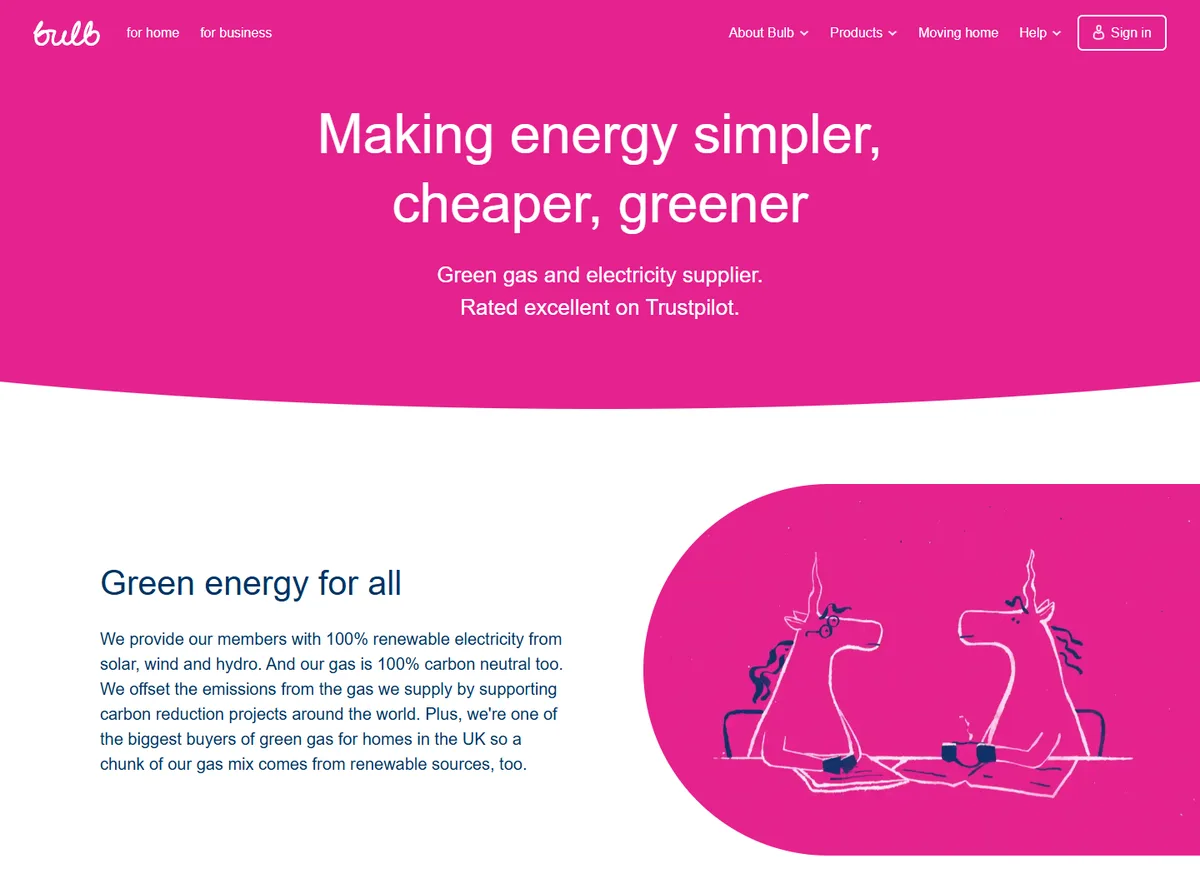
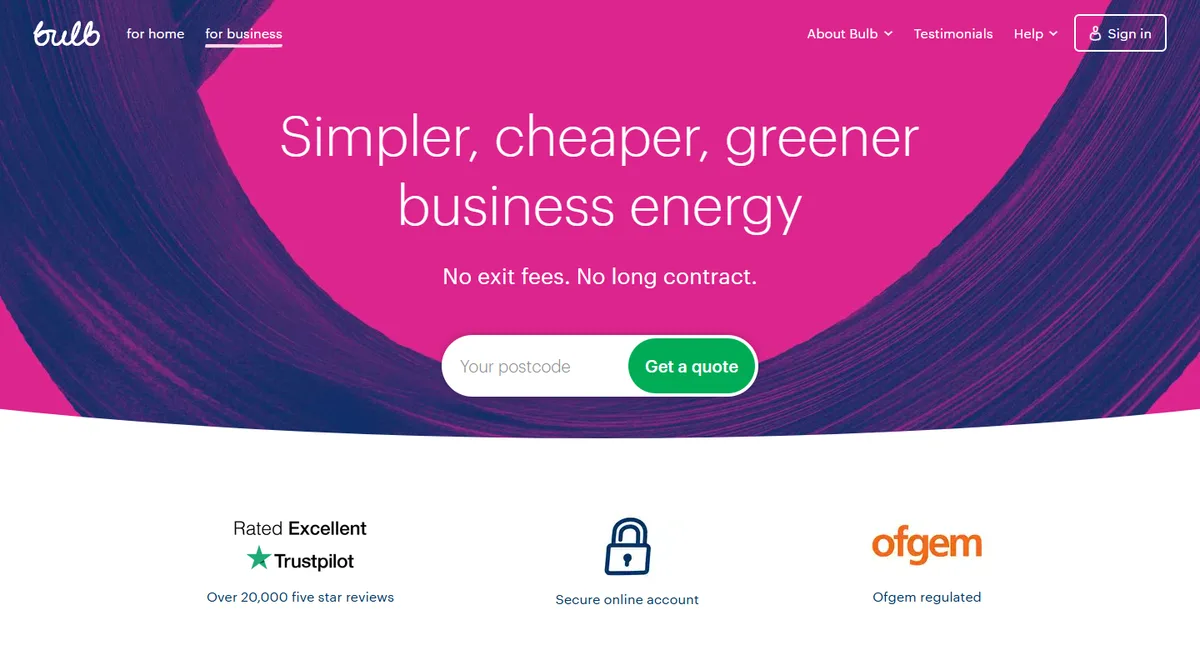
Bulb was the seventh largest energy supplier in Great Britain, built on a single variable tariff, 100% renewable electricity and carbon neutral gas. Its homepage promised to make "energy simpler, cheaper, greener" and its business arm sold "simpler, cheaper, greener business energy" with "no exit fees, no long contract".
On 22 November 2021 the government published guidance on what was about to happen. Two days later, on 24 November 2021, the High Court made an energy supply company administration order and Bulb Energy Ltd entered the Special Administration Regime. Matthew James Cowlishaw, Matthew David Smith and Daniel Francis Butters of Teneo Restructuring were appointed joint special administrators.
Then nothing visible happened. Supply continued, billing continued, tariffs stayed where they were, and the website carried on selling. It sits on our record of the suppliers that have left the market since 2016, but it left it in a way nothing else has.
Why Bulb was handled differently
The normal process when a supplier fails is supplier of last resort. Ofgem runs a competitive process, picks a new supplier, and the customers become that supplier's customers. As the government put it, the successful supplier "takes on a failed company's customers as their own, with customers' credit balances moving with them".
That works for tens of thousands of accounts. It had never been tried with a million and a half. The government's stated position was that "in some cases when a large energy company is in financial difficulty, the Special Administration Regime may be a better option to protect consumers than a Supplier of Last Resort process".
So Ofgem applied for an energy supply company administration order under powers in the Energy Act 2011 that had sat unused since they were written. Bulb is the only energy supplier they have ever been used on.
| Supplier of last resort | Special administration | |
|---|---|---|
| Used for | Every other supplier on this site | Bulb, and only Bulb |
| What happens to the company | Licences revoked, company gone | Keeps trading under administrators |
| What happens to customers | Transferred to a new supplier | Stay exactly where they are |
| What happens to your tariff | Replaced by the new supplier’s terms | Unchanged |
| Who pays the cost | Recovered through everyone’s bills | Funded by the taxpayer up front |
Why did it collapse?
Bulb sold a single variable tariff priced to undercut the market, and it had grown very fast on it. When wholesale gas and electricity prices rose through 2021, the price cap limited what it could charge its domestic customers while nothing limited what it had to pay for energy. It had not bought far enough ahead to cover the gap and had no parent company to absorb it.
It had been on the other side of this once already. In 2019 Bulb was itself appointed supplier of last resort for Gnergy, taking on about 9,000 customers from a failed supplier. Two years later it was the one that could not carry on.
What it cost
Special administration protects customers by paying the bills the company cannot. The National Audit Office put the gross cost at £3.02 billion as at 31 January 2023, made up of:
| What the money went on | Amount |
|---|---|
| Operating the special administration from November 2021 | £1.09bn |
| Paid when the transfer to Octopus completed on 20 December 2022 | £1.22bn |
| Wholesale energy, 21 December 2022 to 31 March 2023 | £0.71bn |
| Gross taxpayer funding as at 31 January 2023 | £3.02bn |
That was a long way below the worst forecast. In November 2022 the Office for Budget Responsibility had put the gross cost at £6.5bn, and the reduction came mainly from wholesale prices falling. The government expects to recover the funding, though the NAO noted that "several risks remain to the recovery of taxpayer funding, which may ultimately be absorbed by household customers".
What its customers got
Almost uniquely on this site, the answer is: what they already had.
Nothing changed, which was the point
Ofgem's guidance to Bulb customers was two sentences long where other failures needed ten: "Your credit balance is protected and your tariff and price plan will not change." Customers were told not to switch, not to do anything, and to carry on as normal. There was no handover, no meter reading deadline, no new supplier to wait to hear from.
That held for thirteen months. In October 2022 Octopus Energy agreed to buy the supply business, and on 20 December 2022 an Energy Transfer Scheme moved Bulb's customers and some of its assets and liabilities across. Customers became Octopus customers without having to do anything then either.
And its business customers
Bulb had a business supply arm. Its site carried "for home" and "for business" side by side, with its own business tariff, its own quote flow and a library of business energy guides. The pitch was the same as the domestic one: one tariff, no exit fees, no long contract.
Ofgem's published guidance addresses domestic customers and gives no non-domestic figure, so we are not going to put a number on the business book. What is clear is the treatment. Because the company itself was kept running, its business customers were carried in exactly the same way as its households: same supply, same contract, same price, no transfer.
Key dates
| Date | What happened |
|---|---|
| 2019 | Bulb is appointed supplier of last resort for Gnergy, taking on about 9,000 customers |
| 22 November 2021 | The government publishes guidance on how Bulb customers will be protected |
| 24 November 2021 | The High Court makes an energy supply company administration order; joint special administrators appointed from Teneo |
| October 2022 | Octopus Energy agrees to acquire Bulb’s supply business |
| 20 December 2022 | An Energy Transfer Scheme moves customers and assets to Octopus; £1.22bn paid the same day |
| 31 January 2023 | Gross taxpayer funding estimated at £3.02bn |
What it means for a business
Bulb is the one case on this site where a business customer was treated exactly like a household. It is tempting to read that as reassurance. It is the opposite.
Business customers were protected here because the entire company was kept alive at public expense, using a power that had never been used before and has not been used since. Nothing about that outcome came from a protection a business holds. Where the ordinary process applies, and it applied to every other supplier on this list, the position is unchanged:
| When your supplier fails | Household | Business |
|---|---|---|
| Supply continues | Yes | Yes |
| Ofgem protects your credit balance | Yes, under the safety net | No |
| A cap limits the rate you move onto | Yes | No |
| You are charged to leave that rate | No | No |
A business with 1.5 million customers behind it gets a rescue. A business on the books of a supplier with forty thousand gets the supplier of last resort process, and whatever the incoming supplier decides to honour.
Where to start
- What a business is paying for electricity per kWh, with the standing charge alongside
- Gas rates for business premises per kWh, priced in a separate market
- The suppliers open to commercial business right now, if you want the field first
Our guide explains the terms you inherit when a contract ends without a new one.
For the ordinary process and what it actually delivers, see CNG Energy, whose business balances were honoured by choice, and Avro Energy, the largest supplier of last resort transfer.
Bulb Energy FAQs
What happened to Bulb Energy?
Why was Bulb not handled like other failed suppliers?
Did Bulb customers lose money?
Did Bulb customers keep their tariff?
Did Bulb supply businesses?
What did Bulb cost the taxpayer?
Why did Bulb go bust?
Sources
- Ofgem, Bulb Energy customers: your questions answered, 24 November 2021
- Department for Business, Energy and Industrial Strategy, How Bulb customers are being protected after its insolvency, 22 November 2021
- National Audit Office, Investigation into Bulb Energy, March 2023
- Department for Business, Energy and Industrial Strategy, UK government approves agreement between Bulb and Octopus Energy
- Internet Archive, bulb.co.uk as captured on 29 November 2021 and its business page on 18 November 2021