

Colorado Energy did not really sell to customers. It sold to letting agents. Its own homepage described the business as "providing tenants across the UK with simple tariffs at fair prices", working "in partnership with selected Letting Agents" to get supply set up when somebody moved in.
So when it ceased trading on 13 October 2021, a large share of the 15,000 people affected had never chosen it, and some will not have recognised the name on the notice.
What happened to Colorado Energy?
Colorado Energy Limited ceased trading on 13 October 2021, the same day as Pure Planet, a collapse fifteen times the size. Ofgem recorded around 15,000 domestic customers. Shell Energy Retail was appointed to take them on, and also took on Pure Planet's 235,000 and, within days, the customers of Daligas and GOTO Energy.
Credit balances were protected in the usual way. Neil Lawrence, Ofgem's director of retail, confirmed that "funds that domestic customers have paid into their accounts will be protected, where they are in credit".
Colorado was the smallest of the four companies Shell rescued that month. Ofgem approved Shell's initial claim for the wholesale cost of supplying all of them at £164,517,606.72, of which Colorado's share was £6,662,018.19, or roughly £444 for each of its customers. Every penny claimed was approved. What that levy is and who ultimately pays it is set out in detail on the GOTO Energy page.
The supplier most of its customers did not choose
What makes Colorado worth its own page is how it got its customers.
Most challenger suppliers of that era competed on price comparison sites. Colorado did not. It built partnerships with letting agents, and the supply was arranged as part of moving into a property. The homepage on the day it collapsed still carried the pitch, directly underneath the notice announcing the end.
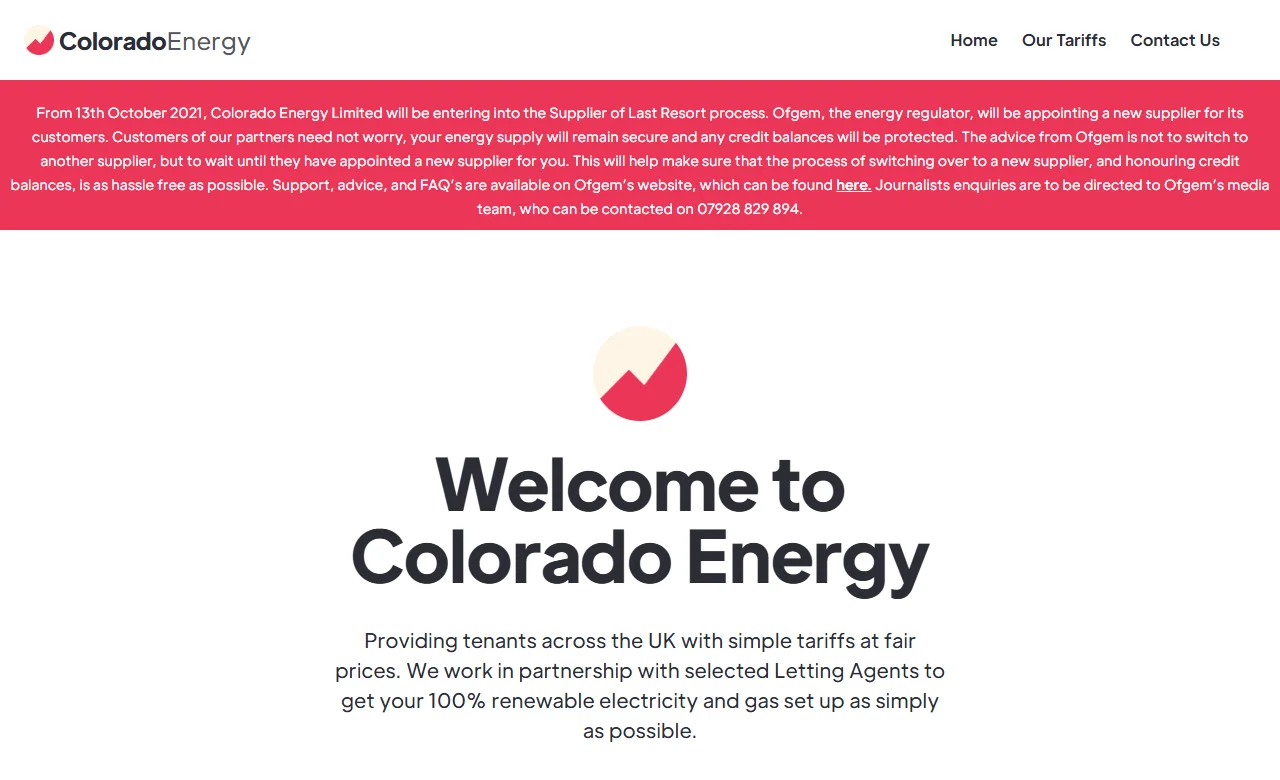
Look at the wording of that banner again: "Customers of our partners need not worry". The company is addressing the letting agents' customers rather than its own, which is an accurate description of the relationship and a slightly odd thing to read if you are the person whose energy it was.
None of this was improper. Somebody has to supply a property between tenancies, and an agent arranging it is doing a tenant a service. But it does produce a category of customer who did not compare anything, did not sign up to a tariff they had chosen, and had no particular reason to be watching whether their supplier was solvent.
Who picks the energy supplier in a rented home
Since this is the one failure on the record where that question really matters, here is the answer properly.
If you pay the energy bill directly
Then you are the customer, whatever the tenancy agreement says and whoever set the account up.
- You inherit whoever supplies the property. On the day you move in you are on a deemed contract with the existing supplier. You did not agree to it and you are not tied to it.
- You can switch straight away. There are no exit fees on a deemed contract, and you do not need the landlord's or the agent's permission to change supplier if you are the one paying the bill. A tenancy clause requiring you to stay with a named supplier is generally not enforceable against that right, though you may be required to return the property to the original supplier at the end of the tenancy.
- Take a meter reading on day one. It is the only thing that separates your bill from the last tenant's, and it matters far more than people expect.
- A deemed rate is the most expensive rate. Staying on one because nobody told you to move is the single most common way renters overpay for energy.
If the rent includes energy
Then your landlord is the customer and the supplier contract is theirs. You are not affected by a supplier failure in the same way, but there are limits on what a landlord can charge you for energy they resell, and the Maximum Resale Price rules cap it at what they paid.
And if the supplier fails
Exactly what happens to everybody else. Supply continues, Ofgem appoints a replacement, and a domestic credit balance is protected whether you chose the supplier or inherited it.
The five names on Ofgem’s list
Colorado's collapse had a date stamped on it a fortnight in advance, and the reason is a deadline that explains a great deal about why supplier failures cluster in the autumn.
Every electricity supplier has to discharge its Renewables Obligation by 31 August each year, either by handing over certificates or paying cash, with a late payment window running to 31 October. On 1 October 2021, Ofgem published a consultation on issuing final orders against five suppliers that had missed the deadline, naming each and what it owed.
| Supplier named on 1 October 2021 | Owed | What happened |
|---|---|---|
| Ampoweruk | £3,590,236 | Issued with a final order, then ceased trading |
| GOTO Energy, named the same day | £2,472,369 | Ceased trading 18 October, order not pursued |
| Colorado Energy | £883,182.30 | Ceased trading 13 October, order not pursued |
| Whoop Energy | £56,306 | Issued with a final order, then ceased trading |
| Home Energy Trading | £2,252 | Paid in full |
Four of those five are on this record. The only one that is not is the only one that paid, and it owed £2,252.
That is the thing worth taking from this page beyond Colorado itself. The Renewables Obligation payment is large, it falls due at the same point every year, and it functions in practice as an annual solvency test. A supplier that cannot find the money in the autumn is usually not short of it only for the autumn. In 2021 the deadline and the wholesale crisis arrived together, and the result was visible across the whole market: Ofgem's published figures record that 37 supplier groups missed the deadline across 66 obligations, that only 12 of those obligations were fully settled in the late payment window, and that the shortfall left behind came to £218,300,151.73 excluding interest.
That money does not disappear. It is mutualised, spread across the suppliers still standing, and recovered from everybody's bills. Colorado's £883,182.30 was a small part of it.
Key dates
| Date | What happened |
|---|---|
| 31 August 2021 | Deadline passes for Colorado to discharge its 2020/21 Renewables Obligation |
| 1 October 2021 | Ofgem names Colorado among five suppliers it may issue final orders against, for £883,182.30 |
| 13 October 2021 | Colorado Energy ceases trading with around 15,000 domestic customers, on the same day as Pure Planet |
| October 2021 | Shell Energy Retail appointed to take on Colorado, Pure Planet, Daligas and GOTO Energy |
| 27 October 2021 | Ofgem decides not to issue the final order, the company having ceased trading, and says it will seek recovery through the administrators |
| 31 October 2021 | The Renewables Obligation late payment window closes with a market-wide shortfall of £218.3 million |
| December 2021 | Ofgem approves Shell’s initial levy claim of £164,517,606.72 across the four suppliers, including £6,662,018.19 for Colorado |
What it means for a business
Colorado's customers were domestic, so no business lost a supplier here. Two groups of businesses should still read it.
Letting agents and landlords
If you arrange energy for properties you manage, Colorado is a worked example of the risk in that arrangement. When the supplier failed, the agents that had placed tenants with it had nothing to do except explain. The tenants were protected by Ofgem's safety net, which is the important part, but the agent was the one holding the relationship.
Worth knowing: supply for an empty property between tenancies is normally a non-domestic arrangement in the landlord's or agent's name, and non-domestic accounts do not get the credit balance protection that the tenants got. If you hold void-period supply across a portfolio, that is where your exposure sits.
Everybody else
The £218.3 million Renewables Obligation shortfall from 2021 was mutualised, which means it reached business bills through the same environmental and social costs line that carries every other scheme. You paid a share of Colorado's £883,182.30 whether or not you had heard of it.
| Energy in a rented property | Who is the customer | Credit balance protected |
|---|---|---|
| Tenant pays the supplier directly | The tenant | Yes |
| Rent includes energy | The landlord | Depends on the account type |
| Property empty between tenancies | Landlord or agent, usually non-domestic | No |
| Commercial property | The business | No |
Where to start
- Electricity prices for business and landlord accounts
- What commercial gas is quoted at today
- Suppliers quoting for non-domestic supply
If a property has been moved to a new supplier without anyone agreeing terms, read what a deemed contract costs and how to get off it.
Colorado Energy FAQs
What happened to Colorado Energy?
Why did Colorado Energy fail?
Who were Colorado Energy’s customers?
Can a tenant change energy supplier?
Were Colorado Energy credit balances protected?
What did the Colorado Energy rescue cost?
Did Colorado Energy supply businesses?
Sources
- Ofgem, Colorado Energy Limited: Final Order, notice of proposal 1 October 2021 and decision not to issue, 27 October 2021
- Ofgem, Ofgem consults on issuing final orders to five suppliers over £7 million in late Renewables Obligations payments, 1 October 2021
- Ofgem, Ofgem protects customers of Pure Planet and Colorado Energy, October 2021
- Ofgem, decision approving Shell Energy Retail’s initial Last Resort Supply Payment claim, December 2021
- Ofgem, Renewables Obligation 2020/21: Mutualisation
- coloradoenergy.co.uk, capture of 13 October 2021, Internet Archive