

Pure Planet was 24% owned by BP, and BP is the reason it stopped trading on the day it did. On 5 October 2021 BP told it there would be no more funding and served a demand for £52.8 million. Eight days later the company ceased trading.
Around 235,000 households went to Shell Energy, which is its own small irony: one oil major pulled the plug and another oil major's retail arm picked up the customers. Pure Planet's own notice to those customers blamed the energy crisis and the price cap, and never mentioned BP at all.
What happened to Pure Planet?
Pure Planet was run from Bath and founded by Andrew Ralston, Chris Alliott and Steven Day, who between them had helped launch Virgin Mobile in the UK in 1999 and gone on to Orange, T-Mobile and EE. The company itself was incorporated in August 2015 as Tulip Energy Supply Limited and took the Pure Planet name in March 2017.
It ceased trading on 13 October 2021. Ofgem ran its competitive process and on 17 October appointed Shell Energy Retail to take on its customers, along with those of two other suppliers that had failed in the same few days, Daligas and Colorado Energy.
Ofgem published only a combined figure for the three: approximately 252,000 domestic customers and 600 non-domestic. It gave no split. Reporting at the time put Pure Planet at around 235,000 and Colorado at about 15,000, with Daligas at roughly 9,000, so Pure Planet was much the largest of the three.
The model it was built on
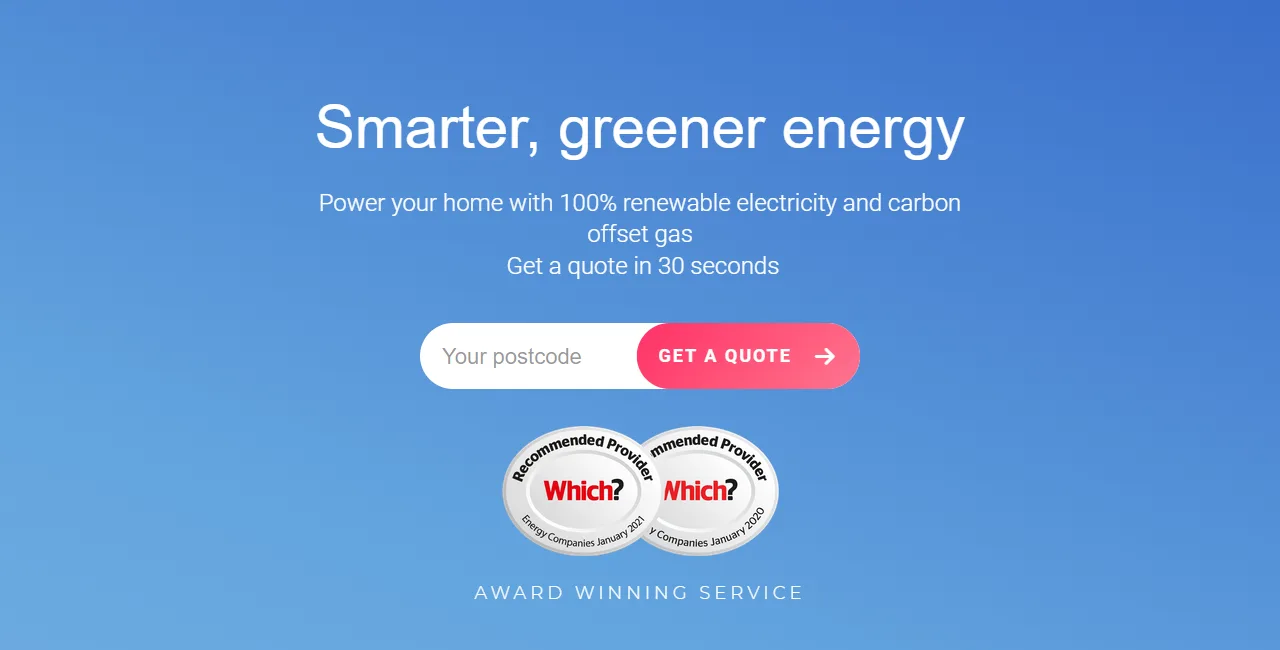
Pure Planet did not sell energy at a markup. It sold energy at what it paid for it, and charged members a fixed monthly membership fee on top. Everything ran through an app, there was no call centre in the usual sense, and the electricity was 100% renewable with the gas carbon offset. Customers were called members, not customers.
On service it worked. It was a Which? Recommended Provider in consecutive years, and the badges were still on the homepage six weeks before the end.
The flaw was the one that caught every supplier in 2021, and the membership model did not protect against it. Selling at cost is only safe if you can reprice when your costs change. The energy price cap set a ceiling on what a domestic supplier could charge, the cost of buying gas went far above it, and a business that had promised to pass its costs through found that it was not allowed to.
What BP did
BP held 24% of Pure Planet and was also its financier and its energy supplier. In March 2017 a BP subsidiary lent the company £10 million at 12% APR. That is a commercial rate with a risk premium attached, not the sort of money a parent lends a subsidiary.
In the autumn of 2021, with wholesale prices climbing and the company losing money on every unit it sold, Pure Planet needed more capital. On 5 October BP declined to provide it, and served a notice of demand for £52.8 million owed as at the end of September.
BP's explanation was that it had "worked hard to avoid this unfortunate outcome" but was "unable to reach a satisfactory solution to the market and policy issues facing Pure Planet", having concluded that it was "no longer commercially viable for BP to continue" the relationship. That is a fair description of a shareholder deciding to stop funding losses. It is also a demand for £52.8 million from a company that plainly could not pay it.
Two explanations, both true
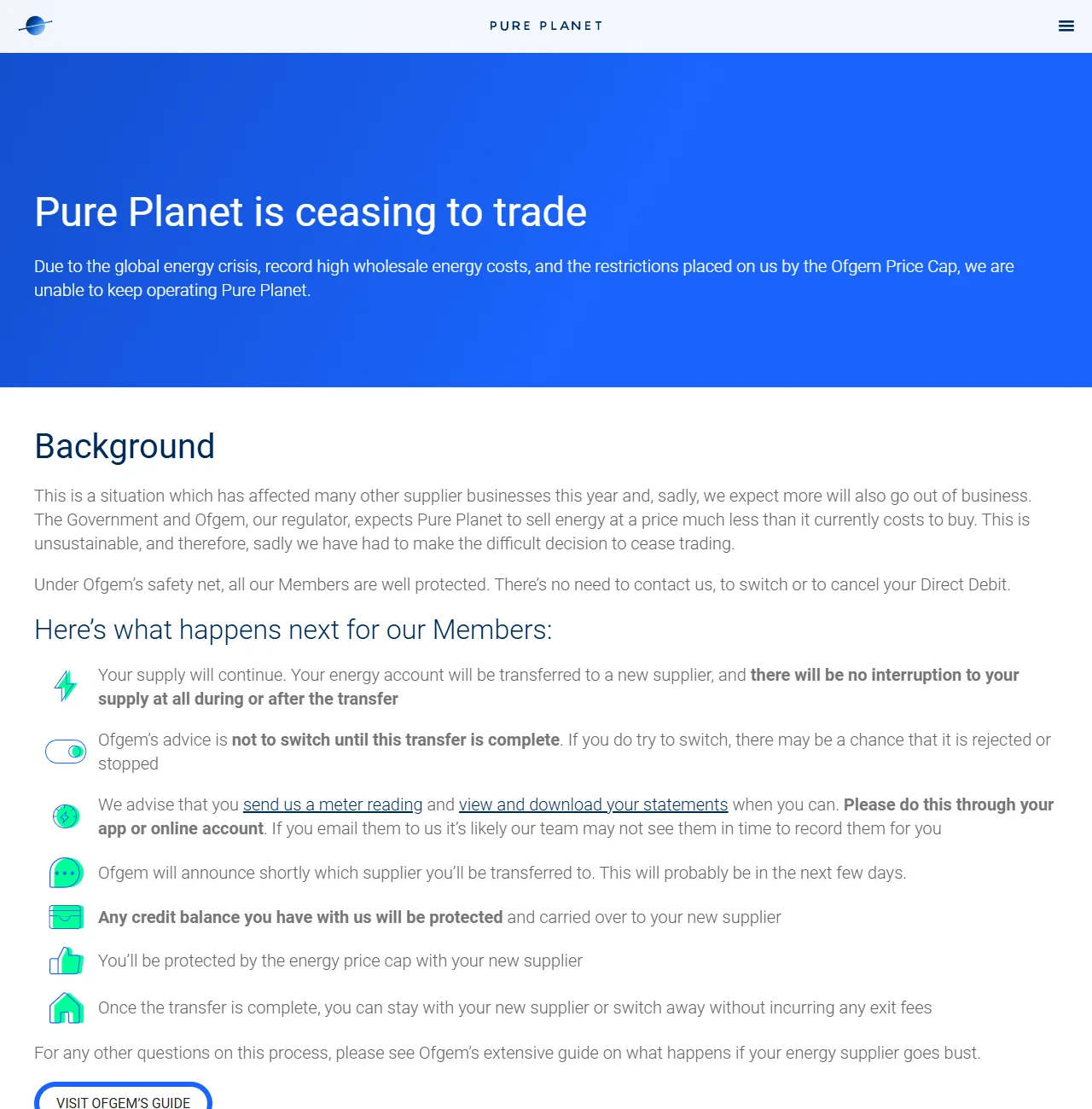
When Pure Planet told its members what had happened, it put it like this: "Due to the global energy crisis, record high wholesale energy costs, and the restrictions placed on us by the Ofgem Price Cap, we are unable to keep operating Pure Planet." It went further in the detail: "The Government and Ofgem, our regulator, expects Pure Planet to sell energy at a price much less than it currently costs to buy. This is unsustainable."
BP is not mentioned anywhere in that notice.
Both accounts are accurate and they answer different questions. The price cap is why the business could not be saved: no amount of funding makes selling below cost work indefinitely. BP's demand is why it ended on 13 October rather than later. A supplier in that position survives exactly as long as somebody is willing to keep funding it, and the decision to stop belongs to the shareholder, not the regulator.
Key dates
| Date | What happened |
|---|---|
| 17 August 2015 | Incorporated as Tulip Energy Supply Limited |
| March 2017 | Renamed Pure Planet; a BP subsidiary lends it £10 million at 12% APR |
| 2017 | Launches in Bath, selling energy at cost plus a monthly membership fee |
| 5 October 2021 | BP declines further funding and serves a demand for £52.8 million |
| 13 October 2021 | Pure Planet ceases trading |
| 17 October 2021 | Ofgem appoints Shell Energy Retail for Pure Planet, Daligas and Colorado Energy, around 252,000 domestic customers between them |
| 30 April 2025 | Pure Planet Limited is dissolved |
What it means for a business
Pure Planet sold to households only. Its navigation carried tariffs, smart meters, boiler care, electric vehicles and Warm Home Discount, which is a domestic scheme, and its hero line was "power your home". The roughly 600 non-domestic customers in Ofgem's combined announcement belonged to the two suppliers that failed alongside it, and Daligas is where that story sits.
What carries across is the funding point. Business contracts run for two, three, sometimes five years, which means you are making a longer bet on your supplier's solvency than any household does. The things that decide whether a supplier is still there in year three are its access to capital and the willingness of whoever stands behind it to keep providing it, and neither appears on a quote.
If it does go, your position is worse than a household's, because the protections Pure Planet's members relied on were written for households:
| When a supplier fails | Household | Business |
|---|---|---|
| Supply continues | Yes | Yes |
| Credit balance protected by Ofgem | Yes | No |
| Price cap limits the rate you move to | Yes | No |
| Exit fee to leave afterwards | None | None |
| Free to agree new terms immediately | Yes | Yes |
Where to start
- Business electricity rates per unit as they stand, plus the standing charge
- What commercial gas costs now
- Suppliers currently writing business contracts
If you were moved and never agreed terms, see how deemed rates are set and how to leave one. For the suppliers that failed alongside Pure Planet, see Daligas; for the other large collapses of that autumn, Avro Energy and Bulb Energy.
Pure Planet FAQs
What happened to Pure Planet?
Why did Pure Planet fail?
Did BP own Pure Planet?
How many customers did Pure Planet have?
Who took over Pure Planet customers?
Did Pure Planet supply businesses?
What was Pure Planet’s membership model?
Sources
- Ofgem, Ofgem appoints Shell Energy Retail Limited to take on customers of Pure Planet Limited, Daligas Limited and Colorado Energy Limited, 17 October 2021, for the combined customer figures and credit balance protection
- MoneySavingExpert, Pure Planet and Colorado Energy cease trading, October 2021, for the per supplier customer numbers
- Companies House, Pure Planet Limited, company number 09735688, for the incorporation, renaming and dissolution
- The company's own closing notice, as archived at purepla.net on 13 October 2021