

Eversmart asked its customers to pay for a whole year of energy before they used any of it, and told them the money would earn more sitting in their energy account than in an ISA. Eleven months after that tariff launched, the High Court declared the company unable to pay its debts.
Nothing else on this record puts the question so sharply. If you hand a supplier a year of your money in advance and it collapses, what happens to it? For Eversmart's households the answer turned out well. The reasons it turned out well are worth understanding, because they do not apply to everyone.
What happened to Eversmart Energy?
Eversmart Energy was a Manchester supplier, trading from Empress Business Park on Chester Road and describing itself on its own site as "a family-run energy business set up to take better care of people". It ceased trading on Friday 6 September 2019.
What followed is unusually well documented, because the paperwork survives. On 9 September the High Court declared the company unable to pay its debts within the meaning of the Insolvency Act 1986. Ofgem issued a notice revoking its electricity supply licence the same day, and that revocation took effect at one minute past midnight on 11 September. Utilita Energy, appointed through Ofgem's supplier of last resort process, began supplying the customers from that moment. Two days later, on 13 September, Andrew Stone and Will Wright of KPMG were appointed joint administrators, and 41 Eversmart staff were kept on to help move the customers across.
Ofgem recorded the book as around 29,000 domestic customers and a very small number of business customers. The administrators' own announcement referred to around 35,300 customers. We have not found anything published that reconciles the two figures, so this page uses Ofgem's.
The tariff that asked for a year in advance
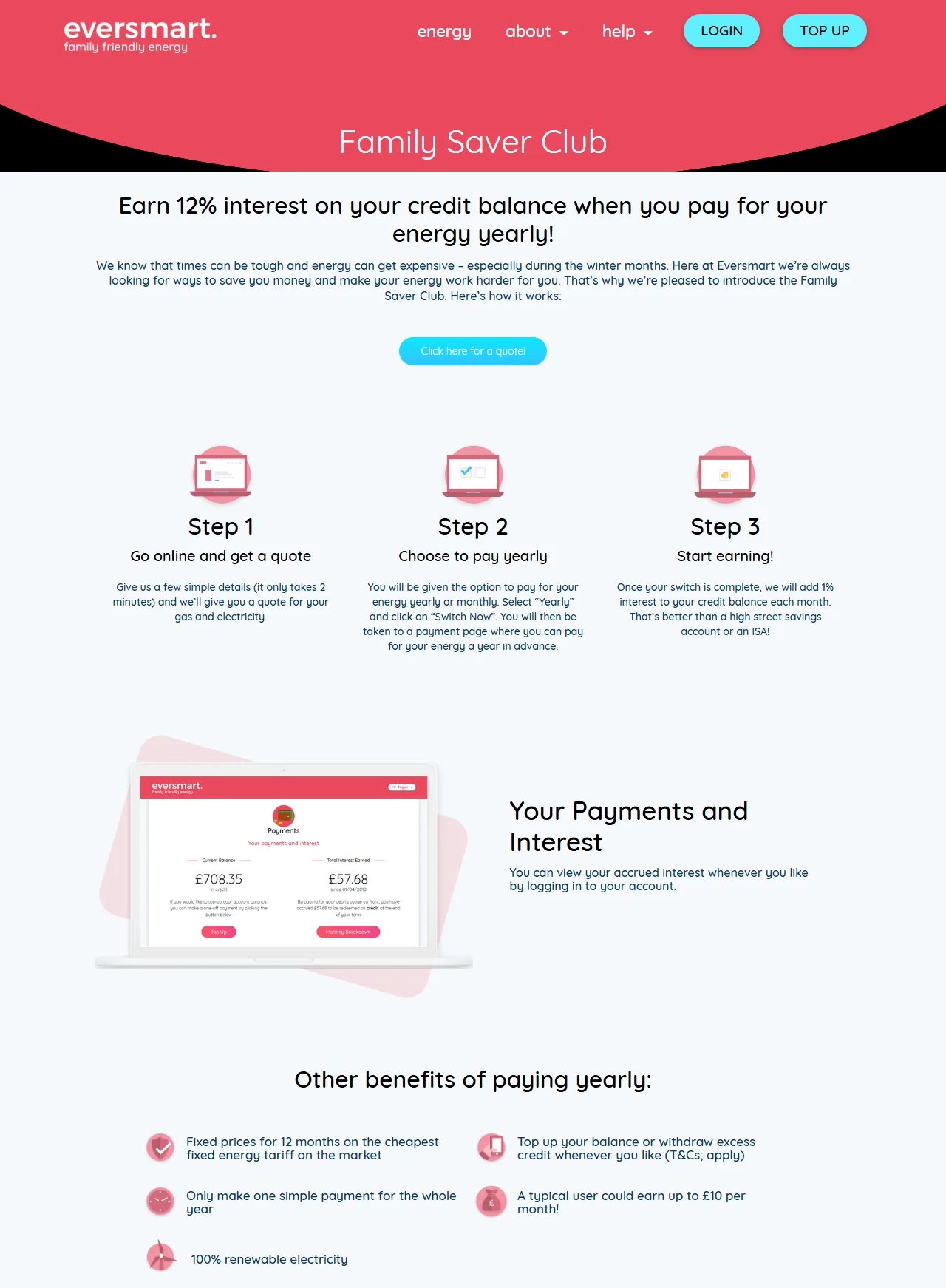
On 29 October 2018, Eversmart launched what it called the Family Saver Club. The pitch was simple: pay for twelve months of energy in one payment, and Eversmart would add 1% interest to whatever was left of that balance every month.
The Family Saver page carried the offer in Eversmart's own words. Its headline was "Earn 12% interest on your credit balance when you pay for your energy yearly!", and the third of its three steps explained what that meant and why a customer should want it: "Once your switch is complete, we will add 1% interest to your credit balance each month. That's better than a high street savings account or an ISA!"
The amount asked for was not small. Eversmart's launch announcement gave the figure for a typical dual fuel household in Greater Manchester as £973, based on Ofgem averages correct as of October 2018. That was the opening payment, taken at the point of switching, before a single unit of gas or electricity had been supplied.
Three other features of the business pointed the same way. Customers could withdraw accrued interest every six months or leave it in as credit. A referral scheme paid credit rather than cash, with the site noting that twenty referrals would cover a year's energy. And a feature called Volt let customers transfer credit from their account to a friend or relative who was also with Eversmart. Taken together, the energy account was being presented as something close to a current account with a good rate on it.
The tariff did not last. It drew attention from elsewhere in the industry, and Utility Week reported that Eversmart pulled it from sale after feedback from stakeholders, describing the withdrawal as temporary and leaving existing customers on it unless they chose to move. MoneySavingExpert reported at the time of the collapse that the concern had been raised with Ofgem and the tariff had since been withdrawn. We have not been able to read a regulatory document directing its withdrawal, and do not suggest there was one.
By the time the Internet Archive captured the Eversmart homepage on 23 August 2019, two weeks before the end, the Family Saver Club had gone from the site completely. The pitch had become green energy, free boiler cover and a free smart meter.
What 12% interest actually came to
The headline said 12%. It is worth doing the arithmetic, because the answer is roughly half that, and you can check it against Eversmart's own published figures without taking anyone's word for it.
The rate was 1% a month, but it was applied to the balance that was left, and that balance fell every month as energy was drawn against it. Pay £973 in month one and you earn 1% of £973. By the middle of the year roughly half has been used, so you earn 1% of about half. By month twelve there is very little left to pay interest on.
Eversmart published both ends of that calculation itself. Its Family Saver page advertised "A typical user could earn up to £10 per month!", which is 1% of the opening £973 and therefore the first month. Its launch announcement said the same typical household "could make around £60 in interest across the year". Sixty pounds on £973 handed over is about 6% of the money, not 12%.
To be fair to Eversmart, none of this was concealed. The mechanism was stated plainly on the same page as the headline, and both numbers came from the company. The 12% was an accurate description of the monthly rate annualised, and a poor description of the return on the sum actually handed over. That distinction is the thing to carry away from it, and it applies well beyond energy.
| Eversmart’s own published figures | Amount |
|---|---|
| Paid up front by a typical dual fuel household | £973 |
| Advertised rate | 1% a month, described as 12% a year |
| Interest in the first month, on the full balance | Up to about £10 |
| Interest over the whole year | Around £60 |
| Return on the sum handed over | About 6% |
What happened to the money
This is the part that matters, and the news is good for households.
Ofgem's safety net protects the credit balances of domestic customers when a supplier fails. Announcing the Eversmart collapse, Philippa Pickford, then Ofgem's director for future retail markets, put it as plainly as the regulator ever does: "Eversmart Energy customers do not need to worry, as under our safety net we'll make sure your energy supplies are secure and domestic customers' credit balances are protected."
Utilita then went further than the guarantee required. It agreed to honour outstanding final credit balances for former Eversmart customers as well as current ones, which the safety net does not oblige an incoming supplier to do. People who had already left Eversmart and were still owed money were covered too.
So a household that had paid £973 the previous autumn and still had several hundred pounds sitting in its account in September 2019 did not lose it. What they lost was time, and in this case a fair amount of it: the administrators were working through the records of a company that had just stopped, and final balances were settled at that pace rather than the customer's. The same lag shows up on the Extra Energy page, where final statements were still being issued the summer after the collapse.
The wider lesson is the one running through this whole record, and it is the reason the Family Saver Club ended better than it might have. The protection is not a promise from the supplier. It is a rule that applies because the supplier failed. For more on what happens to a payment made shortly before a collapse, see how OneSelect's direct debits were treated.
Key dates
| Date | What happened |
|---|---|
| 29 October 2018 | The Family Saver Club launches, asking for a year of energy up front at 1% interest a month |
| November 2018 | Ofgem requires Eversmart to clear £367,150 of outstanding Renewables Obligation by 31 March 2019 in monthly instalments. Eversmart pays |
| 23 August 2019 | The Family Saver Club no longer appears anywhere on the Eversmart website |
| 6 September 2019 | Eversmart ceases trading with around 29,000 domestic customers and a very small number of business customers |
| 9 September 2019 | The High Court declares the company unable to pay its debts. Ofgem issues notice revoking its electricity supply licence and appoints Utilita Energy |
| 11 September 2019 | The licence revocation takes effect at 00:01 and Utilita begins supplying the customers |
| 13 September 2019 | Andrew Stone and Will Wright of KPMG appointed joint administrators. 41 staff retained to support the transfer |
| 18 December 2024 | Eversmart Energy Limited dissolved |
One detail in that table deserves pulling out, because it cuts the other way. In November 2018 Ofgem gave Eversmart notice to clear £367,150 of outstanding Renewables Obligation payments by the end of March 2019, in monthly instalments, and Eversmart cleared it. URE Energy, given an equivalent notice at the same time for £209,013.78, did not pay and was issued a final order. Many of the companies on this record left scheme payments unpaid when they went. Eversmart did not.
The old website is not Eversmart any more
A practical warning, because people still search for this company.
The eversmartenergy.co.uk address no longer has anything to do with the energy supplier. By October 2020 it was being used for an unrelated site publishing payday loan, logbook loan and short term credit content under a similar name. We are not linking to it. If you are chasing a balance or a final bill from Eversmart, the old website is not the route and nothing on it is connected to your account.
Anything still outstanding runs through Utilita, which took on the customers, or through the administrators of Eversmart Energy Limited. The company itself was dissolved in December 2024.
What it means for a business
Eversmart sold to households. Its branding was "family friendly energy", its flagship product was called the Family Saver Club, and its website carried no business or commercial section at any point we can find in the archive.
Even so, Ofgem recorded "a very small number of business customers" on the book when it failed, which is a reminder that small firms end up on domestic-facing suppliers more often than those suppliers' marketing suggests. If that was you, the position was materially worse, and it is worth being precise about why.
Ofgem's statement on Eversmart protected domestic credit balances. That is the whole scope of the guarantee, and it has never covered non-domestic accounts. A business sitting in credit when its supplier collapses depends entirely on what the incoming supplier agrees to absorb, which is settled case by case and usually not published at all. Utilita's commitment covering former as well as current customers was a decision it took, not an obligation it inherited.
The only case on this site where such an arrangement was actually published is Rutherford Energy, where the incoming supplier agreed to honour money owed up to a total of £100,000 across the entire customer book, and not at all for accounts already closed.
Which gives a business a simple rule that Eversmart's tariff inverted: there is no version of paying a year ahead that is worth the discount, because the discount is small and the exposure is total.
| Paying a supplier in advance | Household | Business |
|---|---|---|
| Credit balance guaranteed if the supplier fails | Yes, by Ofgem | No |
| Former customers still owed money | Only if the new supplier agrees | Only if the new supplier agrees |
| Who decides whether you are repaid | Ofgem’s safety net | The incoming supplier, case by case |
| How long a final balance takes | Often months | Often months |
Where to start
- Business electricity prices as they stand today, including the standing charge
- What commercial gas is costing now
- Which suppliers are taking on new business customers
If you were moved to a new supplier without agreeing anything, read what a deemed contract is and what it costs. For the failure that followed this one five weeks later, see Toto Energy.
Eversmart Energy FAQs
What happened to Eversmart Energy?
I paid Eversmart a year of energy in advance. Did I lose it?
What was the Family Saver Club?
Did customers really earn 12% on their money?
Did Eversmart Energy supply businesses?
Who took over Eversmart Energy customers?
Is the old Eversmart website still anything to do with the company?
Sources
- Ofgem, Eversmart Energy Ltd: notice of revocation of an electricity supply licence, 9 September 2019
- Ofgem, Eversmart Energy ceases trading and Ofgem appoints Utilita Energy, September 2019
- Energy Ombudsman, Eversmart Energy: advice for affected customers, 13 September 2019
- Eversmart Energy, Family Saver Club, and the launch announcement of 29 October 2018, as captured by the Internet Archive
- Companies House, Eversmart Energy Limited, company number 09310427