

Green Network Energy failed in January 2021 with around 360,000 households and a smaller number of business customers. It was the biggest supplier failure Britain had seen at that point, and it happened eight months before the collapses most people remember.
That timing turned out to be the best thing that ever happened to its customers. EDF took them on and guaranteed them a price decrease against the tariff they were already on, held until at least the end of September 2021. Customers of the suppliers that went under later that year got nothing of the kind. Same regulator, same process, opposite outcome.
What happened to Green Network Energy?
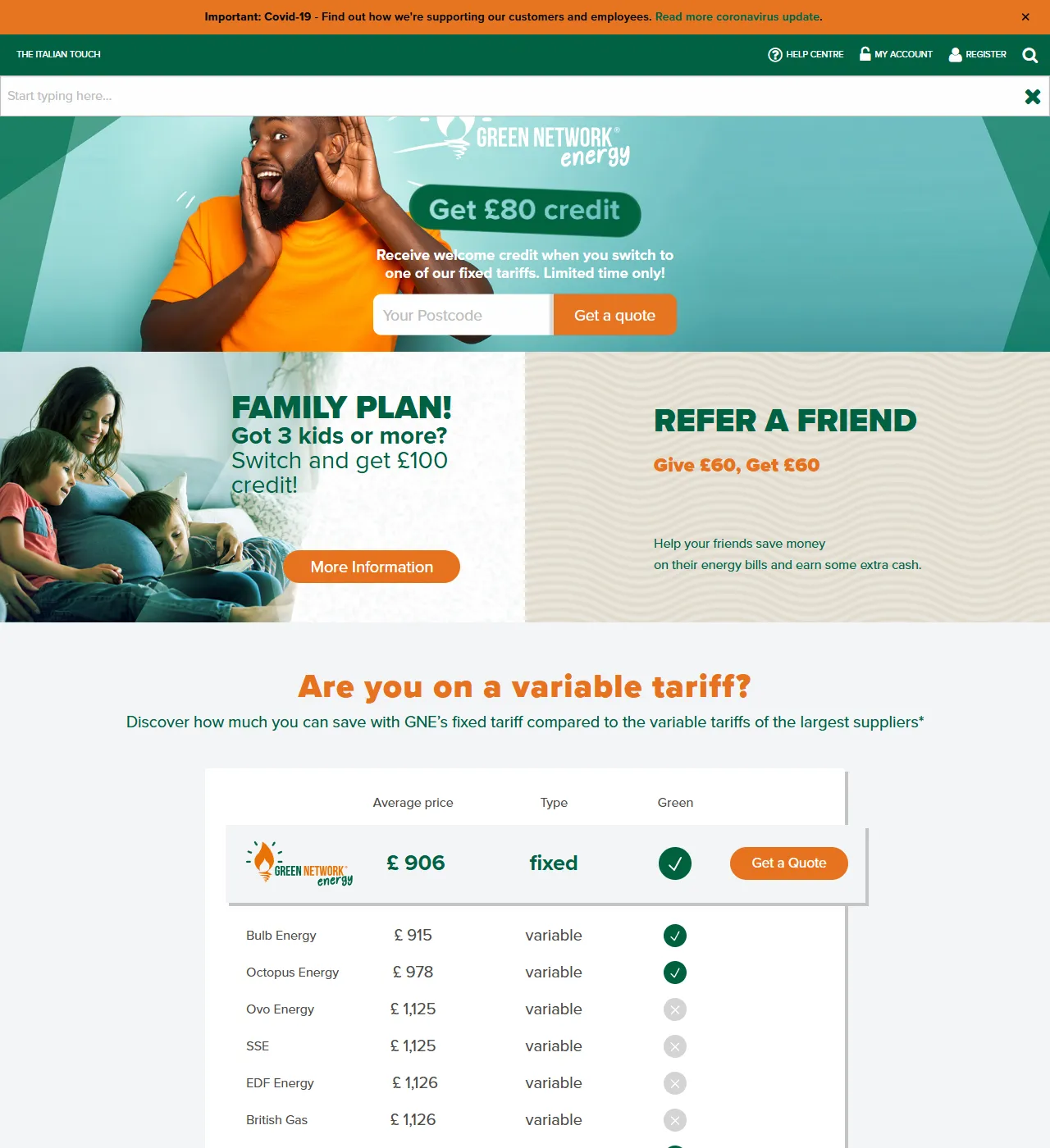
Green Network Energy was the British arm of Green Network, an Italian energy group founded in Rome in 2003. Its UK company, Green Network Energy Limited, was incorporated in April 2015 under the name Zephyr Energy Supply and started supplying here in 2017. The website wore the connection openly: a strip across the top of every page read "THE ITALIAN TOUCH".
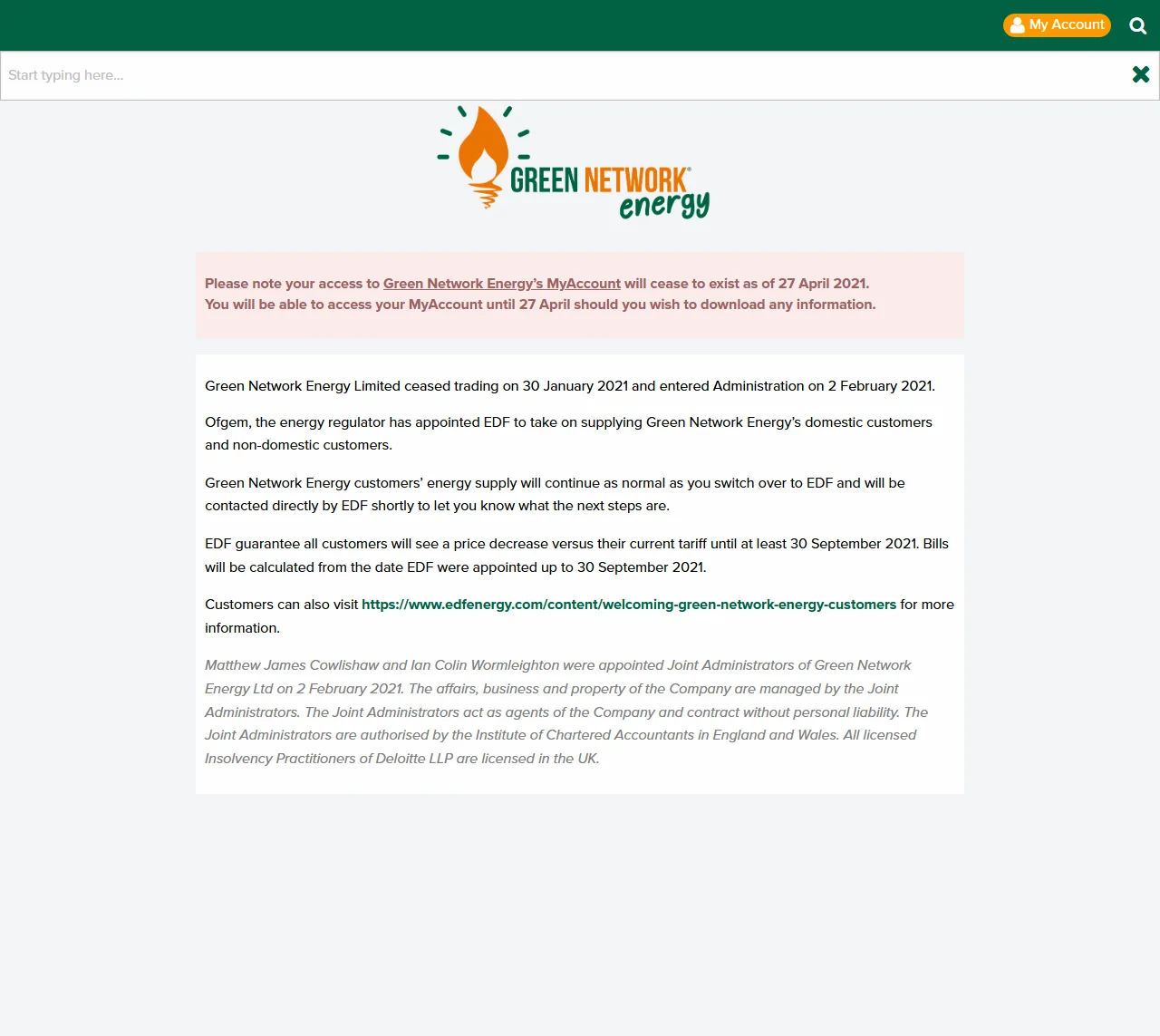
On 27 January 2021 Ofgem announced that Green Network Energy and Simplicity Energy had both ceased trading. Three days later it appointed EDF to take on Green Network's roughly 360,000 domestic customers and a smaller number of non-domestic ones, after what it described as a competitive process. Customers moved on Sunday 31 January. The company entered administration on 2 February, with two licensed insolvency practitioners from Deloitte appointed joint administrators.
One small inconsistency is worth recording rather than smoothing over. Ofgem's announcement of 27 January says the company had ceased trading. The company's own notice, posted later on its website, says it "ceased trading on 30 January 2021", the day EDF was appointed. The dates in the table below give both.
Why it failed
Ofgem does not publish a cause when a supplier goes, and it did not here. What was reported at the time, by Which? among others, was that Green Network Energy had fallen into credit default with Elexon, the body that settles the electricity market. In plain terms it no longer had enough credit cover lodged to keep buying the power and gas its customers were using. Simplicity Energy was in the same position on the same day.
That is a liquidity failure rather than a pricing one, and the screenshot above shows the shape of the business that produced it. Five months before the end it was paying £80 to new customers on sign-up, £100 to families with three or more children, and £60 to each side of a referral, while pricing its fixed tariff below every larger supplier on its own comparison table. Growth bought that way has to be funded from somewhere, and a January cold snap that pushed wholesale prices up sharply was enough to find the limit.
It is worth being clear that this was not the gas crisis. The wholesale spike that destroyed more than two dozen suppliers began in the late summer of 2021. Green Network Energy was gone before any of that started.
What its customers got
Better treatment than almost anyone else on this site.
Supply continued without interruption and customers transferred to EDF on 31 January. Ofgem confirmed that outstanding credit balances would be honoured, including money owed to people who had already left, and that EDF would absorb both those costs and the cost of migrating the accounts. Nobody was charged an exit fee to leave afterwards.
Then the unusual part. EDF did not simply move everyone onto its standard rate. It guaranteed, in the company's own words on its website, that "all customers will see a price decrease versus their current tariff until at least 30 September 2021", with bills calculated on that basis from the date of appointment. A supplier of last resort appointment that leaves you paying less is not how this normally goes.
One group had to act for themselves: customers with solar panels selling power back under the Smart Export Guarantee. Export arrangements do not transfer with supply, and Ofgem advised those customers to find a new SEG licensee promptly.
The luckiest failure of the crisis
Compare that with what the same process delivered nine months later.
When a supplier fails, Ofgem runs a competitive process and appoints whoever offers the best terms for the customers. In January 2021 wholesale prices were normal, the incoming supplier could serve 360,000 extra accounts profitably at a price below what they were paying, and so it did. By the autumn, wholesale gas had multiplied several times over, taking on customers was a loss-making obligation rather than an opportunity, and the appointed suppliers moved people onto deemed and standard rates that rose with the cap.
| What changed | Failed January 2021 | Failed autumn 2021 |
|---|---|---|
| Wholesale market | Normal, with a cold snap | Gas several times its usual price |
| Appetite to take customers on | A book worth having | A cost to be absorbed |
| What customers were moved onto | A guaranteed price decrease | Deemed or standard rates, tracking the cap |
| Domestic credit balances | Honoured | Honoured |
| Exit fees to leave | None | None |
Nothing about the two sets of customers was different. Nothing about the rules was different. The only variable was when their supplier ran out of money, which is not something any of them chose or could see coming.
Key dates
| Date | What happened |
|---|---|
| 1 April 2015 | Incorporated as Zephyr Energy Supply, later renamed Green Network Energy Limited |
| 2017 | Starts supplying in the UK, as the British arm of the Italian Green Network group |
| 27 January 2021 | Ofgem announces that Green Network Energy and Simplicity Energy have ceased trading |
| 30 January 2021 | Ofgem appoints EDF after a competitive process; the company’s own notice gives this as its ceased trading date |
| 31 January 2021 | Around 360,000 domestic customers and a smaller number of non-domestic customers transfer to EDF |
| 2 February 2021 | The company enters administration; joint administrators from Deloitte are appointed |
| 27 April 2021 | Customer access to the company’s online accounts is switched off |
| 30 September 2021 | The end of EDF’s guaranteed price decrease for transferred customers |
What it means for a business
Green Network Energy supplied businesses as well as households, and Ofgem's appointment covered both. But read the wording of what was protected, because it is precise.
Ofgem's announcement says outstanding credit balances would be honoured for "existing and former domestic customers". The company's own notice says EDF guaranteed a price decrease to "all customers". Those two statements cover different things, and only one of them names businesses.
That is the position across every failure documented on this site. Ofgem's safety net protects domestic credit balances. There is no equivalent for a business, and there is no cap limiting what a non-domestic customer can be moved onto:
| When your supplier fails | Household | Business |
|---|---|---|
| Your supply keeps running | Yes | Yes |
| Credit balance protected by Ofgem | Yes | No |
| A price cap limits the new rate | Yes | No |
| Charged an exit fee to leave | No | No |
| Free to agree a new contract straight away | Yes | Yes |
Where to start
- Business electricity prices per unit right now, and the standing charge
- Gas prices for business premises now, on its own separate market
- Suppliers writing non-domestic contracts today
If you were moved by a supplier of last resort and never agreed terms, see how deemed rates work and how to get off one.
For the other end of the same crisis, Avro Energy failed in September 2021 with 580,000 customers, and Bulb was too big for the process altogether.
Green Network Energy FAQs
What happened to Green Network Energy?
Why did Green Network Energy fail?
Did Green Network Energy customers lose money?
Did prices go up for Green Network Energy customers?
Who owned Green Network Energy?
Did Green Network Energy supply businesses?
What happened to solar customers on the Smart Export Guarantee?
Sources
- Ofgem, Ofgem appoints EDF to take on customers of Green Network Energy, and British Gas Evolve to take on customers of Simplicity Energy, 30 January 2021
- EDF, EDF appointed by Ofgem to supply customers of Green Network Energy, 30 January 2021
- Which?, Green Network Energy and Simplicity Energy stop trading, for the Elexon credit default
- Companies House, Green Network Energy Limited, company number 09523066
- The company's own administration notice, as archived at greennetworkenergy.co.uk in April 2021