

Green Supplier Limited, which traded as Green, stopped trading on 22 September 2021 with 255,000 households and a small number of business customers. Shell Energy took them on five days later.
What makes it worth reading is that its chief executive had explained exactly why it was going to happen, in public, about a week before it did. Green was hedged for roughly 60% of its customers and was not allowed to reprice the rest. "We just don't have deep enough pockets to ride out this storm," he said. He was right, and the arithmetic he described is the same arithmetic that took more than two dozen suppliers that autumn.
What happened to Green?
Green Supplier Limited was incorporated on 1 November 2017 as Green Energy Supply and traded under the name Green, styled in lower case with a full stop. It sold to households and, in smaller numbers, to businesses.
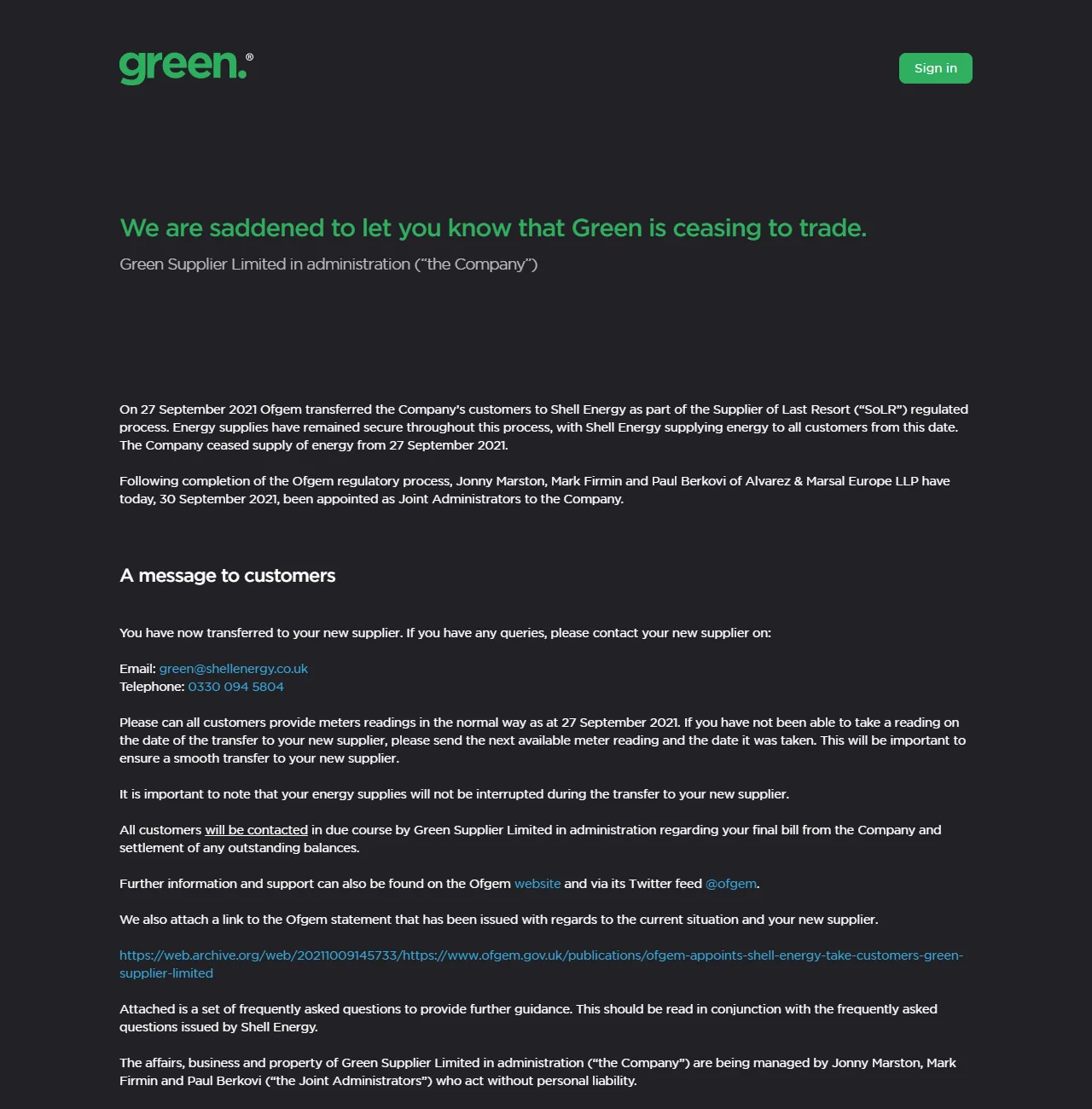
It ceased trading on 22 September 2021. Ofgem ran its competitive process and appointed Shell Energy, which began supplying every account on 27 September. The company's own notice puts it precisely: "On 27 September 2021 Ofgem transferred the Company's customers to Shell Energy as part of the Supplier of Last Resort regulated process... The Company ceased supply of energy from 27 September 2021."
Three days after that, on 30 September, joint administrators from Alvarez & Marsal were appointed. The company remains in liquidation.
It said so itself, a week early
In the days before it failed, Green's chief executive Peter McGirr said publicly that small suppliers were unlikely to get through the winter without government intervention. He set out the company's position plainly: Green was hedged in the wholesale market for about 60% of its customers, the ones on fixed tariffs, and was "curtailed by the regulator Ofgem" from raising variable tariffs for the remainder.
Then the line that sums up the whole of 2021: "We just don't have deep enough pockets to ride out this storm."
Suppliers do not usually narrate their own collapse this accurately in advance. Most of the notices collected on this site were written after the fact and describe the energy crisis in general terms. This one named the mechanism, the proportion and the missing ingredient before any of it had happened.
Why hedging did not save it
Hedging is buying your energy in advance so that you know what it costs before you sell it. A supplier that has hedged is protected from prices rising, which is why "we were hedged" is often offered as a sign of prudence.
The protection only covers what you actually bought, though. Green had bought ahead for the customers on fixed tariffs, roughly 60% of its book. The other 40% were on variable tariffs, where the energy had not been bought in advance and the price charged was limited by the energy price cap. When wholesale costs went far above the cap, every one of those accounts lost money on every unit, and there was no lever to pull.
| What differs | The hedged 60% | The unhedged 40% |
|---|---|---|
| Tariff type | Fixed | Variable |
| Energy bought in advance | Yes, at pre-crisis prices | No |
| Price chargeable to the customer | Fixed by the contract | Limited by the energy price cap |
| Effect of wholesale prices rising | Absorbed by the hedge | A loss on every unit sold |
What its customers got
Supply was uninterrupted and customers moved to Shell Energy on 27 September. Ofgem confirmed that Shell would "honour domestic credit balances for both current and past customers of Green who are owed money", and nobody was charged an exit fee for leaving afterwards.
Ofgem's guidance states that commitment for domestic customers. It says nothing about what happens to the credit balances of the non-domestic customers who transferred at the same time, which is the standard position rather than an oversight: the safety net has never covered business balances.
Key dates
| Date | What happened |
|---|---|
| 1 November 2017 | Incorporated as Green Energy Supply, later renamed Green Supplier Limited |
| September 2021 | Chief executive Peter McGirr warns publicly that small suppliers will not survive the winter without intervention |
| 22 September 2021 | Green ceases trading |
| 27 September 2021 | Ofgem transfers 255,000 domestic customers and a small number of non-domestic customers to Shell Energy |
| 30 September 2021 | Joint administrators from Alvarez & Marsal are appointed |
What it means for a business
Green had business customers, though Ofgem recorded only "a small number" and published no figure. They transferred to Shell Energy with everybody else, and with no stated protection for anything they were owed.
The hedging point is the one that matters for a commercial contract. When you sign a fixed price for two or three years, you are relying on the supplier having bought that energy forward, and on it staying solvent long enough to deliver it. The first part is usually true. The second depends on the rest of its book, which you cannot see.
If it does fail, the position is the one that applies to every supplier on this site:
| When your supplier fails | Household | Business |
|---|---|---|
| Supply continues | Yes | Yes |
| Credit balance honoured by the new supplier | Yes, confirmed by Ofgem | Not stated |
| A price cap limits the rate you move to | Yes | No |
| Exit fee to leave afterwards | None | None |
Where to start
- Business electricity prices per unit at the moment, with the standing charge
- What gas costs for commercial premises
- Suppliers writing non-domestic contracts right now
If a transfer left you on a rate you never agreed, see what deemed contracts are and how to move off them. For the other large collapses of that month, see Avro Energy and People's Energy.
Green Supplier FAQs
What happened to Green energy supplier?
Why did Green fail?
Did Green customers lose money?
Did Green supply businesses?
Was Green one of the suppliers that failed to pay its Renewables Obligation?
What does it mean that a supplier is hedged?
Who took over Green customers?
Sources
- Ofgem, Green Supplier Limited customers: your questions on new supplier Shell Energy, for the customer numbers, dates and credit balance wording
- S&P Global Commodity Insights, Small UK energy suppliers unlikely to survive winter without state intervention: Green Energy CEO, September 2021
- Ofgem, Ofgem orders seven suppliers to pay £17.9m in unpaid Renewables Obligations payments, 29 October 2021
- Companies House, Green Supplier Limited, company number 11042716
- The company's own administration notice, as archived at green.energy in October 2021