

People's Energy was crowdfunded by 2,059 ordinary people who put in £487,815 between them, on a promise that three quarters of any profit would go back to customers. It ceased trading on 14 September 2021 with 350,000 households and 1,000 businesses on its books.
Moving those customers to British Gas cost £282,586,424.01, a figure Ofgem consented to three months later. That money did not come from the company or its founders. It came from everybody else, through the charges that end up on every energy bill in the country. No other failure on this list sets out quite so plainly who carries the cost when a supplier goes.
What happened to People’s Energy?
People's Energy was founded in 2017 by David Pike and Karin Sode and run from Shawfair, just outside Edinburgh. It got its Ofgem licence and launched that August, selling 100% renewable electricity to households and, later, to a small number of businesses.
On 14 September 2021 it announced it was ceasing to trade. Ofgem ran its competitive process and appointed British Gas, and customers transferred on 19 September. Around 300 staff lost their jobs, roughly 200 at Shawfair and Musselburgh and another 100 in Selkirk in the Scottish Borders.
The cause was the one that took more than two dozen suppliers that autumn: wholesale gas multiplied in price while the price cap held down what could be charged to customers, so every unit sold lost money.
What it promised
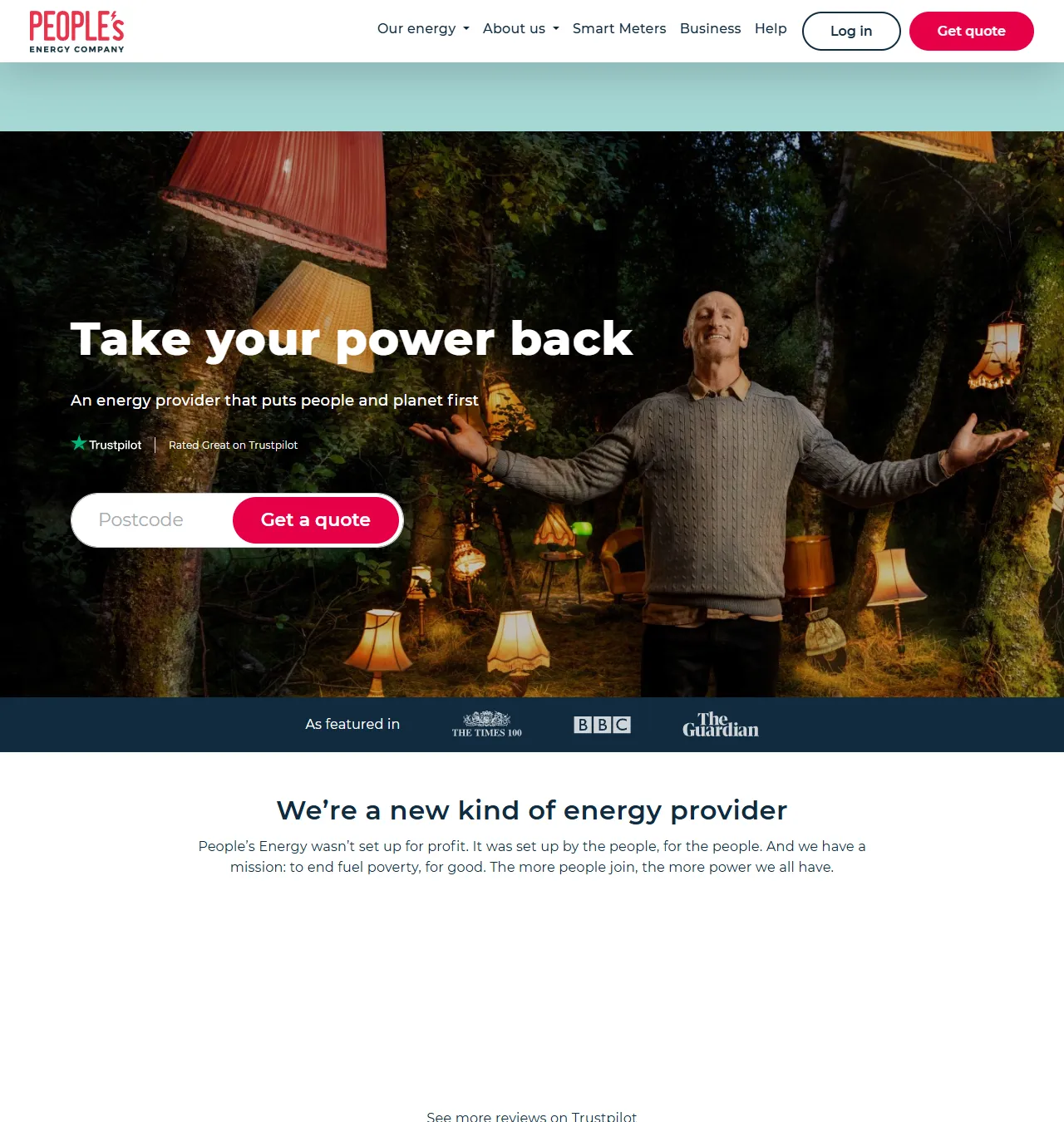
The pitch was unusual and, on its own terms, sincere. People's Energy was not set up to make its founders rich. It was set up to be owned in part by the people who used it, to give three quarters of its profits back to customers, and to do something about fuel poverty. Its own homepage said so in as many words.
In 2017 it raised £487,815 from 2,059 supporters over 199 days. These were not institutional investors. They were members of the public putting in a few hundred pounds each because they liked the idea.
By 2021 it had 351,000 customers, a Trustpilot rating it advertised on the homepage, and coverage in The Times, the BBC and The Guardian. On the numbers that is a successful challenger. What it did not have was the balance sheet to survive a wholesale market that quadrupled.
The data breach
Nine months before it failed, People's Energy lost its entire customer database.
On 16 December 2020 it discovered that an unauthorised third party had accessed a system holding member data. Every one of its then 270,000 customers was affected. The stolen records included names, addresses, phone numbers, email addresses, dates of birth, account numbers, tariff details, and gas and electricity meter identification numbers. Passwords were not taken. The company shut down the affected systems and notified the Information Commissioner's Office and Ofgem.
For a business the meter numbers are the part that matters. An MPAN for electricity or an MPRN for gas identifies a specific supply point, and together with a company name and address they are most of what somebody needs to sound convincing on the phone about your energy account. Anyone who was a customer then should still treat unexpected approaches about their supply with suspicion.
Who paid for it
When a supplier fails, the company that takes on its customers does not do it for nothing. It inherits customers on tariffs below what the energy now costs, it honours their credit balances, and it carries the working capital. It then claims that back from Ofgem as a Last Resort Supply Payment.
British Gas submitted its claim on 6 December 2021 and Ofgem consented on 17 December to a payment of up to £282,586,424.01. That covered unrecoverable wholesale costs, customer credit balances, working capital and the cost of onboarding and migrating the accounts.
Those payments are made by the gas and electricity network operators, who recover them through the charges they levy on suppliers, who in turn recover them from their customers. So the cost was mutualised: spread across the bills of households and businesses across Britain, almost none of whom had ever been customers of People's Energy.
| Detail | Put in | Paid out |
|---|---|---|
| Amount | £487,815 | £282,586,424.01 |
| By whom | 2,059 members of the public, in 2017 | Every energy customer in Britain, through network charges |
| For what | Shares in a new supplier | Moving 351,000 customers to British Gas |
| Decided by | The people who chose to back it | Nobody who paid it |
There is a postscript that is worth stating accurately rather than for effect. In July 2022 Bloomberg reported that the founders stood to receive more than £50 million from the administration, because once a company's creditors are satisfied any surplus belongs to its shareholders, and that they would not be liable for the cost of transferring their customers. David Pike said three quarters of any payout was committed to fuel poverty causes through a community interest company, which is the same 75% split the company was built on, with the remaining quarter going to him and Karin Sode. On the collapse itself he said: "It was absolutely heart-breaking seeing PEC go into administration."
Nothing about that was against the rules. It is simply how insolvency ranking works, and it is unusual only because most failed suppliers leave nothing over. The uncomfortable part is structural: the people who backed the company and the people who paid the £282 million were not the same people, and neither group was asked.
Key dates
| Date | What happened |
|---|---|
| 31 July 2017 | Crowdfunding closes, having raised £487,815 from 2,059 supporters over 199 days |
| August 2017 | Licensed by Ofgem and begins supplying |
| 16 December 2020 | Discovers a data breach affecting all 270,000 customers; ICO and Ofgem notified |
| 14 September 2021 | Announces it is ceasing to trade; around 300 staff are made redundant |
| 19 September 2021 | 350,000 domestic and 1,000 non-domestic customers transfer to British Gas |
| 17 December 2021 | Ofgem consents to a Last Resort Supply Payment of up to £282,586,424.01 |
| July 2022 | Bloomberg reports the founders could receive more than £50 million from the administration |
What it means for a business
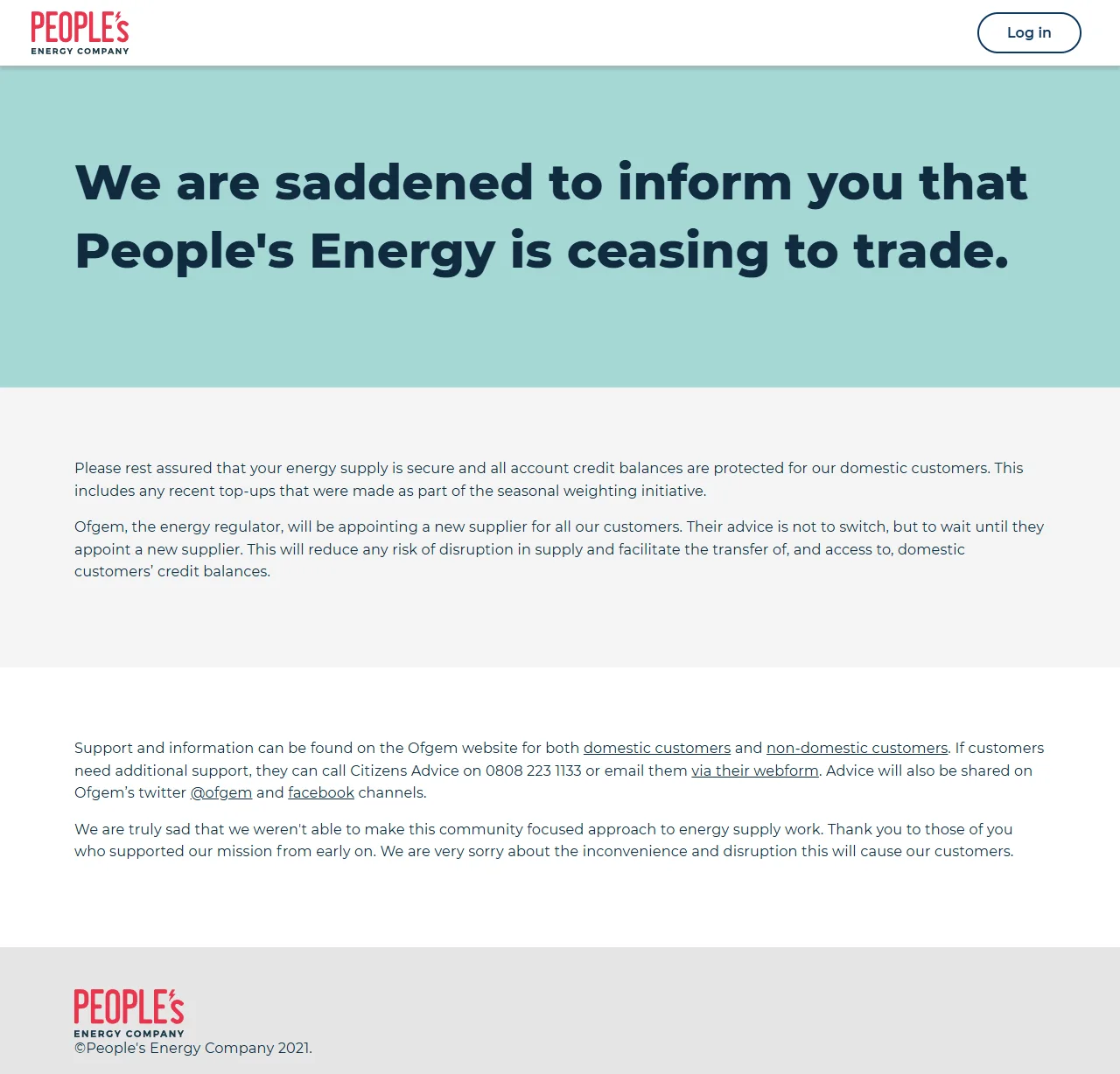
A thousand businesses were supplied by People's Energy when it failed, and the company's own closing notice shows exactly where they stood. It is worth reading the wording.
"Please rest assured that your energy supply is secure and all account credit balances are protected for our domestic customers", it said. Then, further down: "Support and information can be found on the Ofgem website for both domestic customers and non-domestic customers", with a link to each.
Households were told their money was safe. Businesses were given a link. That is not a criticism of People's Energy, which was accurately describing the rules: Ofgem's safety net covers domestic credit balances and has never covered non-domestic ones. British Gas's own commitment, in Ofgem's guidance, was to honour credit balances "for both current and past domestic customers". No equivalent was stated for the 1,000 businesses.
| When your supplier fails | Household | Business |
|---|---|---|
| Supply continues | Yes | Yes |
| Credit balance protected by Ofgem | Yes | No |
| A cap limits the rate you are moved to | Yes | No |
| Exit fee charged to leave afterwards | No | No |
| Free to agree a new contract immediately | Yes | Yes |
Where to start
- What business electricity costs per unit today, with the standing charge
- Gas prices for commercial supply points
- The suppliers quoting for business contracts now
If you were transferred and never agreed terms, read how a deemed rate works and how to leave it. For the other large failures of that autumn, see Avro Energy and Bulb Energy.
People’s Energy FAQs
What happened to People’s Energy?
Did People’s Energy customers lose money?
What happened to the people who crowdfunded it?
How much did the failure cost?
What was the People’s Energy data breach?
Did People’s Energy supply businesses?
Was People’s Energy really owned by its customers?
Sources
- Ofgem, People's Energy customers: your questions on new supplier British Gas, for the customer numbers and the credit balance wording
- Ofgem, British Gas Trading Limited, Last Resort Supply Payment notice of reasons, for the £282,586,424.01
- IT Pro, People's Energy data breach affects all 270,000 customers, December 2020
- Daily Business, Founders of failed energy firm 'in line for £50m', July 2022, reporting Bloomberg's research
- The company's own closing notice, as archived at peoplesenergy.co.uk on 14 September 2021