

Together Energy ceased trading on 18 January 2022 with around 176,000 households, and British Gas was appointed to take them on. It was the first UK supplier to fail that year and the last substantial casualty of the energy crisis.
It is also the strangest entry on this list, because three years earlier Ofgem had chosen Together Energy as the safe pair of hands for somebody else's failed supplier, and a local council had bought half of it with public money. The company that rescued others ended up needing rescuing itself.
What happened to Together Energy?
Together Energy was a Scottish supplier, incorporated in April 2016 and run from Glasgow. It sold to households, and by the end it had about 176,000 of them.
On 18 January 2022 Ofgem announced it had ceased trading, and appointed British Gas to take on its customers through the usual competitive process. Supply continued without interruption, domestic credit balances were protected under Ofgem's safety net, and nobody was charged an exit fee to leave afterwards.
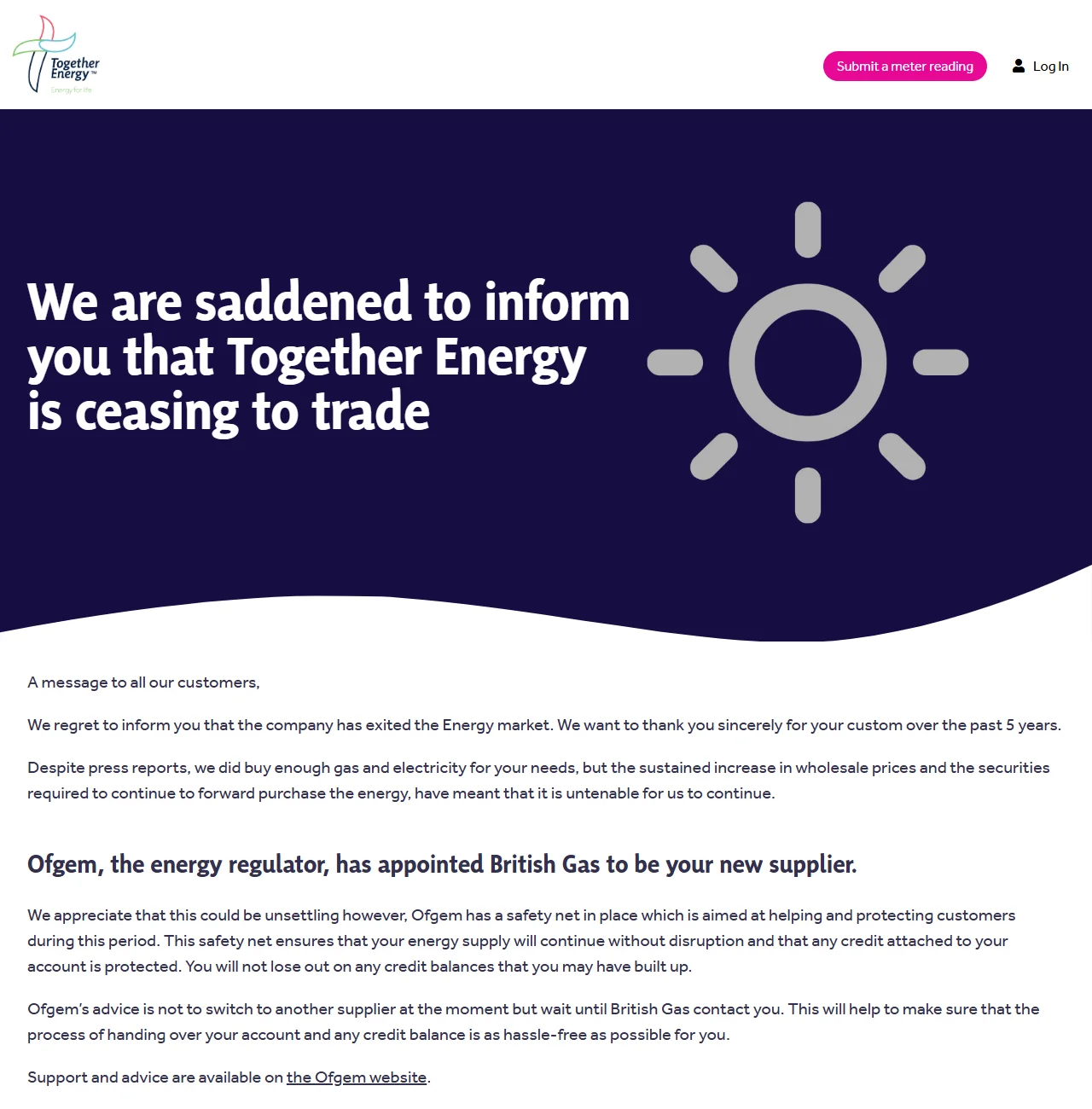
The company's own notice to customers put the cause in its own words, and pushed back at the coverage while it was at it: "Despite press reports, we did buy enough gas and electricity for your needs, but the sustained increase in wholesale prices and the securities required to continue to forward purchase the energy, have meant that it is untenable for us to continue."
That phrase, "the securities required to continue to forward purchase", is the crux. Buying energy ahead of time means lodging collateral, and the amount of collateral rises with the price. A supplier can be selling energy profitably and still be unable to post the security needed to keep buying it.
It was the rescuer first
In December 2018, OneSelect ceased trading with about 36,000 customers. Ofgem ran its competitive process and picked Together Energy to take them on. Those customers moved across on 14 December, on a tariff Ofgem described as competitive, and Together honoured all their outstanding credit balances, including money owed to people who had already left.
In September 2020 it did something similar commercially, buying the Bristol Energy brand and around 155,000 residential meter points for £14 million from Bristol Energy, the council-owned supplier that was being wound down after costing Bristol City Council tens of millions.
So a large share of Together Energy's book had already survived one supplier's collapse before it arrived. Then it went through a second one.
| Book | How it reached Together Energy | Where it went next |
|---|---|---|
| OneSelect, ~36,000 customers | Ofgem appointed Together Energy as supplier of last resort, December 2018 | British Gas, January 2022 |
| Bristol Energy, ~155,000 meter points | Bought commercially for £14 million, September 2020 | British Gas, January 2022 |
| Together Energy’s own customers | Signed up directly | British Gas, January 2022 |
The council that owned half of it
In 2019 Warrington Borough Council paid £18 million for a 50% stake in Together Energy. It is the same idea that produced Robin Hood Energy in Nottingham and Bristol Energy in Bristol: a council putting money into an energy supplier, partly as an investment and partly to do something about fuel poverty. Warrington took the slightly different route of buying into an existing private company rather than starting one.
The council's exposure went beyond the equity. According to the administrators' report from FRP Advisory, as reported locally, Warrington had provided loan facilities of £20.25 million, of which £18.8 million had been drawn by the time administrators were appointed, and had guaranteed 80% of the company's outstanding energy liabilities to Ørsted, its wholesale supplier, estimated at around £29 million.
The outcome was better than the early headlines suggested. The administrators concluded that the council "will have no call under its guarantee to Orsted and should have its outstanding debt paid in full", and the council leader put the worst case at a loss of about £18 million, the original equity. Warrington publicly rejected a £52 million figure that had been circulating.
Even the good version of that is £18 million of public money gone, in a town that did not get to vote on it.
The £12.5m it never paid
Three months before it failed, Ofgem took formal action against it, and the reason is worth understanding because it explains how supplier failures reach everybody's bills.
Every supplier has a Renewables Obligation: it must either present Renewables Obligation Certificates or pay into a buy-out fund, which is how renewable generation gets subsidised. The money is collected from customers through the year and handed over afterwards, which makes it a very tempting source of working capital for a supplier that is short of cash.
On 29 October 2021 Ofgem issued a provisional order against Together Energy (Retail) Limited. The company owed £12,508,099.14, including interest, and had missed the deadline. It had told Ofgem it would pay by the late deadline of 31 October; on 28 October it said it could not. When the company ceased trading in January, Ofgem decided not to confirm the order, there being nothing left to enforce against.
That money was not written off. Renewables Obligation shortfalls are mutualised: the cost is spread across every other supplier, and those suppliers recover it from their customers. The same is true of the payments made to a supplier of last resort for taking on a failed company's customers. Both arrive, eventually, on the bills of people who were never customers of the supplier that failed.
Key dates
| Date | What happened |
|---|---|
| 25 April 2016 | Together Energy Limited incorporated in Scotland |
| 10 December 2018 | OneSelect ceases trading with around 36,000 customers |
| 14 December 2018 | Ofgem appoints Together Energy as supplier of last resort; OneSelect customers transfer |
| 2019 | Warrington Borough Council pays £18 million for a 50% stake |
| September 2020 | Together Energy buys the Bristol Energy brand and around 155,000 residential meter points for £14 million |
| 29 October 2021 | Ofgem issues a provisional order over £12,508,099.14 of unpaid Renewables Obligation |
| 18 January 2022 | Together Energy ceases trading; Ofgem appoints British Gas for around 176,000 customers |
What it means for a business
On the public record Together Energy was a household supplier. Ofgem's figure is 176,000 domestic customers, and the company's own website through 2021 offered tariffs, green energy and support for pre-payment and vulnerable customers, with no non-domestic section anywhere. Its business-facing sale, Bristol Energy's commercial book, had gone to Yü Energy separately in 2020 and never belonged to Together Energy at all.
What a business should take from it is the collateral point. "The securities required to continue to forward purchase the energy" is not a domestic problem or a household one; it is the reason a supplier with paying customers can stop trading in a week. Every supplier quoting you a fixed price for the next two or three years has to buy that energy forward and post security against it, and you cannot see whether they can.
And if the supplier holding your commercial contract does go, your position is worse than a household's, because the safety net was not built for you:
| When a supplier fails | Household | Business |
|---|---|---|
| Supply continues | Yes | Yes |
| Credit balance protected by Ofgem | Yes | No |
| A cap limits the rate you are moved to | Yes | No |
| Exit fee charged to leave afterwards | No | No |
| Free to agree a new contract at once | Yes | Yes |
Where to start
- Business electricity unit rates today, with the standing charge
- Commercial gas prices as they stand
- Which suppliers are quoting for non-domestic contracts
If a transfer left you on terms you never agreed, read what a deemed contract means for you. For the councils that ran their own suppliers, see Robin Hood Energy and Bristol Energy.
Together Energy FAQs
What happened to Together Energy?
Why did Together Energy fail?
Did Warrington Borough Council own Together Energy?
What was the Renewables Obligation problem?
What happened to OneSelect and Bristol Energy customers?
Did Together Energy supply businesses?
Did customers lose money?
Sources
- Ofgem, Together Energy (Retail) Limited: Provisional Order, 29 October 2021, for the £12,508,099.14 and the missed deadlines
- Ofgem, Ofgem appoints Together Energy to take on customers of OneSelect, December 2018
- Warrington Worldwide, Council set to get loans back from collapsed Together Energy, April 2022, reporting the administrators' figures
- Companies House, Together Energy Limited, SC533489 and Together Energy (Retail) Limited, 10300767
- The company's own closure notice, as archived at togetherenergy.co.uk in February 2022