

Robin Hood Energy ceased trading on 5 January 2021, four months after Nottingham City Council sold its 112,000 household and 2,600 business customers to British Gas. Because the book was sold rather than abandoned, no customer went through the supplier of last resort process and nobody landed on a deemed rate.
It is the only publicly owned supplier on this site: a council company, run not for profit, set up to do something about fuel poverty in Nottingham. It is also the only one whose collapse was examined by auditors in public. If you buy energy for a business, you can see the suppliers quoting for commercial contracts today.
What happened to Robin Hood Energy?
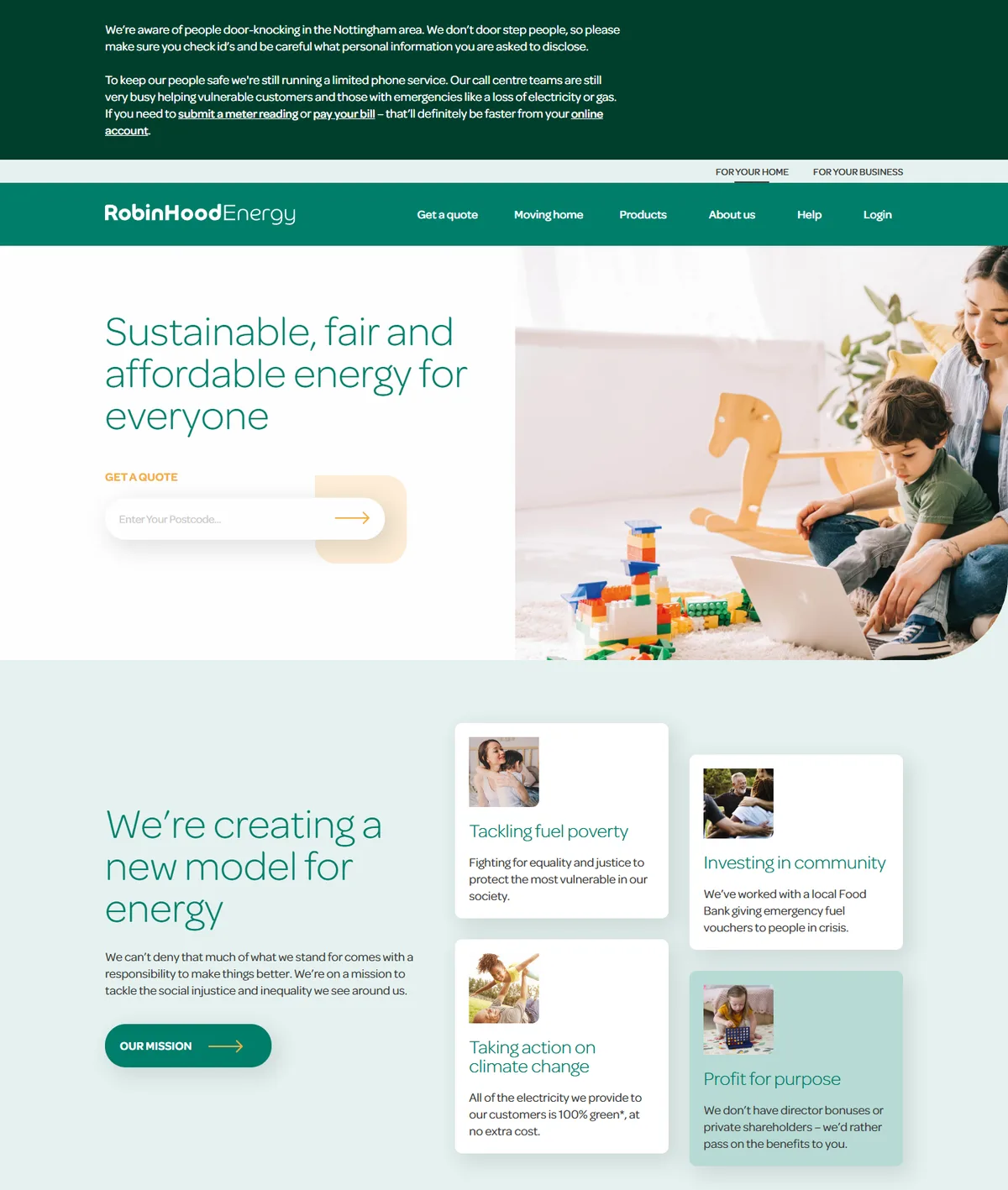
Nottingham City Council set up Robin Hood Energy in 2015, in response to the level of fuel poverty in the city and a view that the energy industry was not acting in the best interests of consumers. It was owned by the council and run not for profit. Its homepage promised "sustainable, fair and affordable energy for everyone", and one of the four things it advertised about itself was headed "Profit for purpose": "We don't have director bonuses or private shareholders, we'd rather pass on the benefits to you."
It supplied households and businesses, with "for your home" and "for your business" sitting side by side in its navigation, and it became the engine behind a small public-sector energy sector. Ten other councils sold Robin Hood Energy under their own brands:
| White label brand | Council |
|---|---|
| Angelic Energy | Islington |
| Beam Energy | Barking & Dagenham |
| Citizen Energy | Southampton |
| Fosse Energy | Leicestershire |
| Great North Energy | Doncaster & Barnsley |
| The Leccy | Liverpool |
| RAM Energy | Derby |
| Southend Energy | Southend-on-Sea |
| White Rose Energy | Leeds |
| Your Energy Sussex | West Sussex |
When Robin Hood Energy went, all ten went with it. The councils behind them did not carry the losses: Leeds City Council confirmed that the white label arrangement meant the West Yorkshire councils "will not be affected financially". The money was Nottingham's.
Why did it collapse?
Robin Hood Energy was a small supplier competing on price against companies many times its size, and it lost money doing it. The council launched a strategic review in March 2020. By August the auditors had reported. On 4 September 2020 the council announced it had agreed to sell the customer base to British Gas.
The company itself carried on for a few months as a shell and stopped trading on 5 January 2021. Its gas and electricity supply licences were revoked on 12 April 2021. It sits on our record of every energy supplier that has left the market since 2016.
The renewables bill it did not pay
Ofgem's enforcement ran alongside all of this and did not pause for the sale. Robin Hood Energy missed the 31 August and 1 September 2020 deadlines to meet its Renewables Obligation. On 2 October Ofgem named it among seven suppliers that had not paid, for £12,091,824.93, the largest single amount of the seven.
A final order followed on 28 October 2020, requiring payment by 31 October plus interest. It was one of three issued that week:
| Supplier issued a final order, 30 October 2020 | Amount |
|---|---|
| Robin Hood Energy Limited | £12,091,824.93 |
| Nabuh Energy Ltd | £2,683,631.70 |
| Symbio Energy Limited | £506,308 |
Robin Hood Energy's share was £12,057,879.42 of Renewables Obligation payments and £33,945.51 of Feed-in Tariff levelisation. It never paid it, and Ofgem's enforcement ended when the licences were revoked the following April.
What the auditors found
This is the part no privately owned supplier on this site has, because a company owned by a council is examined in public in a way a private one is not.
In August 2020 Grant Thornton, the council's external auditor, published a report in the public interest. It found cumulative losses of £34.4m and a series of failings in how the council had created and managed the company: inadequate governance arrangements, and a failure to understand the risks of entering the energy market.
Its sharpest finding was that the council's determination that the company should succeed had overshadowed its governance, producing what the report called "institutional blindness" to escalating risks. Where individuals did raise concerns, the report found those concerns were downplayed and the resulting action insufficient.
In November 2020 a separate non-statutory review of the council by Max Caller CBE put the loss to the council, and so to city taxpayers, at around £38m.
Both findings belong to their authors and are quoted here as they were published.
What its customers got
Better than anyone else covered on this site, and that is not a coincidence.
A sale, not a rescue
Because the council sold the book while the company was still supplying, this was a commercial transaction rather than an Ofgem intervention. British Gas bought the customer base, the transaction was expected to complete on 16 September 2020, and customers were written to from the week commencing 21 September inviting them to move across.
The terms were the part that mattered. Customers were offered rates "equal to or better than their current tariffs", and were free to switch elsewhere without paying exit fees. Nobody was moved onto a deemed rate, which is the default outcome of a supplier of last resort transfer and is normally dearer than the deal it replaces.
Its own account of it
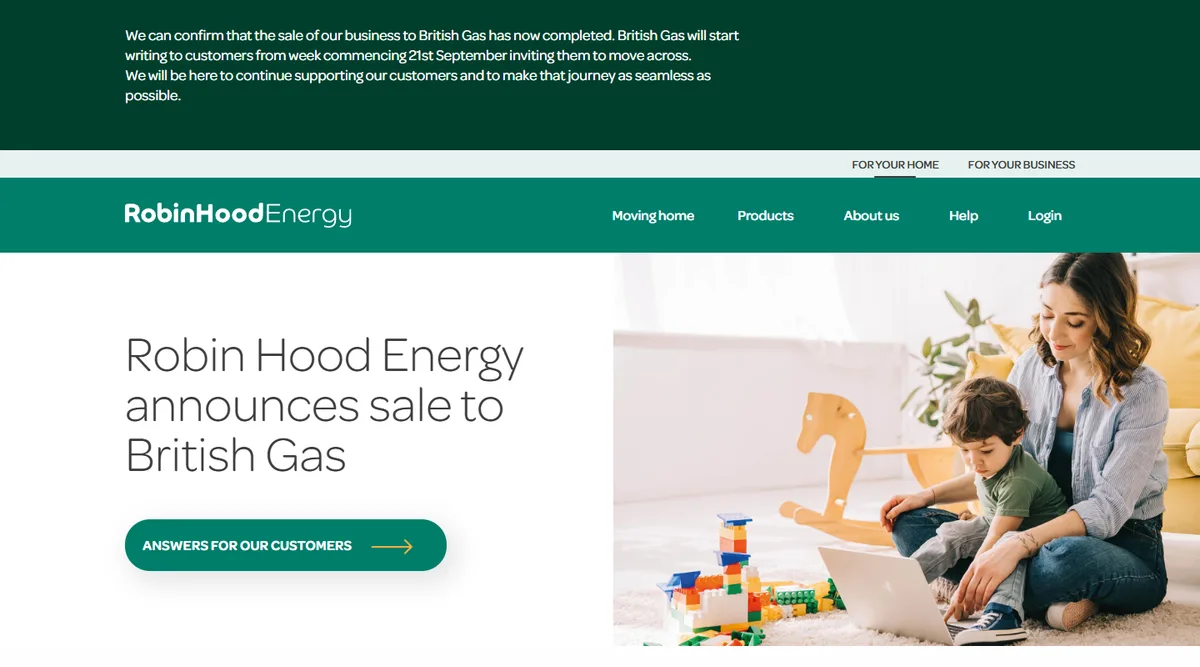
Robin Hood Energy replaced its homepage with the news. A banner across the top read: "We can confirm that the sale of our business to British Gas has now completed. British Gas will start writing to customers from week commencing 21st September inviting them to move across. We will be here to continue supporting our customers and to make that journey as seamless as possible."
Underneath it, the mission cards were still there.
Key dates
| Date | What happened |
|---|---|
| 2015 | Nottingham City Council sets up Robin Hood Energy as a not-for-profit supplier |
| March 2020 | The council launches a strategic review of the company |
| August 2020 | Grant Thornton publishes a report in the public interest: £34.4m of losses and "institutional blindness" to risk |
| 4 September 2020 | The council announces the sale of 112,000 household and 2,600 business customers to British Gas |
| 16 September 2020 | The transaction was expected to complete |
| 1 October 2020 | Ofgem issues a notice of proposal for a final order |
| 2 October 2020 | Ofgem names Robin Hood Energy as owing £12,091,824.93, the largest of seven suppliers |
| 28 October 2020 | Final order made, requiring payment by 31 October plus interest |
| November 2020 | Max Caller’s review puts the loss to the council at around £38m |
| 5 January 2021 | Robin Hood Energy ceases trading |
| 12 April 2021 | Gas and electricity supply licences revoked |
What it means for a business
Robin Hood Energy is one of the few failures on this site with a published business customer number: 2,600 non-domestic accounts alongside 112,000 households. Both groups were sold to British Gas together and both were offered rates equal to or better than the ones they were on.
That is the best outcome any business customer gets anywhere on this site, and it happened because the owner sold the book before the company failed. Where a supplier runs to the point of collapse, the ordinary rules apply and they are not generous:
| When your supplier fails | Household | Business |
|---|---|---|
| Supply continues | Yes | Yes |
| Ofgem protects your credit balance | Yes, under the safety net | No |
| A cap limits the rate you move onto | Yes | No |
| You are charged to leave that rate | No | No |
You cannot control which of those two routes your supplier takes. What you can control is how long you sit on a rate you did not choose once it happens, and there is no exit fee stopping you moving.
Where to start
- Electricity unit rates for business premises, with the daily standing charge
- What business gas is quoted at per kWh, priced in its own market
- The suppliers currently writing commercial deals, if you want the field first
Our guide explains the default rate that applies when no contract has been agreed.
For the ordinary route and what it delivers, see CNG Energy, an all-business book handled by Ofgem, and Tonik Energy, named in the same renewables enforcement.
Robin Hood Energy FAQs
What happened to Robin Hood Energy?
Who took over Robin Hood Energy customers?
Did Robin Hood Energy customers lose out?
Did Robin Hood Energy supply businesses?
Why did Robin Hood Energy fail?
What did the auditors mean by institutional blindness?
What happened to the councils that sold Robin Hood Energy under their own brands?
Sources
- Ofgem, Ofgem issues three final orders for £15 million in unpaid Renewables Obligation and Feed-in Tariff payments, 30 October 2020
- Ofgem, Robin Hood Energy Limited: Final Order, 28 October 2020
- Grant Thornton, Report in the public interest, Nottingham City Council, August 2020
- Ministry of Housing, Communities and Local Government, Non-statutory review of Nottingham City Council, Max Caller CBE, November 2020
- Leeds City Council, White Rose Energy to be discontinued following the sale of Robin Hood Energy, 4 September 2020
- Internet Archive, robinhoodenergy.co.uk as captured on 15 August 2020 and on 24 September 2020