

Ofgem banned Tomato Energy from taking on a single new customer in April 2025, seven months before it collapsed, and said so in public. It then confirmed that order in July, and in October proposed a £1.5 million penalty, recording that the company had been at heightened risk of insolvency for a prolonged period.
Tomato ceased trading on 5 November 2025. Of its roughly 23,000 customers, about 8,000 were businesses, and the protection that covered the households did not cover them. This is the clearest case on the whole record of a failure that could be seen coming, which makes it the most useful one to read.
What happened to Tomato Energy?
Tomato Energy Limited was a supplier registered in Basingstoke, trading under a bright red and lime brand with its own retail stores and a tariff range built around smart meters and electric vehicles. It ceased trading on Wednesday 5 November 2025.
Ofgem recorded the book as around 15,000 domestic customers and around 8,000 non-domestic customers. It appointed British Gas through the supplier of last resort process, and the customers transferred on Sunday 9 November 2025.
On credit balances, Ofgem's wording was careful and worth reading closely: "Funds that current and former domestic customers of the supplier have paid into their accounts will be protected, where they are in credit." Rohan Churm, Ofgem's director for financial resilience and controls, said that "any credit domestic customers have on their accounts remains protected under Ofgem's rules". Neither statement mentions the 8,000 business accounts, and that omission is not an oversight. We come back to it below.
The warnings were all published in advance
Most of the companies on this record failed with little public notice. Tomato is the exception, and the paper trail is remarkable.
Late 2024: the regulator starts hearing from creditors
Ofgem's confirmed order records that from late 2024 it "has been contacted by multiple industry parties in relation to the late or non-payment of financial liabilities by Tomato Energy". It met the company on 13 February, 5 March and 7 April 2025. At those meetings Tomato repeatedly assured the regulator that although it had experienced cashflow difficulties, effective action had been taken to stop them recurring.
One line in the order is starker than the rest. Suppliers are obliged to notify Ofgem in writing within seven days when certain financial trigger points occur. Ofgem found that Tomato "has not submitted any notifications to the Authority" at all.
April 2025: the sales ban
On 2 April 2025, Ofgem was told by multiple market participants that they were considering legal proceedings against Tomato to recover unpaid liabilities totalling over £3 million. Eight days later, on 10 April, it made a provisional order.
The order required Tomato to obtain and maintain enough liquidity to meet its liabilities as they fell due, and until it did, to refrain from all sales, marketing and customer acquisition activity, including the acquisition of any new domestic and non-domestic customers. It was also barred from making non-essential payments, loans or asset transfers to third parties.
July 2025: confirmed, with a deadline
Ofgem proposed confirming the order on 13 June and confirmed it with modifications in July 2025, setting a hard deadline: the liquidity requirement had to be met by no later than 4pm on 31 August 2025. The sales ban stayed in force until Ofgem confirmed in writing that compliance had been achieved. It never did.
October 2025: a £1.5 million penalty proposed
On 10 October 2025, Ofgem published a notice proposing a financial penalty of £1,500,000 for the continuing breach. Its reasoning was blunt. The contravention, it said, "has resulted in a financial benefit to Tomato Energy (and a corresponding financial detriment to its creditors)", and amounted to a serious and ongoing breach of the rules put in place to ensure the financial resilience of suppliers after the gas crisis of 2022. Ofgem also noted that it had taken into account that the company "has been in financial distress and therefore at heightened risk of exiting the supply market due to insolvency for a prolonged period".
Representations against that proposal were due by 4pm on 3 November 2025. Tomato ceased trading two days later. No final penalty decision appears to have followed, and this page says proposed rather than imposed throughout, because that is what the document says.
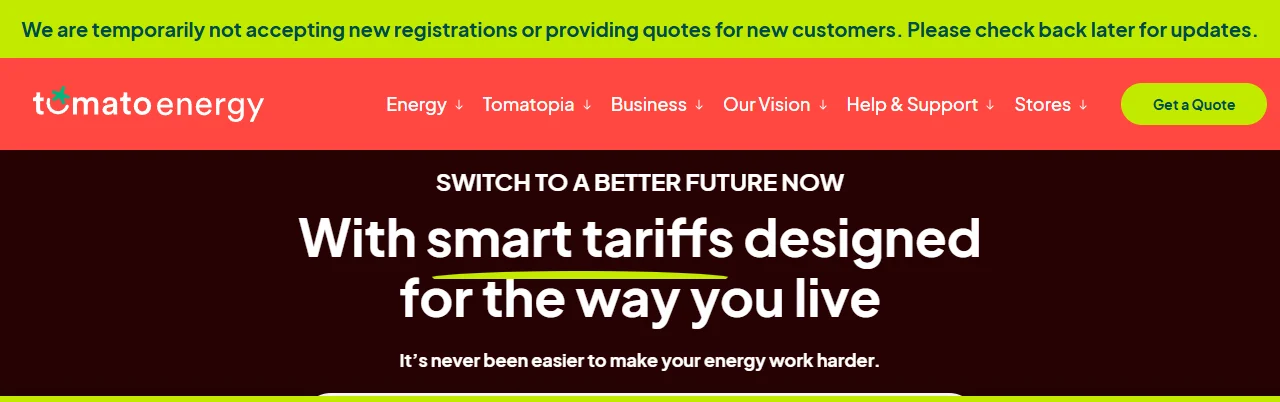
That banner is worth sitting with. A supplier under an enforcement order not to acquire customers described the position to the public as a temporary pause, with no mention of the regulator, while the page beneath it still invited visitors to switch. Nothing about the wording was untrue. It simply left out why.
How to tell whether your supplier is in trouble
The practical value of the Tomato case is that all of this was public. Here is where to look, which is worth knowing for any supplier, not just a failed one.
- Ofgem publishes enforcement action against named suppliers. Provisional orders, confirmed orders and notices proposing financial penalties all go on the Ofgem website with the company named. A provisional order against your supplier is the single strongest signal available to an ordinary customer.
- A supplier that stops quoting has usually stopped by necessity. If a company will not give new customers a price, something is constraining it, whether that is an enforcement order or simply the inability to buy forward. The same tell appears on Orbit Energy, whose site said its focus was entirely on existing customers a month before it went.
- Watch the wording, not the tone. "Temporarily", "paused", "while we focus on existing customers" and "check back later" are the house style for this situation across the whole record.
- Creditors talk before customers hear anything. By the time a sales ban appears, the regulator has usually been dealing with the company for months.
What to do if your supplier is under an order
For a household, very little changes: the safety net means your supply continues and your credit balance is protected whatever happens, so there is no emergency. It is still worth keeping your balance modest and your meter readings current.
For a business it is different, and acting early is the whole game. A business credit balance is not protected, so the moment a supplier is publicly constrained is the moment to stop letting a balance build and to find out what your contract allows. Waiting until the company fails removes every option you had.
Key dates
| Date | What happened |
|---|---|
| Late 2024 | Ofgem begins receiving contact from multiple industry parties about late or non-payment of liabilities by Tomato Energy |
| 13 Feb, 5 Mar, 7 Apr 2025 | Ofgem meets Tomato Energy, which says effective action has been taken over its cashflow difficulties |
| 2 April 2025 | Multiple market participants tell Ofgem they are considering legal proceedings to recover unpaid liabilities of over £3 million |
| 10 April 2025 | Ofgem makes a provisional order. Tomato is banned from all sales, marketing and customer acquisition, and from non-essential payments |
| 13 June 2025 | Ofgem proposes confirming the order with modifications |
| July 2025 | The order is confirmed. Tomato must obtain and maintain sufficient liquidity by 4pm on 31 August 2025 |
| 31 August 2025 | The liquidity deadline passes without compliance |
| 10 October 2025 | Ofgem publishes a notice proposing a £1.5 million penalty for the continuing breach |
| 3 November 2025 | Deadline for representations against the proposed penalty, 4pm |
| 5 November 2025 | Tomato Energy ceases trading |
| 9 November 2025 | Around 15,000 domestic and 8,000 business customers transfer to British Gas |
A third of the customers were businesses
Most failed suppliers on this record were overwhelmingly domestic, and the business customers caught up in them were an afterthought. Tomato is the opposite. Around 8,000 of its roughly 23,000 customers were non-domestic, which is the largest business share of any failure here.
That matters because of what Ofgem's safety net does and does not do. It guarantees continuity of supply for everyone: no business lost its electricity or gas, and British Gas picked all of them up. What it guarantees financially is narrower. The protection covers the credit balances of domestic customers, current and former. It has never covered non-domestic accounts.
So on 9 November 2025, roughly 15,000 households moved across with a guarantee that any money sitting in their accounts would follow them, and roughly 8,000 businesses moved across with no such guarantee. Whether a business balance is honoured depends on what the incoming supplier agrees to absorb, which is settled case by case and frequently not published at all.
The only case on this site where the terms of such an arrangement were actually published is Rutherford Energy, where the limit was set at £100,000 across the entire book and closed accounts were excluded altogether.
There is a second cost that falls on everyone. Ofgem's order explains why these rules exist in the first place: the financial resilience requirements "help to minimise the costs at risk of Mutualisation in the event of a market exit". When a supplier fails owing money to industry schemes, the shortfall is spread across the remaining suppliers and reaches the rest of us through bills. That is the mechanism described in more detail on how mutualisation played out at Together Energy.
What it means for a business
Tomato makes the argument more cleanly than any other entry here, because the timeline is so well documented. A business customer who saw the April 2025 order had seven months to act, and acting meant three specific things.
- Stop the balance building. Credit held with a supplier under an enforcement order is money you have no guaranteed route back to. Pay for what you use and no more.
- Read the contract for the exit position. Fixed term business contracts usually have no cooling off and no right to leave early, so knowing the actual position before a collapse is better than discovering it after.
- Price the alternative before you need it. A business moved by a supplier of last resort lands on a deemed contract, which is the most expensive way to buy energy, and sorting it out takes longer than people expect.
| When a supplier fails | Household | Business |
|---|---|---|
| Supply continues | Yes | Yes |
| Credit balance guaranteed | Yes, current and former customers | No |
| Covered by the price cap afterwards | Yes | No |
| Rate landed on with the new supplier | Capped standard variable | Deemed contract, usually the highest rate |
Where to start
- The current price of business electricity per kWh
- Commercial gas rates and the daily standing charge
- Who is quoting for business contracts at the moment
If you have been moved across and never agreed terms, start with the rate a deemed contract puts you on. For another supplier whose public wording gave the position away, see Symbio Energy.
Tomato Energy FAQs
What happened to Tomato Energy?
Who took over Tomato Energy customers?
Was there any warning before Tomato Energy collapsed?
Did Ofgem fine Tomato Energy £1.5 million?
Is my credit balance safe if I was a Tomato Energy customer?
Did Tomato Energy supply businesses?
How can I tell if my own supplier is in trouble?
Sources
- Ofgem, Confirmed Provisional Order: Tomato Energy Ltd, July 2025, made under section 25(4) of the Electricity Act 1989
- Ofgem, Notice of Proposal to Impose a Financial Penalty, Tomato Energy Limited, 10 October 2025
- Ofgem, Ofgem protects customers of Tomato Energy, November 2025
- Ofgem, Ofgem appoints British Gas to take on customers of Tomato Energy, November 2025
- Companies House, Tomato Energy Limited, company number 09735768