

CitizEn Energy closed in September 2020, when Robin Hood Energy, the supplier whose licence it ran on, was sold to British Gas. Southampton City Council had launched it in 2018 as a not-for-profit brand, and its closing notice put the position more plainly than any other on this site: "we're not able to operate without them".
It was the most ambitious of the ten council brands, because it was designed from the start to be adopted by other councils too. It was also the only failure covered here where customers were asked whether they wanted to move, rather than simply being moved. If you want to know which licensed supplier would hold your own contract, you can see who quotes for commercial supply.
What happened to CitizEn Energy?
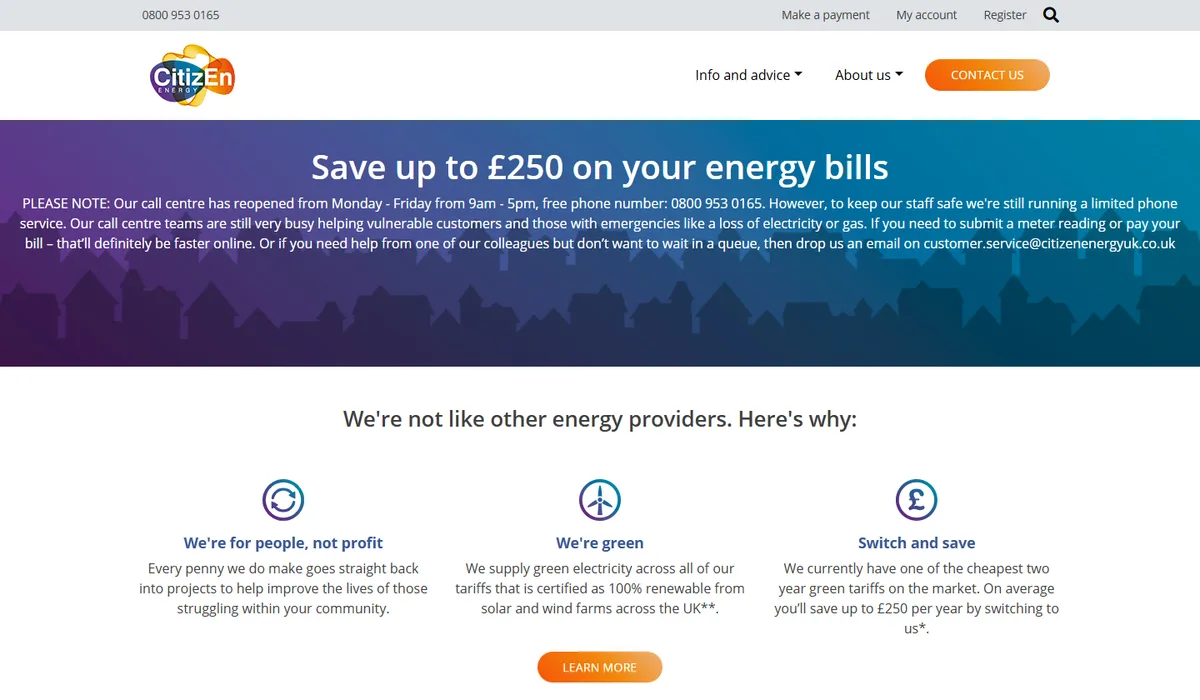
Southampton City Council announced its energy brand in March 2018 and launched it that September, styling it CitizEn Energy. The pitch was explicitly civic. "We're for people, not profit", the homepage said: "Every penny we do make goes straight back into projects to help improve the lives of those struggling within your community." Its electricity was "certified as 100% renewable from solar and wind farms across the UK", and it claimed "one of the cheapest two year green tariffs on the market", worth up to £250 a year.
Like Islington's Angelic Energy and Beam Energy in Barking and Dagenham, it held no supply licence. The energy came from Nottingham's Robin Hood Energy. Even the customer portal was off the shelf: the sign-up site ran on a billing platform's white-label web portal, with the words in the address.
On 4 September 2020 Nottingham announced it was selling Robin Hood Energy to British Gas, and CitizEn Energy ended with it. It sits on our record of the UK suppliers and brands that have closed since 2016.
A brand built to be shared
This is what separates CitizEn Energy from the other nine. The rest were single-council brands: one authority, one name, one area. Southampton built something it intended other councils to use as well, and reporting at the launch said up to thirteen further local authorities were expected to sell energy to their residents under the CitizEn name.
That makes it a white label of a white label. Stacked up, the arrangement ran four deep:
| Layer | Who |
|---|---|
| The brand a resident signed up to | CitizEn Energy |
| The council that owned the brand | Southampton City Council, with other authorities able to adopt it |
| The licensed supplier behind it | Robin Hood Energy |
| The council that owned that supplier | Nottingham City Council |
A customer in Southampton had a relationship with the first row. The decision that ended their tariff was taken in the fourth. Nothing in between gave anyone in Hampshire a vote on it.
What its customers got
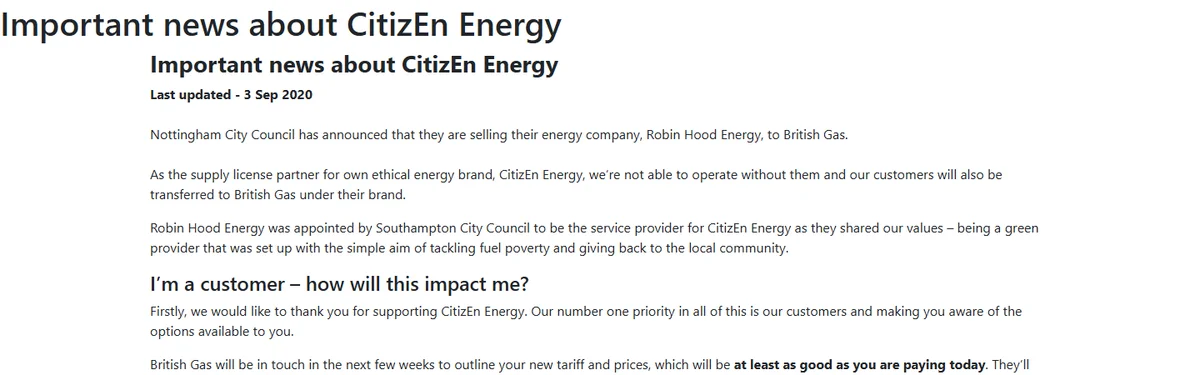
CitizEn Energy told its customers on 3 September 2020, a day before Nottingham made the sale public. Its notice is worth reading because it is the clearest account of the white-label position anywhere in this series:
"Nottingham City Council has announced that they are selling their energy company, Robin Hood Energy, to British Gas. As the supply license partner for own ethical energy brand, CitizEn Energy, we're not able to operate without them and our customers will also be transferred to British Gas under their brand."
It went on to explain why Robin Hood had been chosen in the first place: "Robin Hood Energy was appointed by Southampton City Council to be the service provider for CitizEn Energy as they shared our values, being a green provider that was set up with the simple aim of tackling fuel poverty and giving back to the local community."
Customers were told their supply was not at risk and their service would be uninterrupted, and that British Gas would be in touch "to outline your new tariff and prices, which will be at least as good as you are paying today". The council also gave an email address for anyone struggling to switch, at southampton.gov.uk.
The one failure where customers were asked
One line in that notice does something no other page on this site can report. British Gas, it said, would outline the new tariff and "They'll also ask for your consent to join them".
Asked. Not moved. That is only possible because Robin Hood Energy's customer book was sold as a going concern rather than collapsing. A commercial buyer of a customer base has to get customers to agree to come across.
Compare that with what happens when a supplier actually fails. Ofgem runs the supplier of last resort process, appoints a new supplier, and the accounts transfer. Customers are told not to switch and to wait to be contacted. There is no consent step, because the alternative to being transferred is having no supplier at all.
| A customer book is sold | A supplier fails | |
|---|---|---|
| What triggers it | A commercial decision by the owner | Insolvency or licence revocation |
| Who picks the new supplier | The seller, in a negotiated deal | Ofgem, through a competitive process |
| Are you asked | Yes, your consent is sought | No, you are transferred |
| What happens to your rate | Negotiated as part of the sale | The new supplier’s terms, or a deemed rate |
CitizEn Energy's customers got the first column. Almost everyone else on this site got the second.
Key dates
| Date | What happened |
|---|---|
| 26 March 2018 | Southampton City Council announces it will launch an energy brand |
| September 2018 | CitizEn Energy launches, supplied under Robin Hood Energy’s licence |
| 3 September 2020 | CitizEn Energy tells customers it is "not able to operate without" Robin Hood Energy |
| 4 September 2020 | Nottingham City Council announces the sale of Robin Hood Energy to British Gas |
| Weeks following | British Gas contacts customers with new prices and asks for their consent to transfer |
What it means for a business
CitizEn Energy was a household brand and had no business customers, so nothing here happened to a business directly. The reason it earns space on a business energy site is the structure, and this page has the clearest example of it: four layers between the customer and the licence, and a decision two councils away that ended the arrangement.
Non-domestic energy is sold through brands and intermediaries constantly. Brokers, franchises, trade associations and buying groups all put their own name in front of a licensed supplier. Before signing under any of them, the questions are the same three from the Angelic Energy page on how white labels work: who holds the licence, what happens if they change hands, and who you actually call.
And if the licence holder fails rather than being sold, no consent is sought from anyone, and the protections split like this:
| When your supplier fails | Household | Business |
|---|---|---|
| Supply continues | Yes | Yes |
| Ofgem protects your credit balance | Yes, under the safety net | No |
| A cap limits the rate you move onto | Yes | No |
| You are charged to leave that rate | No | No |
Where to start
- Business electricity prices per kWh this month, with the standing charge
- The rate businesses are paying for gas, set in its own market
- Licensed suppliers that take on business sites, so you know who is behind the name
Our guide explains what applies when a contract ends and nothing replaces it.
For the licence all ten brands ran on, see Robin Hood Energy and the councils it supplied.
CitizEn Energy FAQs
What happened to CitizEn Energy?
Who took over CitizEn Energy customers?
Why were CitizEn Energy customers asked for consent?
Was CitizEn Energy a real energy supplier?
Was CitizEn Energy only for Southampton?
Did CitizEn Energy customers lose money?
Did CitizEn Energy supply businesses?
Sources
- CitizEn Energy, Important news about CitizEn Energy, last updated 3 September 2020
- Energy Live News, Southampton Council to launch energy supplier, 26 March 2018
- Southampton City Council, Southampton City Council
- Internet Archive, citizenenergyuk.co.uk as captured on 3 August 2020