

Economy Energy stopped trading on 8 January 2019 with around 235,000 customers. Ofgem appointed Ovo Energy, with prepayment accounts going to Ovo's prepayment brand Boost. Credit balances were honoured, but customers moved onto a deemed rate rather than keeping their tariff.
It is the only supplier on this site with a competition law finding against it, and the only one that tried to sell part of its customer book as it went. Both are on Ofgem's record and both are set out below. If you are on a default rate now, you can see which business energy suppliers are open to new sites.
What happened to Economy Energy?
Economy Energy sold on price to customers who tend to pay most: its site led with "Giving you more for less" and built its offer around prepayment and pay-as-you-go, alongside fixed and variable contracts and a mobile arm.
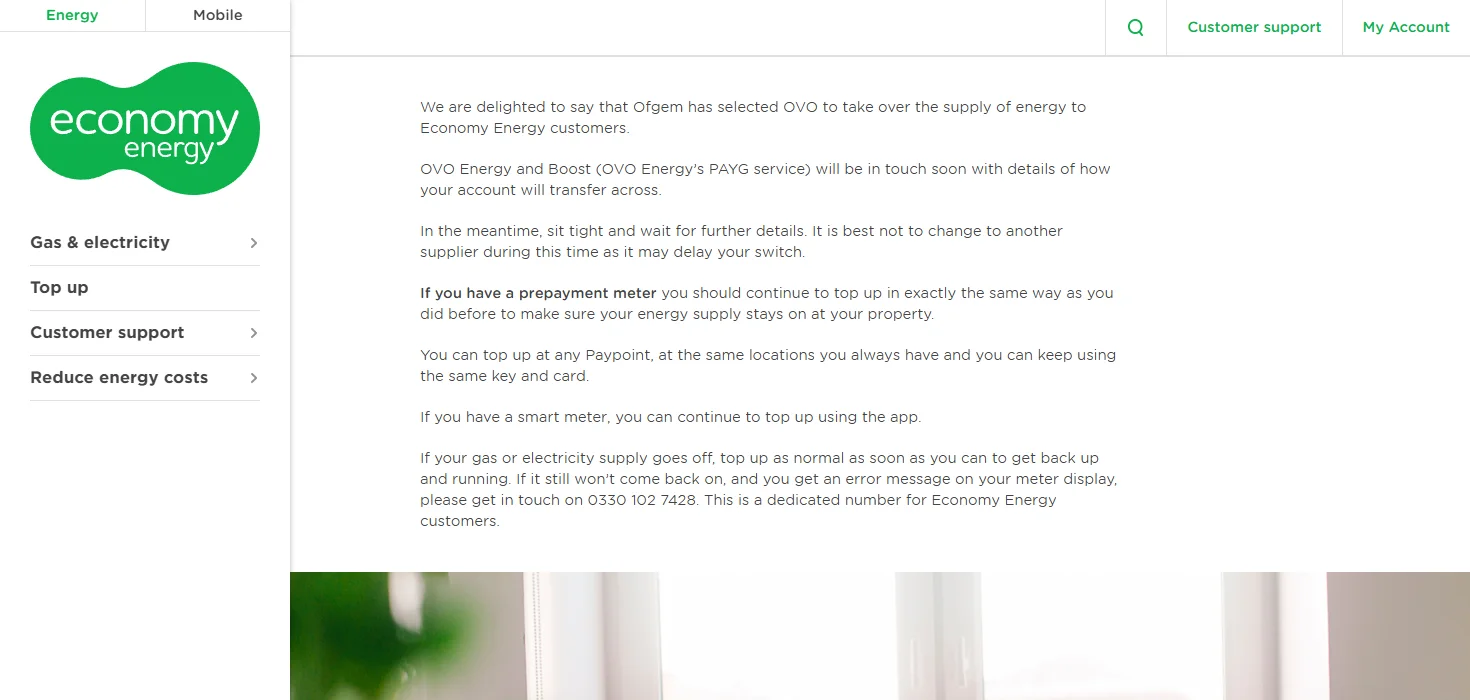
It ceased trading on 8 January 2019, and Ofgem revoked its gas and electricity supply licences four days later. Ovo Energy was appointed supplier of last resort, with prepayment customers handled by Boost, Ovo's prepayment brand.
It was the largest failure of 2019 and sits on our record of the UK energy suppliers that have collapsed since 2016.
A statement four weeks before
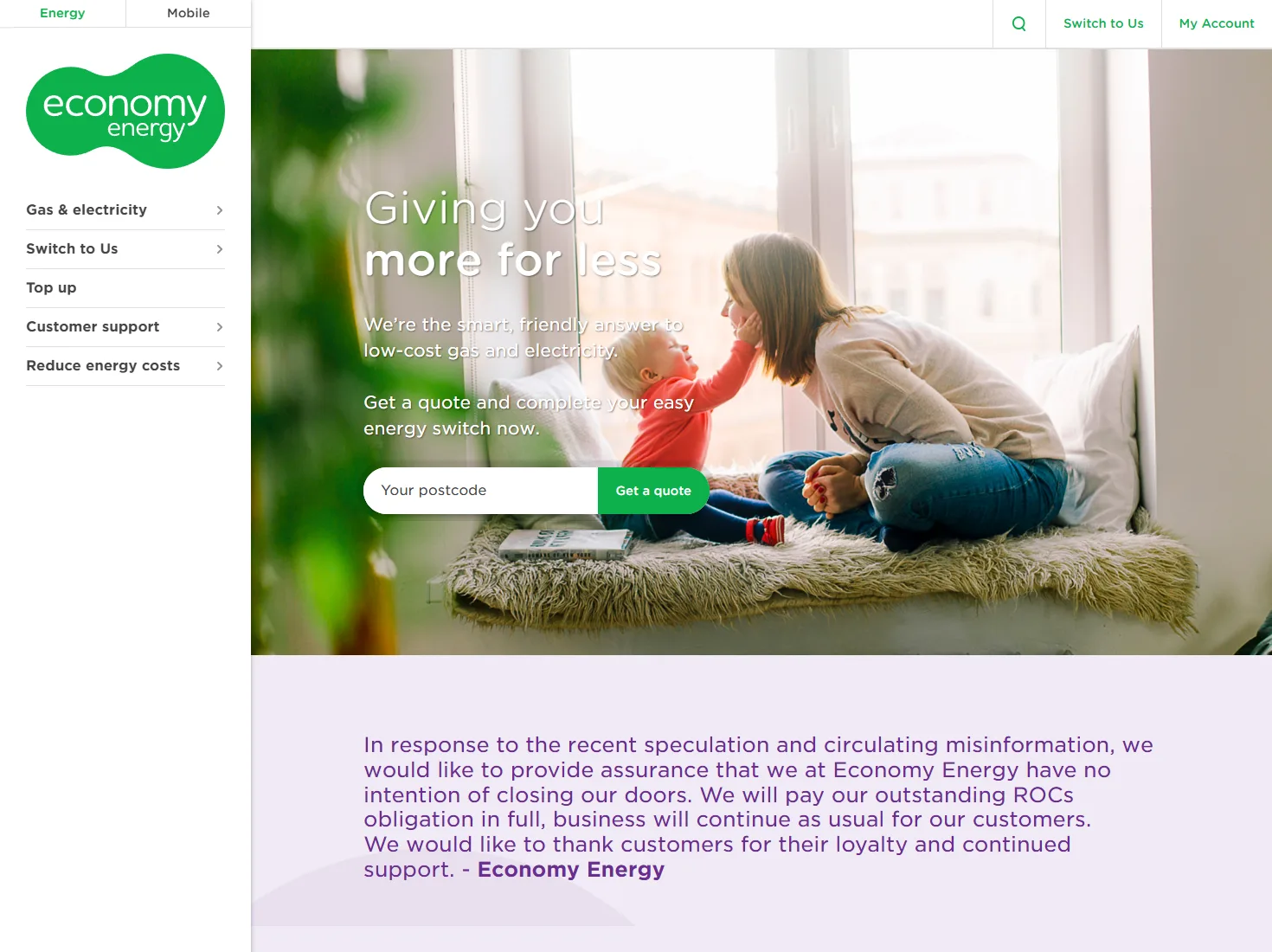
On 12 December 2018 its homepage carried a notice to customers. It read: "In response to the recent speculation and circulating misinformation, we would like to provide assurance that we at Economy Energy have no intention of closing our doors. We will pay our outstanding ROCs obligation in full, business will continue as usual for our customers."
It stopped trading 27 days later. What the company knew when is not on the public record, so we will not speculate; the dates are simply what they are.
Why did it collapse?
Ofgem had been circling for some time. It issued a provisional order against Economy Energy on 4 January 2019, four days before the company stopped trading, and that order fell away when the licences were revoked on the 12th.
Two investigations were open into its compliance: one into its Renewables Obligations, the annual bill every electricity supplier has to meet, and one into its obligations under Standard Licence Condition 25, which governs how suppliers treat customers. Both were closed once the company no longer existed.
The customer book it tried to sell
In December 2018, while publicly saying it had no intention of closing, Economy Energy agreed to sell around 30,000 customers to E (Gas and Electricity) Ltd. It did not tell Ofgem about that sale when it stopped operating.
On 16 January 2019 Ofgem issued a provisional order to E requiring it to stop completing the transfer, on the basis that the contract "may no longer be effective as a result of Economy Energy ceasing to trade", and to prevent "further harm and uncertainty being experienced by former customers of the failed supplier". Those customers went to Ovo and Boost with everyone else.
The competition law finding
On 30 May 2019, months after the company had gone, Ofgem found that Economy Energy, E (Gas and Electricity) and a software firm, Dyball Associates, had breached competition law.
Between January and September 2016 the two suppliers had an anti-competitive agreement not to target each other's customers through face-to-face sales, and shared commercially sensitive information in the form of customer meter point details to make it work. Dyball provided the technical means.
| Party | Penalty |
|---|---|
| E (Gas and Electricity) Limited | £650,000 |
| Economy Energy | £200,000 |
| Dyball Associates | £20,000 |
| Total | £870,000 |
What its customers got
Nobody lost supply and nobody lost money, but unlike the better-handled failures the tariff did not survive.
A deemed rate, not the old price
Customers were moved onto a deemed tariff with Ovo, which is the default that applies when no contract has been agreed and is normally dearer than the deal it replaces. Ovo then contacted customers with personalised tariff information, and they were free to move. Ofgem was explicit that "you won't be charged any exit fees".
That is the usual outcome, and it is worth contrasting with GB Energy Supply in 2016 and Spark Energy in 2018, whose customers kept the prices they were already on.
Credit balances and prepayment
Ovo honoured credit balances for both current and past customers who were owed money. Former customers who had already left were told to register a refund claim once they had their final bill. Prepayment customers were contacted by Boost and told to carry on topping up exactly as before.
Key dates
| Date | What happened |
|---|---|
| January to September 2016 | The conduct later found to breach competition law takes place |
| December 2018 | Economy Energy agrees to sell about 30,000 customers to E (Gas and Electricity) |
| 12 December 2018 | Its homepage says it has "no intention of closing our doors" |
| 4 January 2019 | Ofgem issues a provisional order against Economy Energy |
| 8 January 2019 | Economy Energy ceases trading |
| 12 January 2019 | Gas and electricity supply licences revoked |
| 16 January 2019 | Ofgem orders E to stop completing the transfer of those 30,000 customers |
| 30 May 2019 | Ofgem finds a competition law breach and imposes £870,000 in penalties |
What it means for a business
Everything Ofgem published about this failure concerns domestic customers, and no non-domestic figure was released, so what any business customer received is not on the public record.
The general position is unchanged, and it is the part worth knowing before it affects you. A business has fewer protections than a household when its supplier fails:
| When your supplier fails | Household | Business |
|---|---|---|
| Supply continues | Yes | Yes |
| Ofgem protects your credit balance | Yes, under the safety net | No |
| A cap limits the rate you move onto | Yes | No |
| You are charged to leave that rate | No | No |
Where to start
- Business electricity rates per kWh as they stand, with the standing charge beside them
- What gas costs a business per kWh, priced off a separate market
- The suppliers quoting for commercial supply, if you want the field before choosing
Our guide explains why a deemed contract is the expensive way to buy energy.
For other outcomes from the same process, see Ampower, where business credit was only part honoured, and Better Energy, which left the market by choice.
Economy Energy FAQs
What happened to Economy Energy?
Who took over Economy Energy customers?
Did Economy Energy customers lose money?
Did customers keep their tariff?
Was Economy Energy fined?
What did the competition case involve?
What happened to the 30,000 customers sold to E?
Sources
- Ofgem, Economy Energy customers: your questions on new supplier Ovo Energy
- Ofgem, Ofgem orders E to stop transfer of former Economy Energy customers, 16 January 2019
- Ofgem, Ofgem finds E Gas and Electricity, Economy Energy and Dyball Associates in breach of competition law, 30 May 2019
- Ofgem, Economy Energy: provisional order, 4 January 2019
- Internet Archive, economyenergy.co.uk as captured on 12 December 2018 and on 14 January 2019