

Spark Energy Supply Limited stopped supplying on 23 November 2018, with 290,000 customers. Ofgem appointed Ovo Energy, customers moved on 28 November, and they kept the tariffs they were already on. Every credit balance was honoured, including for people who had already left.
Two things set it apart from the other failures on this site. Only part of the Spark group went under, so its commercial arm carried on trading throughout. And the brand itself survived: Ovo bought the operating company and kept running Spark Energy under its own licence. If you are pricing a supply now, see which business energy suppliers are quoting at the moment.
What happened to Spark Energy?
Spark was not a conventional energy supplier. It had built its business around tenants and letting agents, describing itself as "the leading energy supplier for tenants across the UK", and handled the awkward moment when someone moves into a rented property and inherits a supply they never chose. Its homepage sold moving-in reassurance rather than price.
On Friday 23 November 2018 it announced that Spark Energy Supply Limited would be unable to continue supplying customers. Ofgem confirmed the appointment of Ovo Energy on 27 November, and the 290,000 domestic customers transferred on Wednesday 28 November.
It was the largest failure of 2018 and sits on our record of the UK energy suppliers that have gone under since 2016.

Why did it fail?
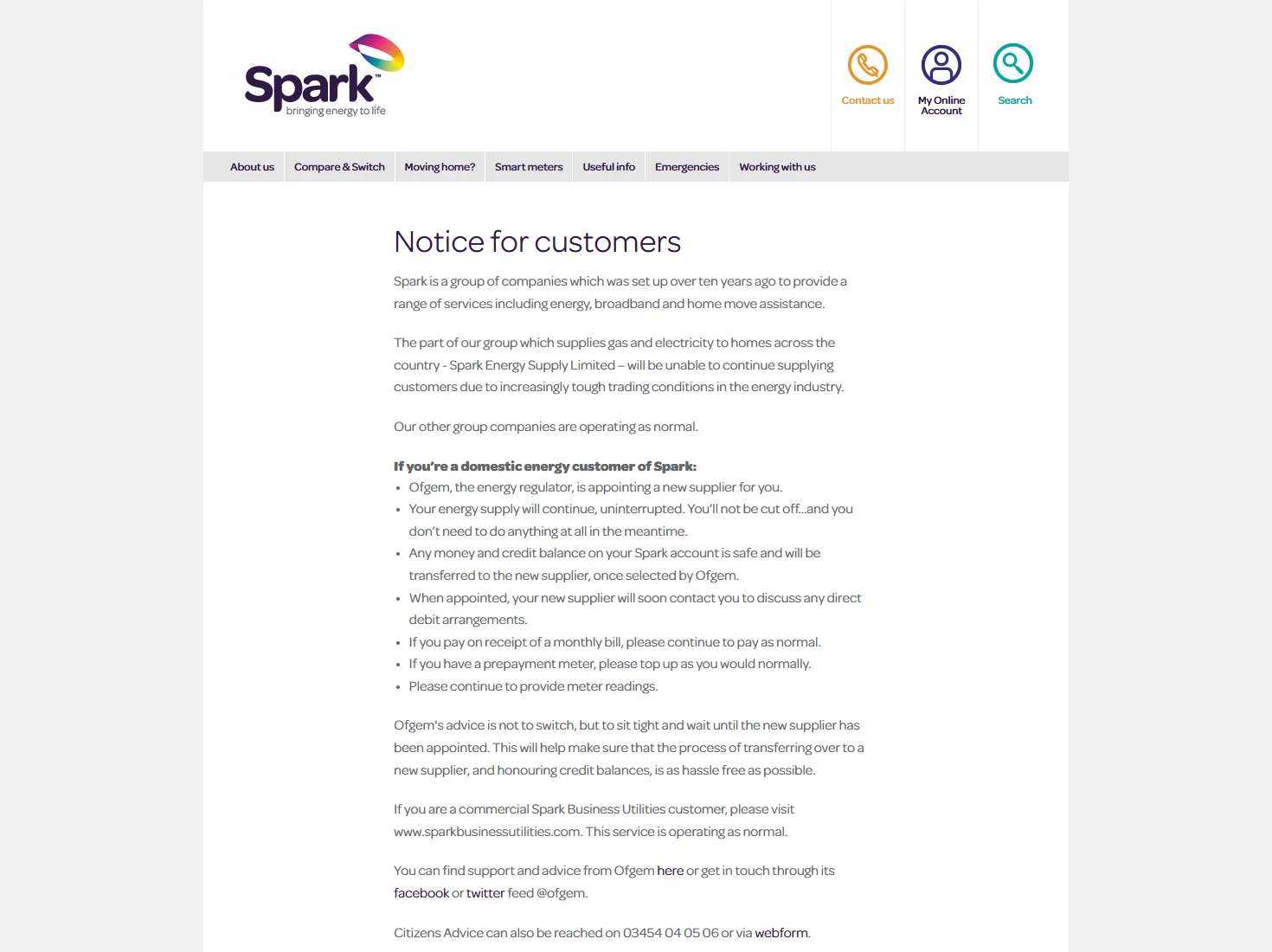
Spark put the reason on its own homepage the day it announced. The site was replaced with a notice to customers, and the archive caught it.
The notice explained that Spark was "a group of companies which was set up over ten years ago to provide a range of services including energy, broadband and home move assistance", and that the part supplying gas and electricity "will be unable to continue supplying customers due to increasingly tough trading conditions in the energy industry".
That phrase covers what 2018 did to small suppliers. Wholesale costs were rising into the first domestic price cap, which arrived at the start of 2019, and a supplier without the scale or the hedging to absorb the gap had nowhere to put it. Spark was the second sizeable failure of that autumn, weeks after Extra Energy.
What its customers got
Better terms than most. Ofgem's Mary Starks said at the time that "Spark Energy's customers will be offered the same tariffs they are already on", so nobody was moved onto a more expensive deemed rate, which is what usually happens.
Credit balances were honoured in full for current customers and for former customers who were still owed money. Ofgem noted that the cost of that was met partly by Ovo Energy and partly by the safety net, which is the mechanism that spreads the bill across the industry.
The brand that outlived the failure
Every other supplier on this site simply stopped existing. Spark did not.
Separately from the customer transfer, Ovo Energy acquired Spark's operating company, Spark Energy Ltd, and kept the Spark Energy brand. Customers carried on receiving Spark-branded bills, handled by Spark's own customer service team, with the energy supplied under Ovo's licence.
It is a useful distinction to understand. The licensed supplier failed; the business around it, its people, systems and name, was bought. That is why you can find references to Spark Energy operating after the date it is recorded as having failed.
Key dates
| Date | What happened |
|---|---|
| Friday 23 November 2018 | Spark announces Spark Energy Supply Limited cannot continue supplying, and posts a notice to customers |
| 27 November 2018 | Ofgem confirms Ovo Energy as supplier of last resort |
| Wednesday 28 November 2018 | The 290,000 customers transfer to Ovo on their existing tariffs |
What it means for a business
Spark is the one case in this set where business customers were not affected at all, and the reason is worth understanding because it is structural rather than lucky.
The failure was of one licensed company in a group. Its notice told commercial customers to carry on with Spark Business Utilities, a separate company at its own address, adding that "this service is operating as normal". Those customers were never part of the supplier of last resort process, because their supplier had not failed.
That will not be true of the next one. Where a business is supplied by the licensed company that fails, the protections are thinner than a household's:
| When your supplier fails | Household | Business |
|---|---|---|
| Supply continues | Yes | Yes |
| Credit balance protected by Ofgem | Yes, under the safety net | No |
| A cap on the rate you move to | Yes | No |
| Exit fee for leaving that rate | None | None |
Where to start
- What a business pays for electricity per kWh, with the standing charge that goes with it
- Business gas rates as they stand now, priced off a separate market
- Suppliers currently taking on business sites, if you want the field before you choose
Our guide explains what a deemed contract is and why it costs more.
For the same process with different outcomes, see GB Energy Supply, whose customers also kept their prices, Ampower, where business credit was only part honoured, and Neon Reef.