

Ten suppliers bid to rescue Hub Energy's customers. Most of them would have honoured the money owed to households. Only a minority were willing to cover the businesses.
That is not our summary. It is what Ofgem wrote in its decision letter, and it is the clearest evidence anywhere on this record of something every business energy customer ought to know: when your supplier fails, whether you get your money back is a decision somebody else makes.
Hub's 9,000 business customers were lucky. Ofgem picked one of the suppliers that said yes.
What happened to Hub Energy?
Hub Energy was the trading name of Gas and Power Limited. It sold 100% renewable electricity and carbon neutral gas to homes and businesses, on tariffs it ran entirely online.
In July 2021 the company told Ofgem it was in severe financial difficulties, and Ofgem began preparing the supplier of last resort process before anything had been announced publicly. Hub ceased trading on 9 August 2021. On 12 August Ofgem announced it had appointed E.ON Next and gave notice that it would revoke Hub's supply licences, and the customers transferred on 13 August. Andrew Stone and Rick Harrison of Interpath Advisory were appointed joint administrators of Gas and Power Limited the same day.
Hub went a few weeks before the wave of failures that took more than two dozen suppliers through the autumn of 2021, at a point when a collapse was still unusual enough to be news on its own.
A supplier whose customers were mostly businesses
Almost every company on this record was overwhelmingly domestic. Hub was not. Ofgem recorded around 6,000 domestic customers and around 9,000 non-domestic customers. Three fifths of the book was businesses, which makes Hub the most business-weighted failure here by a distance.
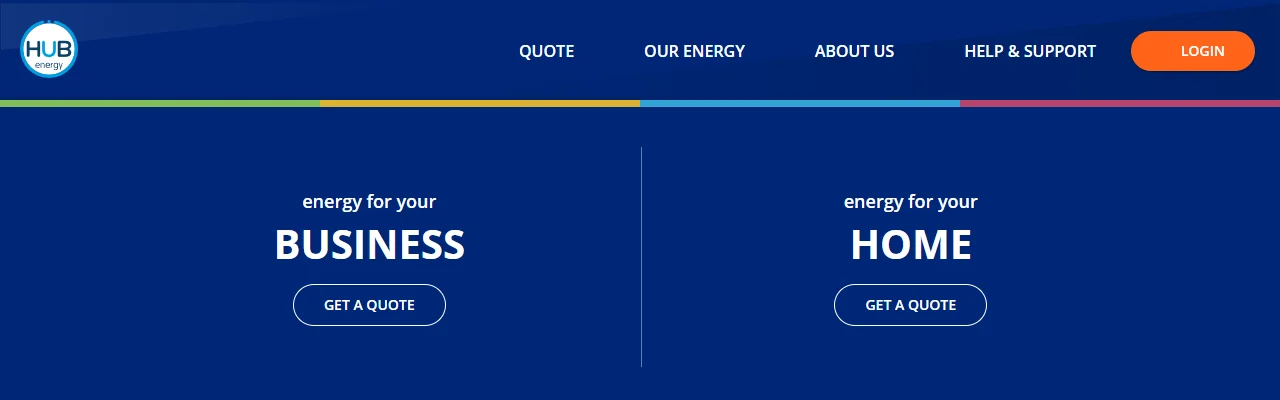
You could see it on the website. Nine days before the end, the homepage offered "energy for your BUSINESS" and "energy for your HOME" side by side, with the business option on the left.
The sentence every business should read
When a supplier fails, Ofgem runs a competitive process to choose who takes the customers on. It asks interested suppliers how they would handle the job, including what they would do about money owed to customers.
Ten suppliers submitted bids for Hub's customers. Here is what Ofgem recorded about what they were prepared to pay for, in its own words.
| Of the ten suppliers that bid | How many agreed |
|---|---|
| Volunteered for the role at all | Four, including E.ON Next |
| Would honour credit balances of current domestic customers | A majority, including E.ON Next |
| Would honour refunds owed to former domestic customers | A majority, including E.ON Next |
| Would honour open and closed credit balances of non-domestic customers | A minority, including E.ON Next |
| Would contribute to costs rather than charge them all to the industry levy | A minority, including E.ON Next |
Read the fourth row again. Ofgem's safety net protects the credit balances of domestic customers. It has never covered business accounts. So every bidder had to decide for itself whether to absorb what Hub owed its 9,000 business customers, and most of them said no.
E.ON Next said yes, to open and closed balances alike, meaning businesses that had already left Hub and were still owed money were covered too. It also offered to pay for part of the rescue itself rather than charging everything to the industry levy that the rest of us fund. That combination is why it won.
The outcome for Hub's business customers was therefore a good one. The mechanism that produced it was not a protection. It was a preference expressed by one bidder among ten, in a process those customers never saw and could not influence.
What to do about it
If the protection is a lottery, the sensible response is to hold fewer tickets. Four things follow.
- Do not let a business account sit in credit. This is the whole lesson. A household in credit is holding protected money. A business in credit is holding an unsecured claim against a company that might not survive. Pay close to what you use, and query a direct debit that is building a balance you did not ask for.
- Check where you stand before you leave a supplier. Closed accounts are the weakest position of all. Even where a rescuer honours business balances, it does not always extend to accounts already closed, and E.ON Next covering closed balances here was unusually generous rather than standard. Settle the final bill and get the refund out before you move on.
- Watch for the public signals. Hub told Ofgem it was in severe financial difficulty in July, a month before customers heard anything. Sometimes there is more warning in the open: enforcement orders against a named supplier are published, as set out on the Tomato Energy page.
- Know what you land on. A rescued business goes onto a deemed contract, which is not price capped and is normally the most expensive rate the supplier has. It is not a trap, you can leave it without exit fees, but nobody moves you off it for you.
Key dates
| Date | What happened |
|---|---|
| July 2021 | Hub Energy tells Ofgem it is in severe financial difficulties. Ofgem begins preparing the supplier of last resort process |
| 31 July 2021 | The Hub Energy website is still trading normally, offering quotes to businesses and households alike |
| 9 August 2021 | Hub Energy ceases trading with around 6,000 domestic and 9,000 non-domestic customers |
| 12 August 2021 | Ofgem announces E.ON Next as supplier of last resort, chosen from ten bids, and gives notice to revoke Hub’s licences |
| 13 August 2021 | Customers transfer to E.ON Next. Interpath Advisory appointed joint administrators of Gas and Power Limited |
What it means for a business
Most of this page is that answer already, so this section is short and practical.
Your supply is never at risk. Ofgem's process guarantees that somebody keeps supplying you, and in every case on this record it has worked, for businesses exactly as for households. Nobody has been cut off because their supplier went bust.
Your money is a different question, and the honest answer is that it depends on a decision taken by a supplier you have never dealt with, in a process that takes a few days and is not published until afterwards. Sometimes the answer is generous. For Rutherford Energy's business customers it was capped at £100,000 across the whole customer book with closed accounts excluded. For Hub's it was open and closed balances in full. Those were both choices, made by different companies, and neither customer group had any say.
So the practical position for a business is the same whichever way it goes: treat money sitting with your supplier as money at risk, and treat your rate as the thing you can actually control.
| When your supplier fails | Household | Business |
|---|---|---|
| Supply continues | Guaranteed | Guaranteed |
| Credit balance honoured | Guaranteed by Ofgem | Only if the incoming supplier agreed to |
| Money owed on a closed account | Usually honoured | Least likely of all to be honoured |
| Price after the transfer | Deemed tariff, capped | Deemed contract, not capped |
Where to start
- Business electricity rates as they stand
- What business gas costs per kWh
- Suppliers taking on business customers now
If you have been moved and never agreed a contract, read how a deemed contract is priced. For how a rescuer is chosen in the first place, see the criteria Ofgem applies.
Hub Energy FAQs
What happened to Hub Energy?
Did Hub Energy business customers get their credit balances back?
Are business credit balances protected when a supplier fails?
How many of Hub Energy’s customers were businesses?
Who took over Hub Energy customers?
What tariff were Hub Energy customers moved onto?
Was there any warning that Hub Energy was in trouble?
Sources
- Ofgem, Decision letter: appointment of E.ON Next as Supplier of Last Resort for Hub Energy, September 2021
- Ofgem, Hub Energy customers: your questions on new supplier E.ON Next
- Ofgem, Ofgem appoints E.ON Next to take on customers of Hub Energy, August 2021
- Interpath Advisory, Administrators appointed to Gas and Power Limited trading as HUB Energy, August 2021
- hubenergy.co.uk, capture of 31 July 2021, Internet Archive