

MoneyPlus sold three things: debt advice, legal help and energy. Its website put them on the page together, under a line about helping people "overcome your troubles with debt once and for all".
In September 2021 the energy arm failed, and around 9,000 households found out that the company handling their gas and electricity had gone. The credit balance guarantee is not an abstraction in a case like this. It is the difference between an inconvenience and a loss for people who were already watching their money.
What happened to MoneyPlus Energy?
MoneyPlus Energy Limited ceased trading on Tuesday 7 September 2021, with around 9,000 domestic customers. Ofgem appointed British Gas through the supplier of last resort process, and the appointment took effect on Saturday 11 September. The company entered administration on 13 September 2021.
You will find this failure dated to 2018 in several places. That is wrong: it was September 2021, in the opening weeks of the collapse that took more than two dozen suppliers before the year ended.
The company handled the ending better than most on this record. Its website carried a plain explanation rather than a holding page, its own team stayed on the phone to answer questions, and the notice told customers exactly what they needed to hear: "any credit attached to your account is protected. You will not lose out on any credit balances that you may have built up."
An energy supplier inside a money advice group
MoneyPlus Energy was not a standalone energy company. It was one of three arms of MoneyPlus, a Manchester group whose strapline was "We help people live better".
The group's own website, captured in June 2021, three months before the collapse, is the clearest description of what it was:
"Our services help to make life less complicated and expensive. From transparent energy supply at a price you can trust, to financial services that can help you to overcome your troubles with debt once and for all."
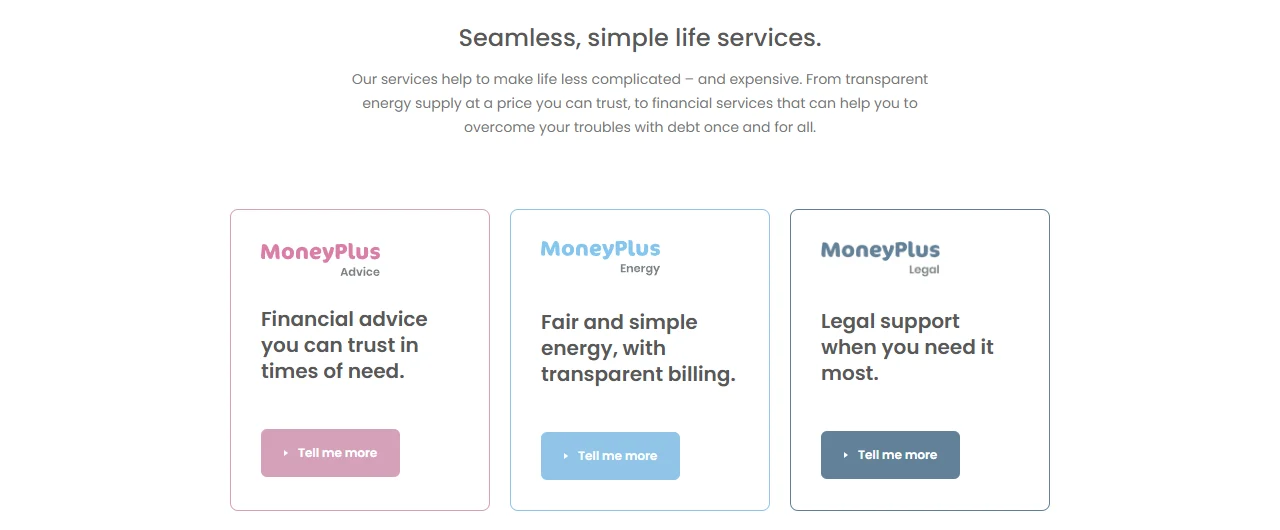
There is nothing improper in any of that. Plenty of groups sell more than one thing, energy is a legitimate product for a financial services company to offer, and nothing on the record suggests MoneyPlus Energy treated its customers badly. The reason it is worth noticing is simply who the group was talking to. A company whose front page is about debt and times of need is reaching people for whom a few hundred pounds sitting in an energy account is not a rounding error.
Why the safety net mattered here
Ofgem's safety net gets described on every page of this record in the same flat terms: domestic credit balances are protected. MoneyPlus is a good place to say what that actually prevents.
Most households on a monthly direct debit are in credit for most of the year, by design. You pay the same amount every month while using far more energy in winter than in summer, so a balance builds up over the warmer months and is drawn down over the colder ones. By late summer, which is when MoneyPlus failed, a typical direct debit customer is at or near their annual high point.
Without the guarantee, that money would be an unsecured claim in an administration, ranking behind secured lenders and preferential creditors, and in practice returning pennies in the pound or nothing at all. The published figures for the GOTO Energy administration show what they actually return: a creditor dividend of £15,720.93 against roughly £12.4 million of costs.
With the guarantee, the balance transfers to the new supplier and the cost of honouring it is spread across the market. Nobody has to be able to afford the loss, because there is no loss.
What to do if your supplier fails
- Take a meter reading the day you hear. Photograph it. That reading decides where your old account stops and your new one starts.
- Do not cancel the direct debit. It makes the account harder to reconcile and does not get your money back faster.
- Wait to be contacted rather than switching away, so the balance and the transfer are handled together.
- Expect it to take weeks, not days. The final figure has to come from the administrators.
- If you are struggling, say so. The new supplier inherits your account, including any arrangement you were on, and Citizens Advice can help if it does not.
Two suppliers in one day
MoneyPlus Energy did not fail alone. PfP Energy ceased trading the same day, 7 September 2021, and British Gas took both books on together from 11 September.
That pairing is the first sign of what the rest of 2021 would look like. Until then, supplier failures had come one at a time, with weeks or months between them, and Ofgem could run a competitive process for each. From September onwards they arrived in clusters, and by the time Colorado Energy and Pure Planet went on the same October day, a single rescuer was absorbing hundreds of thousands of customers at once.
Key dates
| Date | What happened |
|---|---|
| 14 June 2021 | The MoneyPlus group website is selling debt advice, energy and legal support side by side |
| 7 September 2021 | MoneyPlus Energy ceases trading with around 9,000 domestic customers, on the same day as PfP Energy |
| 11 September 2021 | British Gas takes on the customers of both suppliers |
| 13 September 2021 | MoneyPlus Energy Limited enters administration |
| 8 September 2022 | The administration concludes |
What it means for a business
Ofgem recorded MoneyPlus Energy's book as 9,000 domestic customers and published no business figure, so this is not a page about a business failure.
It is, though, the clearest illustration of the gap, because the argument made above for households is exactly the argument that does not apply to companies.
A business on a monthly payment plan builds up a credit balance over the summer in the same way a household does, for the same reason. The difference is what happens to it. The household balance is guaranteed and transfers. The business balance is not guaranteed, and whether it transfers depends on a decision taken by the incoming supplier during the appointment process, which is settled in days and published afterwards if at all. When Hub Energy failed later that same year, Ofgem recorded that only a minority of the ten suppliers bidding were willing to cover non-domestic balances.
So the practical advice for a business is the inverse of the advice for a household. A household should leave the direct debit alone and let the system work. A business should keep the balance down, because there is no system behind it.
| A credit balance built up over summer | Household | Business |
|---|---|---|
| Guaranteed if the supplier fails | Yes | No |
| Transfers to the new supplier | Yes | Only if that supplier agreed to it |
| Otherwise ranks as | Not applicable | An unsecured claim in the administration |
| Typical return on an unsecured claim | Not applicable | Pennies in the pound, or nothing |
Where to start
- What business electricity costs at the moment
- Business gas prices and standing charges today
- Suppliers open to new commercial accounts
If a failure has already moved your business, check what a deemed contract is costing you.
MoneyPlus Energy FAQs
What happened to MoneyPlus Energy?
Did MoneyPlus Energy fail in 2018?
Were MoneyPlus Energy credit balances protected?
What was MoneyPlus Energy’s connection to debt advice?
Who took over MoneyPlus Energy customers?
Did MoneyPlus Energy supply businesses?
What should I do if my energy supplier goes bust?
Sources
- Ofgem, MoneyPlus Energy customers: your questions on new supplier British Gas, September 2021
- moneyplusgroup.com, capture of 14 June 2021, and moneyplusenergy.com, capture of 23 September 2021, Internet Archive
- Companies House, MoneyPlus Energy Limited, company number 10769313