

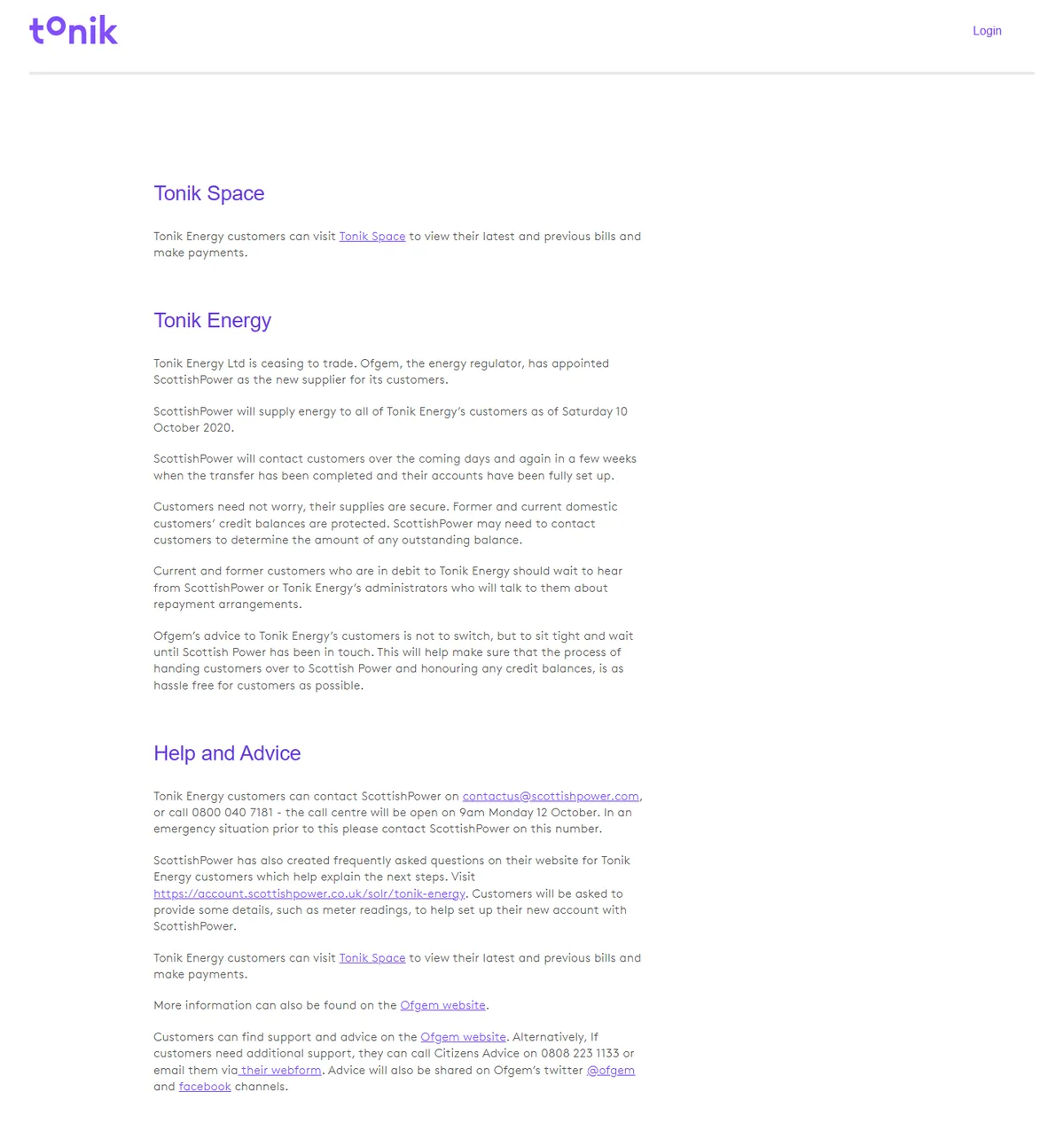
Tonik Energy stopped trading in October 2020 with around 130,000 domestic customers. Ofgem appointed ScottishPower as supplier of last resort, and it began supplying every Tonik account on Saturday 10 October 2020. Credit balances were honoured for current and former customers, and nobody was charged an exit fee to leave afterwards.
Weeks earlier Ofgem had named Tonik as owing £8,776,684.88 in renewables and feed-in tariff payments. It is the clearest cause of death on this site, and the detail that makes it worth reading: a supplier built on renewable energy brought down by the bill that pays for renewable energy. If your own supply is sitting on a default rate, you can check which suppliers will take on a business site.
What happened to Tonik Energy?
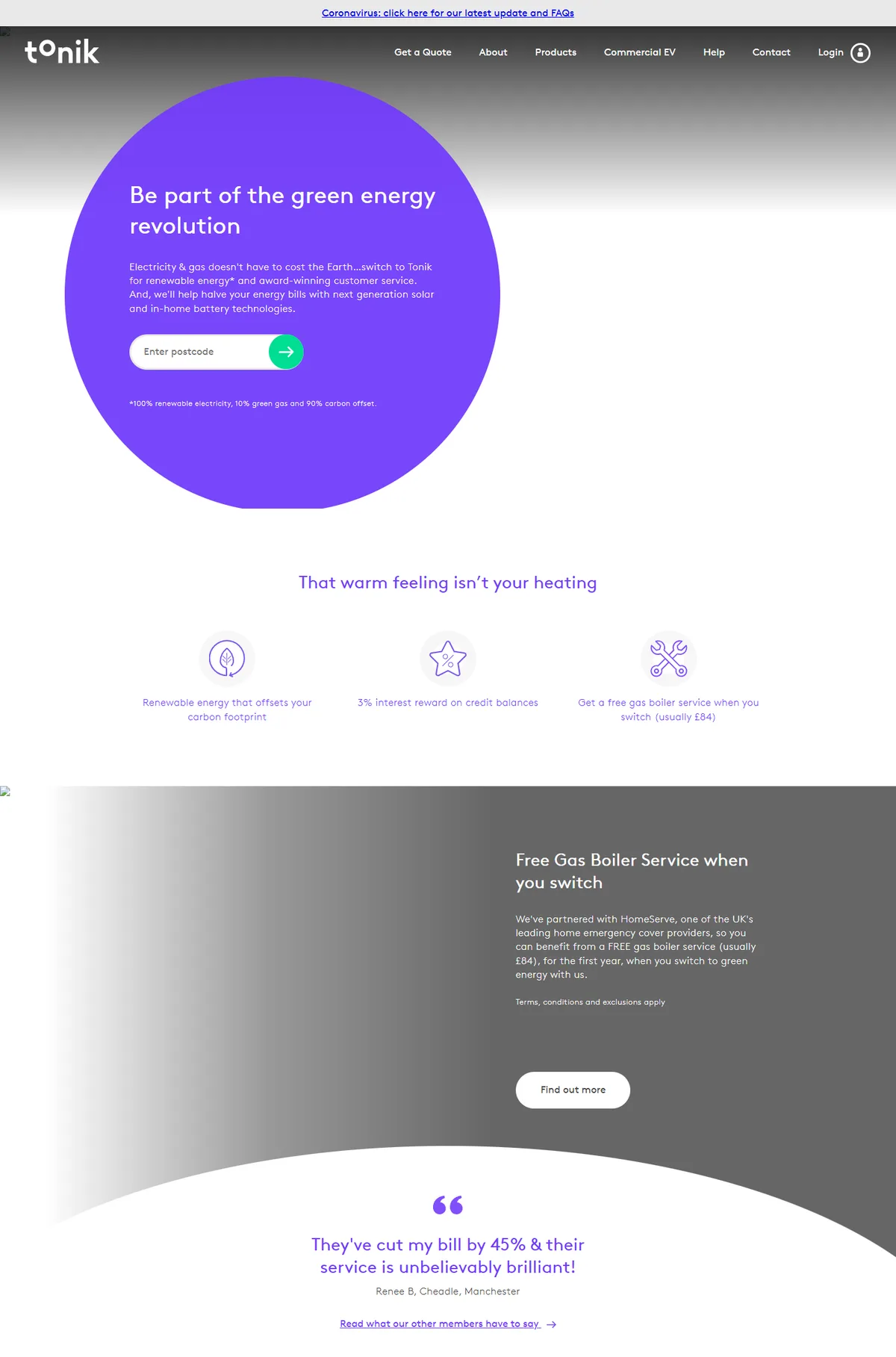
Tonik Energy was a Birmingham supplier that had been trading since 2015 and sold itself as more than an energy company. Its homepage asked customers to "be part of the green energy revolution", and the product range went well past gas and electricity: solar panels, in-home battery storage and chargers for electric vehicles, with a separate commercial arm for EV charging.
It ceased trading in October 2020. Ofgem announced on 9 October that ScottishPower had been appointed supplier of last resort after what it called "a competitive process to get the best deal for customers", and ScottishPower took on every account from Saturday 10 October. Joint administrators, Matthew James Cowlishaw and Paul James Meadows, were appointed to Tonik Energy Limited on 12 October.
It was the third supplier to fail in 2020 and sits on our record of the full list of UK energy suppliers that have failed since 2016.
What it actually sold
The offer was unusually specific for a small supplier, and all of it is still legible in the archived site:
- 100% renewable electricity, 10% green gas and 90% carbon offset
- Solar panels and in-home battery storage, pitched as a way to "halve your energy bills"
- Home and commercial EV chargers
- A 3% interest reward paid on customer credit balances
- A free HomeServe gas boiler service, normally £84, for the first year after switching
Why did it collapse?
Unlike most failures on this site, there is no guesswork involved. Ofgem published the number, published it eleven days before the company went, and published it alongside six other suppliers in the same position.
Every electricity supplier in Great Britain has to meet the Renewables Obligation each year. It does that in one of two ways: by presenting Renewables Obligation Certificates, which it gets by buying renewable power, or by paying into the buy-out fund instead. The deadline to pay was 31 August 2020 and the deadline to present certificates was 1 September 2020. Tonik met neither.
It had also missed its Feed-in Tariff Year 10 annual levelisation payment, the mechanism that spreads the cost of the FIT scheme across suppliers.
A shortage of cash, not of customers
Tonik was not shrinking. It had roughly 130,000 customers when it went, having grown fast on a low-price, high-service pitch, and the products around the supply business needed money spent up front. What it did not have, when two of the market's biggest annual bills landed within a day of each other, was the cash to pay them.
The scale of the problem was not unique to Tonik. Across 2019-20 there was a combined shortfall of £105,555,614.21 in the buy-out funds, caused by 33 suppliers failing to meet their obligations.
The renewables bill it could not pay
On 2 October 2020 Ofgem proposed provisional orders against seven suppliers for a combined £34 million. Tonik Energy Limited was named for £8,776,684.88, made up of £8,651,815.92 of Renewables Obligation payments and £124,868.96 of Feed-in Tariff levelisation. Only Robin Hood Energy owed more.
What seven suppliers owed when Ofgem proposed orders
- Robin Hood Energy £12.09m
- Tonik Energy £8.78m
- Co-operative Energy £5.47m
- Flow Energy £2.69m
- Nabuh Energy £2.68m
- MA Energy £1.39m
- Symbio Energy £0.93m
Tonik never paid it. Ofgem opened a final order but abandoned it, recording that "as Tonik ceased trading on 26 October 2020, the Authority has taken the decision not to proceed with issuing a FO", and saying it would instead "engage with Tonik's administrators and seek to recover as much money as possible through that process".
That 26 October date is Ofgem's own, and it sits oddly beside the handover, which was finished on 10 October. The practical end of Tonik as a supplier was the earlier date. The later one is the date the regulator's renewables paperwork records, five days before the 31 October late payment deadline that would have made the debt formally enforceable.
| What Tonik owed | Amount |
|---|---|
| Renewables Obligation | £8,651,815.92 |
| Feed-in Tariff Year 10 levelisation | £124,868.96 |
| Total named by Ofgem, 2 October 2020 | £8,776,684.88 |
What its customers got
The handover itself was one of the cleaner ones. Nobody lost supply, nobody lost money, and Ofgem picked the new supplier through a competitive process rather than simply assigning the book.
Credit balances, including for people who had left
Ofgem was explicit that "all outstanding credit balances, including money owed to both existing and former domestic customers of Tonik, will also be honoured". That second half matters. Tonik paid a 3% interest reward on credit balances, which gave customers a reason to run an account in credit, and people who had already switched away were still owed those balances. They were covered too.
The tariff did not carry over
Ofgem described ScottishPower as "offering customers a competitive tariff" and did not say the old Tonik prices survived. In practice that is the normal outcome: accounts move onto the new supplier's terms rather than keeping the deal they were on, which is usually dearer than the tariff it replaces.
Customers were free to leave, and Ofgem confirmed they "will not be charged exit fees if they decide to switch to another supplier". The standing advice was still to wait until ScottishPower had been in touch before moving, so the transfer and the credit balances settled cleanly first.
That is the same outcome as Economy Energy, whose customers moved to a deemed rate, and not the better one that GB Energy Supply and Spark Energy customers got, where the prices carried over intact.
What it cost the rest of the market
On 17 December 2021 Ofgem approved a last resort supply payment of £1.04 million to ScottishPower for the additional costs of taking Tonik on. Those payments are recovered through network charges, which means they reach every bill in the country, including business ones.
Key dates
| Date | What happened |
|---|---|
| 31 August 2020 | Deadline to make Renewables Obligation buy-out payments passes |
| 1 September 2020 | Deadline to present Renewables Obligation Certificates instead passes |
| 2 October 2020 | Ofgem names Tonik among seven suppliers owing money, £8,776,684.88 in its case |
| 9 October 2020 | Ofgem announces ScottishPower as supplier of last resort |
| 10 October 2020 | ScottishPower begins supplying all Tonik customers |
| 12 October 2020 | Joint administrators appointed to Tonik Energy Limited |
| 26 October 2020 | The date Ofgem records Tonik as having ceased trading |
| 30 October 2020 | Ofgem decides not to issue a final order and turns to the administrators |
| 17 December 2021 | Ofgem approves a £1.04m last resort supply payment to ScottishPower |
What it means for a business
Everything Ofgem published about this failure concerns domestic customers. The 130,000 figure is a domestic one, no non-domestic number was released, and Tonik's commercial activity showed up in EV charging rather than in a business supply book. So what any business customer received here is not on the public record.
The general position is worth knowing before it affects you, because a business has fewer protections than a household when its supplier fails:
| When your supplier fails | Household | Business |
|---|---|---|
| Supply continues | Yes | Yes |
| Ofgem protects your credit balance | Yes, under the safety net | No |
| A cap limits the rate you move onto | Yes | No |
| You are charged to leave that rate | No | No |
Where to start
- Business electricity prices, per kWh and standing charge, as they stand this month
- What a business is quoted for gas per kWh, priced off a separate market
- Which suppliers are open to new business contracts, if you want the field before you choose
Our guide explains what a deemed rate is and how to get off it.
For other outcomes from the same process, see Ampower, the one with business customers on the books, and Spark Energy, where the tariff survived the handover.
Tonik Energy FAQs
What happened to Tonik Energy?
Who took over Tonik Energy customers?
Did Tonik Energy customers lose money?
Did customers keep their Tonik tariff?
Why did Tonik Energy go bust?
What is the Renewables Obligation?
Did Tonik Energy supply businesses?
Sources
- Ofgem, Ofgem appoints Scottish Power to take on customers of Tonik Energy Ltd, 9 October 2020
- Ofgem, Ofgem proposes orders to pay £34 million in Renewables Obligations and Feed-in Tariff payments, 2 October 2020
- Ofgem, Tonik Energy Limited: Final Order, 30 October 2020
- Ofgem, Decision on Last Resort Supply Payment claim from Scottish Power for Yorkshire Energy and Tonik Energy, 17 December 2021
- Internet Archive, tonikenergy.com as captured on 29 September 2020 and on 19 October 2020