

RAM Energy closed in September 2020, when Robin Hood Energy, the supplier whose licence it ran on, was sold to British Gas. Derby City Council had launched it in October 2017, named after the ram the city has used as its symbol for centuries.
Of the ten council brands, this is the one that went furthest past being a logo on a tariff. Derby wired it into its own housing, benefits and advice services, and ran a fuel poverty fund through it. When the licence was sold, the council was left with all of that and nothing to connect it to. If you want to know which licensed supplier stands behind a brand you are buying from, you can find out who is quoting for business sites.
What happened to RAM Energy?
Derby City Council launched RAM Energy on 7 October 2017 to sell cheaper gas and electricity to households in Derby and the wider Midlands. Reporting at the time put fuel poverty in the region at close to one household in six, and the council adopted a not-for-profit model specifically to keep prices down.
It held no supply licence. The energy was supplied under the licence of Robin Hood Energy, the company Nottingham City Council owned, which by then was already supplying several other council brands. When Nottingham sold that business to British Gas on 4 September 2020, RAM Energy ended with the nine others. It sits on our record of the whole record of failed UK suppliers since 2016.
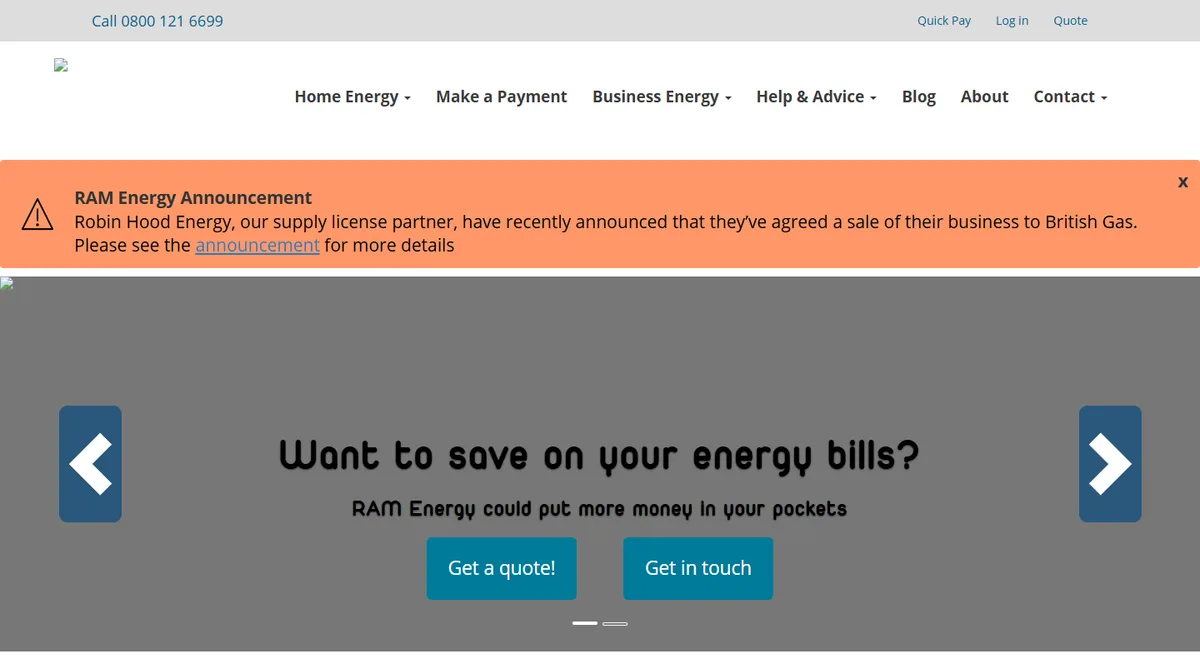
The one that was plugged into the council
Most of these brands were a website, a tariff and a logo. Derby built something more involved, and the evidence is a document the council still publishes today: a privacy notice for "RAM Energy fuel poverty".
Privacy notices are dull by design, which is what makes them useful. This one sets out, in the council's own words, exactly what RAM Energy was doing with residents' data and why. The council collected names, addresses and "other more sensitive data" in order to "provide a quote for energy" and "to administer the RAM Energy Fuel Poverty Fund".
That data did not only come from people filling in a form. It came from inside the council and from the organisations it works with:
- Derby Homes, the council's housing arm
- The council's own website and RAM Energy's
- Citizens Advice
- The Department for Work and Pensions
- Charities working with RAM Energy
And it flowed outwards to one place in particular. The notice says the council shares information with "Our supply partner Robin Hood Energy where appropriate. For example the delivery of the RAM Energy Fuel Poverty Fund."
On top of that, frontline council staff were to walk residents through switching rather than leaving them to a comparison site. This was a referral machine attached to a tariff, not a marketing exercise.
What its customers got
RAM Energy's customers were households in Derby and the Midlands, and they moved to British Gas with the rest of Robin Hood Energy's book.
Because the customer base was sold as a going concern rather than collapsing, no supplier of last resort process was involved. Nobody was put onto a deemed rate, prices were matched or bettered, and there were no exit fees for anyone who chose to move elsewhere instead. Supply was never at risk.
The tariff survived in economic terms. The scheme around it did not.
What Derby was left holding
This is the part that separates RAM Energy from the other nine, and it is worth being precise about it.
When the licence was sold, Derby still had everything it had built. The referral routes from Derby Homes and the DWP still existed. The relationships with Citizens Advice and local charities still existed. The trained frontline staff still existed. The Fuel Poverty Fund still existed.
What it no longer had was anywhere to send people. A referral scheme needs a tariff at the end of it, and the tariff was gone because it had never belonged to Derby in the first place.
The privacy notice is still on the council's website years later, describing a supply partner that no longer exists and a fund delivered through it. Whether that is an oversight or a document nobody has had reason to retire, it is a reasonable summary of what these arrangements left behind: the local half intact, and the half that made it work sold to somebody else.
Key dates
| Date | What happened |
|---|---|
| 7 October 2017 | Derby City Council launches RAM Energy, supplied under Robin Hood Energy’s licence |
| 2017 onwards | The council runs a RAM Energy Fuel Poverty Fund, taking referrals via Derby Homes, Citizens Advice, the DWP and charities |
| 4 September 2020 | Nottingham City Council announces the sale of Robin Hood Energy to British Gas |
| September 2020 | RAM Energy closes; customers transfer to British Gas |
| May 2021 | The RAM Energy website is decommissioned |
What it means for a business
RAM Energy sold to businesses as well as households. Its site carried a Business Energy section with its own terms, meter reading instructions, FAQs and efficiency advice: operational pages for a live service rather than a placeholder. It is one of four of the ten council brands that did so, alongside Southend Energy, White Rose Energy and Your Energy Sussex.
So a Derby business could buy energy from a council brand whose legal footer named a company in Nottingham, and whose supply licence belonged to a different council entirely.
The reason it belongs here is the division of labour, which is exactly the same in non-domestic energy. A broker, a buying group or a trade association builds the customer relationship, the local knowledge and the service around it. A licensed supplier holds the contract. The first half can be excellent and still be worth nothing on the day the second half changes hands.
Before signing under any brand that is not itself a licensed supplier, the questions are the same three: who holds the licence, what happens if they are sold or fail, and who you call when something goes wrong. If the licence holder fails rather than being sold, this is the position:
| When your supplier fails | Household | Business |
|---|---|---|
| Supply continues | Yes | Yes |
| Ofgem protects your credit balance | Yes, under the safety net | No |
| A cap limits the rate you move onto | Yes | No |
| You are charged to leave that rate | No | No |
Where to start
- Business electricity unit rates right now, with the daily standing charge
- Gas prices quoted to businesses, set in a separate market
- Suppliers holding licences for business supply, so you know who the contract is with
Our guide explains the terms that apply once an agreement lapses.
For the contract lesson from the same group, see The Leccy and its five-year deal.
RAM Energy FAQs
What happened to RAM Energy?
Who took over RAM Energy customers?
What was the RAM Energy Fuel Poverty Fund?
Why was RAM Energy called that?
Was RAM Energy a real energy supplier?
Did RAM Energy supply businesses?
What happened to the fuel poverty scheme?
Sources
- Derby City Council, RAM Energy fuel poverty: privacy notice
- The Energyst, Derby City Council launches Ram Energy, powered by Nottingham, 7 October 2017