

Your Energy Sussex closed in September 2020, when Robin Hood Energy, the supplier whose licence it ran on, was sold to British Gas. Launched in February 2018 and led by West Sussex County Council, it was backed by more authorities than any of the other nine council brands.
It is also the one that matters most on a business energy site. Of the ten, only four sold to non-domestic customers, and this is the only one that ran a dedicated business and charity tariff, with registered charities getting the business rate at a discount. You can see which licensed suppliers are quoting for non-domestic supply today.
What happened to Your Energy Sussex?
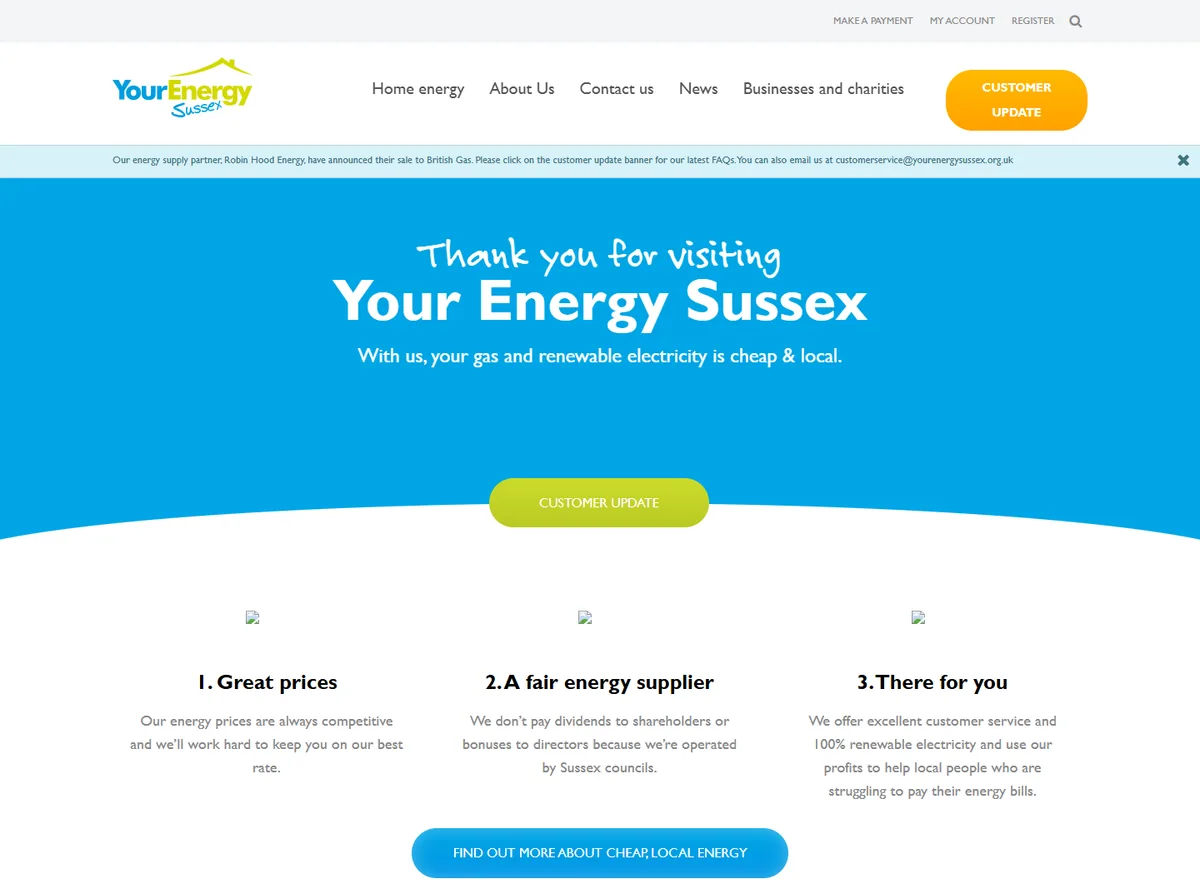
Your Energy Sussex launched in February 2018 with a simple promise on the homepage: "With us, your gas and renewable electricity is cheap and local." It explained its model in one line that no commercial supplier could use: "We don't pay dividends to shareholders or bonuses to directors because we're operated by Sussex councils."
It supplied 100% renewable electricity and said it used its profits "to help local people who are struggling to pay their energy bills". In its first four months, over a thousand households switched to it, with average potential savings reported at £300 a year.
It held no supply licence. The energy came from Robin Hood Energy, owned by Nottingham City Council. When Nottingham sold that business to British Gas on 4 September 2020, Your Energy Sussex ended, the last of the ten brands running on that licence to be covered here. It sits on our record of every UK supplier and brand that has closed since 2016.
The biggest coalition of the ten
Most of these brands belonged to one council. Fosse Energy had two. White Rose Energy had three. Your Energy Sussex had more than any of them, and spanned three separate upper-tier authorities plus the districts underneath them.
| Authority | Role |
|---|---|
| West Sussex County Council | Led the partnership |
| East Sussex County Council | Partner authority |
| Brighton & Hove City Council | Partner authority |
| District and borough councils across Sussex | Delivered locally |
The councillors who launched it were unusually clear that the point was not simply to sell their own tariff. Deborah Urquhart at West Sussex said they had "made a really good start in encouraging people across the county to become regular switchers and save money". Nick Bennett at East Sussex said it "encourages people to shop around for lower gas and electricity tariffs". Anne Meadows at Brighton and Hove framed it as helping people compare: "comparing tariffs offered by different energy suppliers can help people to get a better deal".
The last of the ten was the one that told people to shop around. We run a comparison site, so we would say that is the right instinct, but it is also the one thing on this page that survived the brand.
The business and charity tariff
Five of the ten council brands sold to households and nothing else. Four did not: Southend Energy ran a business tariff in its OVO years, White Rose Energy carried a non-domestic section, and Your Energy Sussex went furthest of the three.
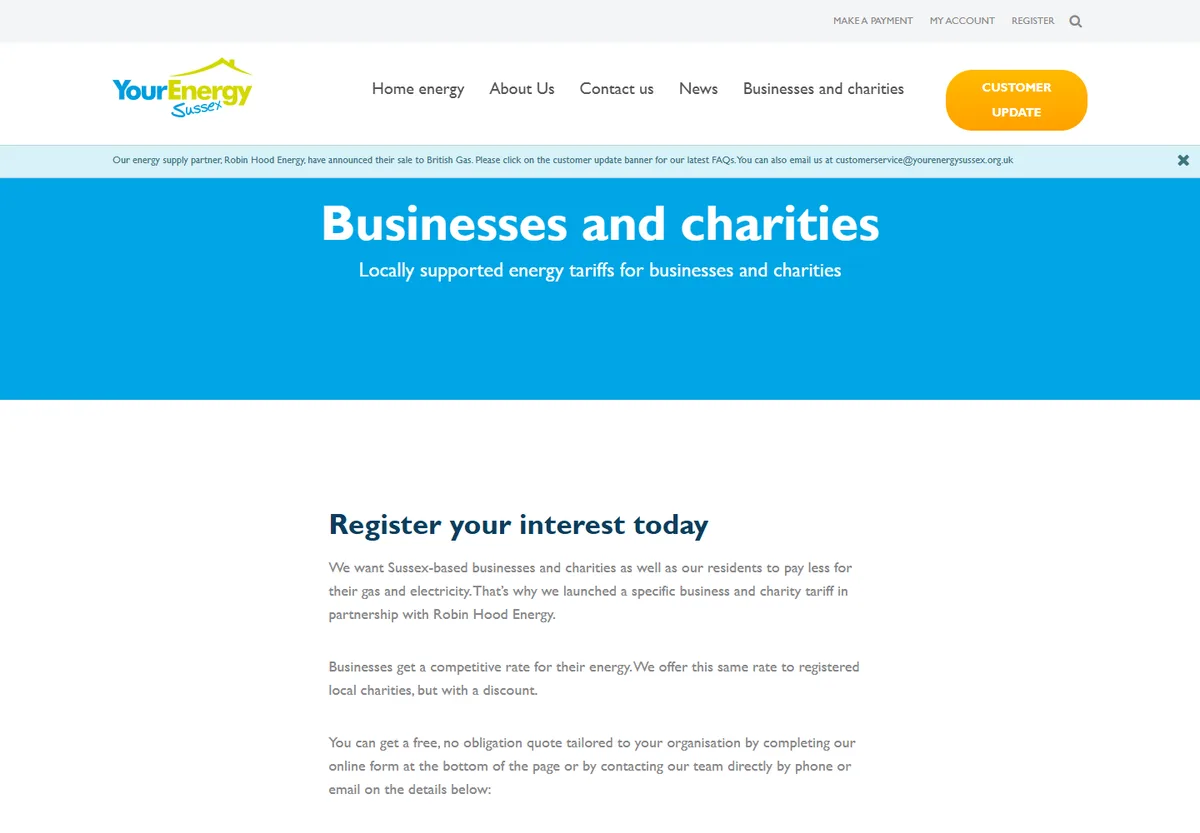
It ran a specific product, described in its own words: "We want Sussex-based businesses and charities as well as our residents to pay less for their gas and electricity. That's why we launched a specific business and charity tariff in partnership with Robin Hood Energy."
The detail that sets it apart from anything else in this series is what came next: "Businesses get a competitive rate for their energy. We offer this same rate to registered local charities, but with a discount." A free, no-obligation quote was offered, tailored to the organisation.
A charity discount on a non-domestic tariff is not something a commercial supplier has much reason to offer. It is the clearest example anywhere on this site of what a council-run brand could do that the market would not, and it lasted about two and a half years.
What its customers got
Customers found out from a banner across the top of the site: "Our energy supply partner, Robin Hood Energy, have announced their sale to British Gas. Please click on the customer update banner for our latest FAQs. You can also email us at customerservice@yourenergysussex.org.uk."
They moved to British Gas with the rest of Robin Hood Energy's book. Because the customer base was sold as a going concern rather than collapsing, there was no supplier of last resort process, nobody was moved onto a deemed rate, prices were matched or bettered, and no exit fees applied to anyone who chose to go elsewhere instead.
That applied to the households. What the business and charity customers were offered is not set out in the public record the way the domestic position is, which is the recurring gap across this whole section of the site.
The website itself is gone. The domain no longer resolves to a working site.
Key dates
| Date | What happened |
|---|---|
| February 2018 | Your Energy Sussex launches, led by West Sussex County Council with East Sussex, Brighton and Hove and district councils |
| First four months | Over a thousand households switch, with average potential savings reported at £300 a year |
| By 2019 | A specific business and charity tariff is running, with a discount for registered local charities |
| 4 September 2020 | Nottingham City Council announces the sale of Robin Hood Energy to British Gas |
| September 2020 | Your Energy Sussex closes; customers move to British Gas |
What it means for a business
This is the tenth and last of the council white-label brands on this site, and it is the one where a business was most directly involved. A Sussex firm or charity could buy electricity and gas from it, on a tariff designed for them, from an organisation accountable to local councillors.
And the arrangement ended in exactly the same way as the nine household-only brands did, on the same day, for the same reason, with no more warning. Nothing about being a business customer, or having a better tariff, or dealing with a council rather than a call centre, changed the outcome.
The question to carry away from all ten is short: who holds the licence, and what happens to me if they are sold or fail? If they fail rather than being sold, the answer is this:
| When your supplier fails | Household | Business |
|---|---|---|
| Supply continues | Yes | Yes |
| Ofgem protects your credit balance | Yes, under the safety net | No |
| A cap limits the rate you move onto | Yes | No |
| You are charged to leave that rate | No | No |
Where to start
- Business electricity prices in today's market, unit rate and standing charge
- What businesses are paying for gas, priced separately from electricity
- The licensed suppliers taking on business and charity sites, so you know whose licence you are on
Our guide explains what happens to your rate when no contract is in force.
For the council that owned its supplier outright and lost money doing it, see Robin Hood Energy and the ten brands it carried.
Your Energy Sussex FAQs
What happened to Your Energy Sussex?
Which councils ran Your Energy Sussex?
Did Your Energy Sussex supply businesses?
Who took over Your Energy Sussex customers?
Was Your Energy Sussex a real energy supplier?
How many customers did it have?
Is the Your Energy Sussex website still up?
Sources
- Brighton & Hove City Council, Council-backed energy supplier goes from strength to strength, 2018
- Energy Ombudsman, Your Energy Sussex complaints
- Internet Archive, yourenergysussex.org.uk as captured on 30 September 2020 and its businesses and charities page