
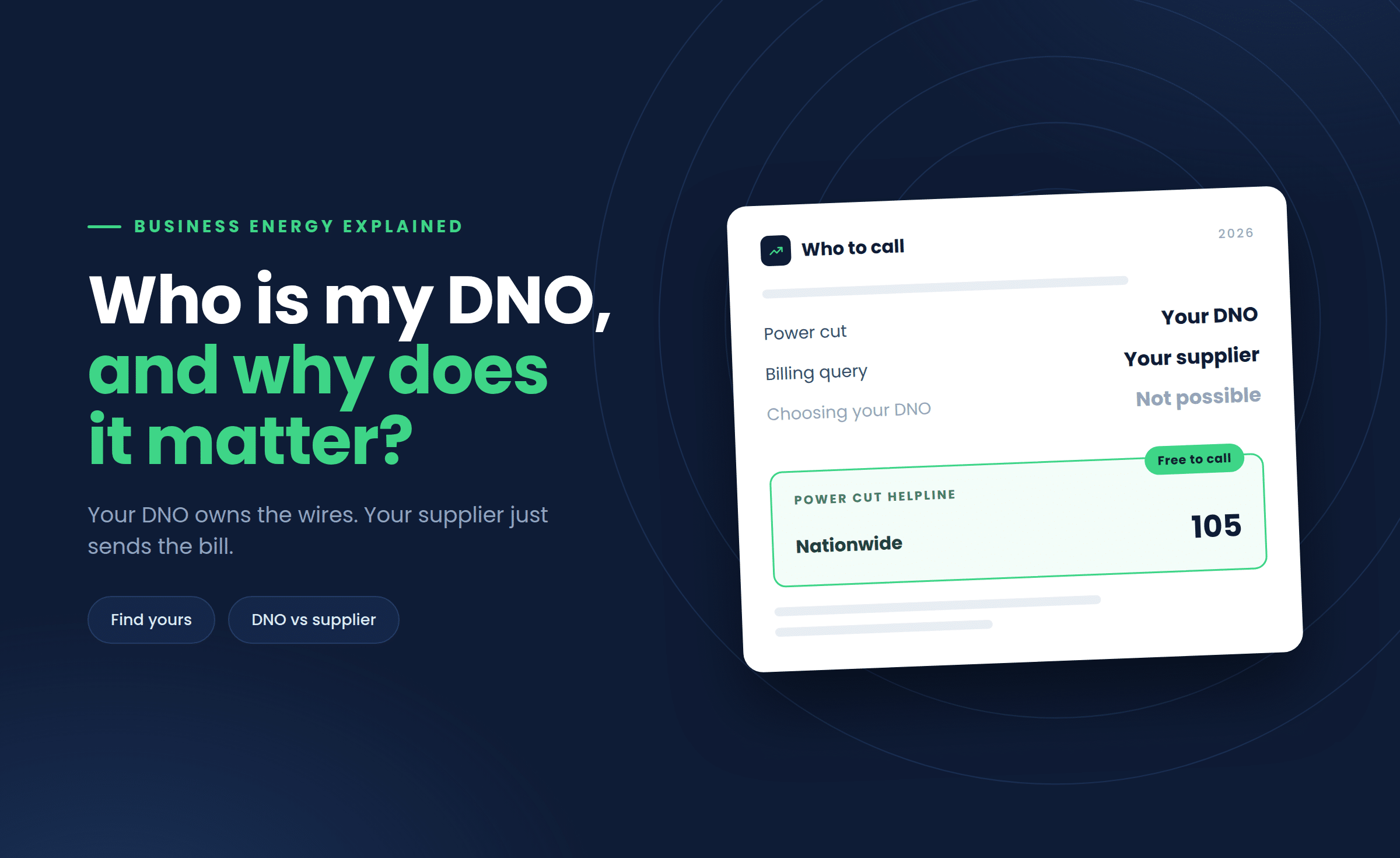
A Distribution Network Operator, or DNO, is the regulated company that owns and maintains the local electricity cables, substations and infrastructure delivering power to your business premises. It is a separate business from whoever supplies and bills you for that electricity.
The DNO gets confused with the supplier fairly often, and it is an easy mix-up given both appear connected to how your business gets its power.
One company sells you electricity as a commodity and competes for your custom. The other owns the physical wires and has no say in who you buy from.
That split, between the network and the market that runs on top of it, is fundamental to how Great Britain’s electricity system has worked since privatisation.
What does a distribution network operator actually do?
A DNO builds, owns and maintains the local electricity network, from substations down to the cable running into your building. It also manages new connections, capacity upgrades and fault repairs across its licence area.
Regulated, not competitive
That covers everything below the high-voltage transmission grid: regional substations, local transformers and the lower-voltage cables most businesses connect to. Ofgem licenses and regulates every DNO, setting the network price controls on what they can charge.
- Maintains the network: local substations, transformers and cables.
- Handles connections: new connection requests and capacity upgrades.
- Responds to faults: power cuts and network faults in its licence area.
How is a DNO different from your energy supplier?
Your supplier sells electricity and competes for your business through pricing and service. Your DNO owns the physical network and has a regional monopoly with no competition at all.
One you can switch, one you can’t
You can switch supplier every year if you want. You cannot switch DNO, because there is only ever one company physically wired to your postcode.
Dozens of business energy suppliers all compete on the same network, run by whichever DNO happens to cover that region. The network stays fixed while the market on top of it moves.
How is a DNO different from National Grid and NESO?
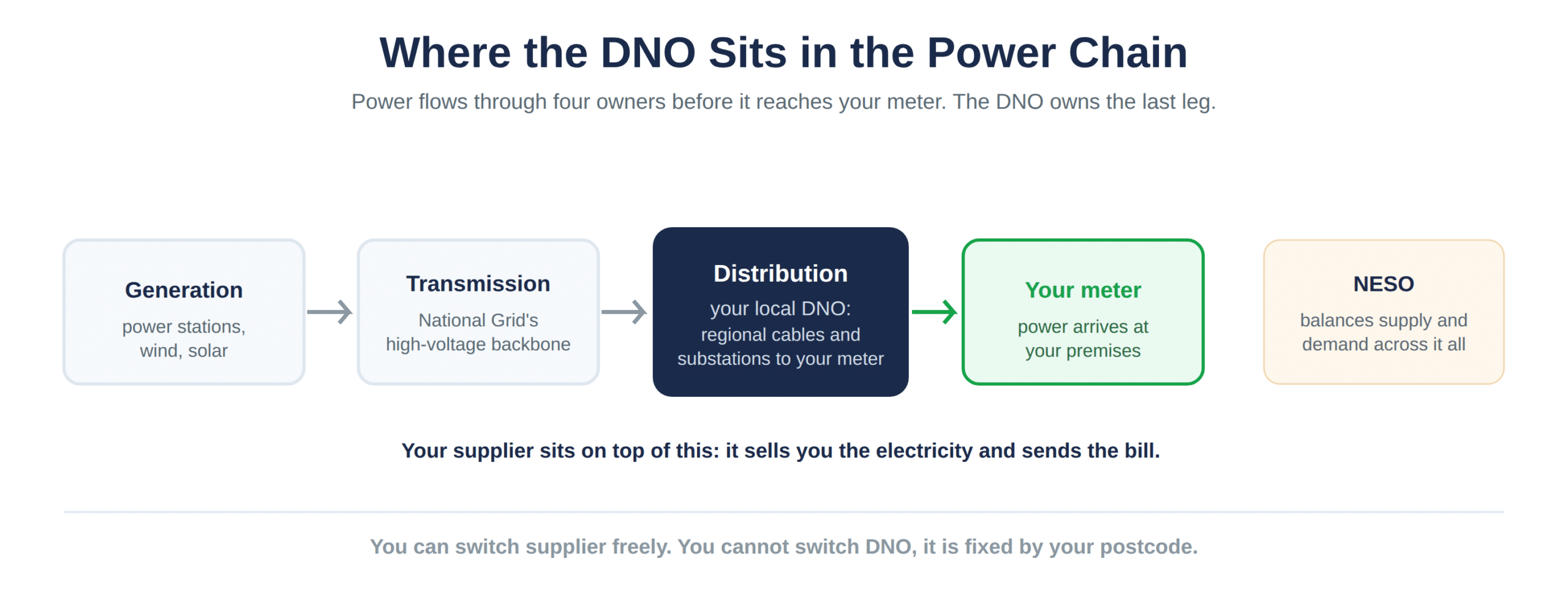
National Grid Electricity Transmission owns the high-voltage backbone connecting power stations to regional networks, while NESO, the National Energy System Operator, balances supply and demand across the country in real time. Neither deals directly with your premises.
The flow from generator to meter
| Layer | Who runs it | What it covers |
|---|---|---|
| Generation | Power stations, wind, solar | Producing electricity |
| Transmission | National Grid Electricity Transmission | High-voltage backbone across the country |
| System balancing | NESO | Matching supply and demand nationally |
| Distribution | Your local DNO | Regional substations and cables to your meter |
| Supply | Your chosen supplier | Billing, contracts and customer service |
Power flows from generators, onto the transmission system, then down into a regional DNO network, before reaching your meter through local low-voltage cables. NESO keeps the whole system balanced second by second.
National Gas Transmission plays the equivalent role for gas, moving it around the high-pressure national network before regional networks take over. Comparing business gas works the same way: you pick the supplier, not the network.
How do DNO charges appear on your business energy bill?
DNO costs show up as Distribution Use of System (DUoS) charges, built into your unit rate or itemised separately depending on your supplier’s billing format. You never pay the DNO directly.
Where dUoS sits on the bill
DUoS charges vary by time of day and region, since network wear differs between a rural area and a city-centre network. They sit among the wider non-commodity costs, separate from the Climate Change Levy, so do not mistake one for the other when reading a business energy bill.
If your business runs half-hourly settlement, our guide to half-hourly meters explains how those time-banded charges are calculated.
How do you identify which DNO covers your premises?
Check the two-digit Distributor ID within your MPAN on a recent bill, or search your postcode via the Energy Networks Association website for an instant match.
Two ways to check, plus one exception
- Distributor ID: a two-digit code within your MPAN that maps to a specific DNO.
- Postcode search: an instant lookup via the Energy Networks Association.
A small number of newer developments sit on a private network owned by an Independent Distribution Network Operator, rather than one of the six main DNOs directly. These still connect back into the regional network, and the same regulation and charging broadly apply.
It is worth doing this check once and keeping a note, particularly across multiple sites, and our guide to who your DNO is and why it matters covers the day-to-day side.