
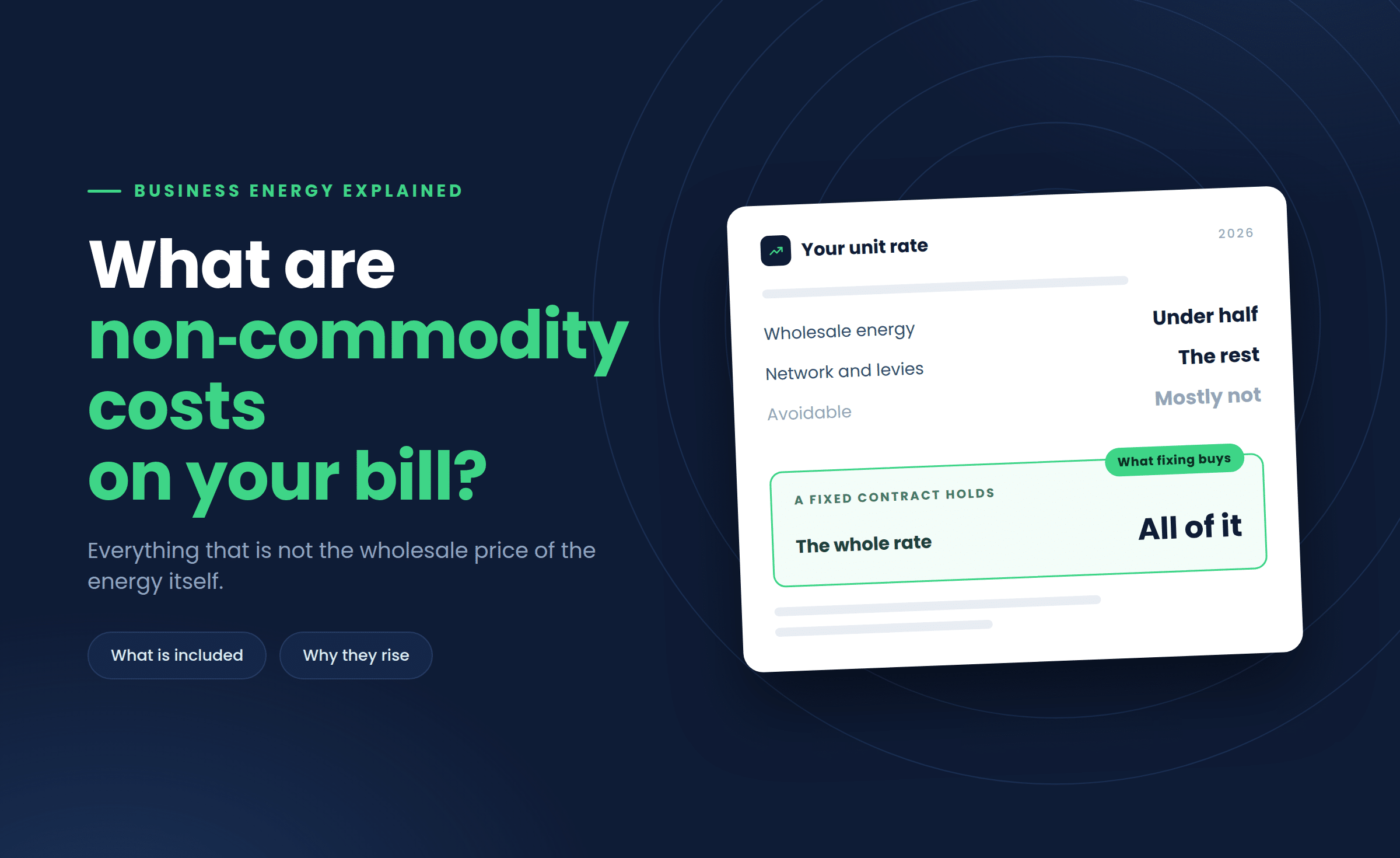
Non-commodity costs are everything on a business energy bill that is not the wholesale price of the gas or electricity itself, covering network charges, environmental levies and supplier operating costs. On many contracts they now make up a larger share of the total than the energy price does.
Open a business energy invoice line by line and the wholesale unit rate is only part of the story. A cluster of other charges sits alongside it, each funding a different part of getting power to your premises.
Most business owners never separate these out. The bill just shows one total, and the assumption is that it is all the energy price.
It is not. Wholesale cost, network charges, policy costs and supplier margin are four genuinely different things bundled into a single figure.
What’s included in non-commodity charges on a business bill?
Non-commodity charges include network costs (DUoS, TNUoS and BSUoS), environmental and policy costs like the Climate Change Levy and Renewables Obligation, plus metering, settlement and supplier operating costs.
Different owners, different reasons
| Charge | What it pays for | Who sets it |
|---|---|---|
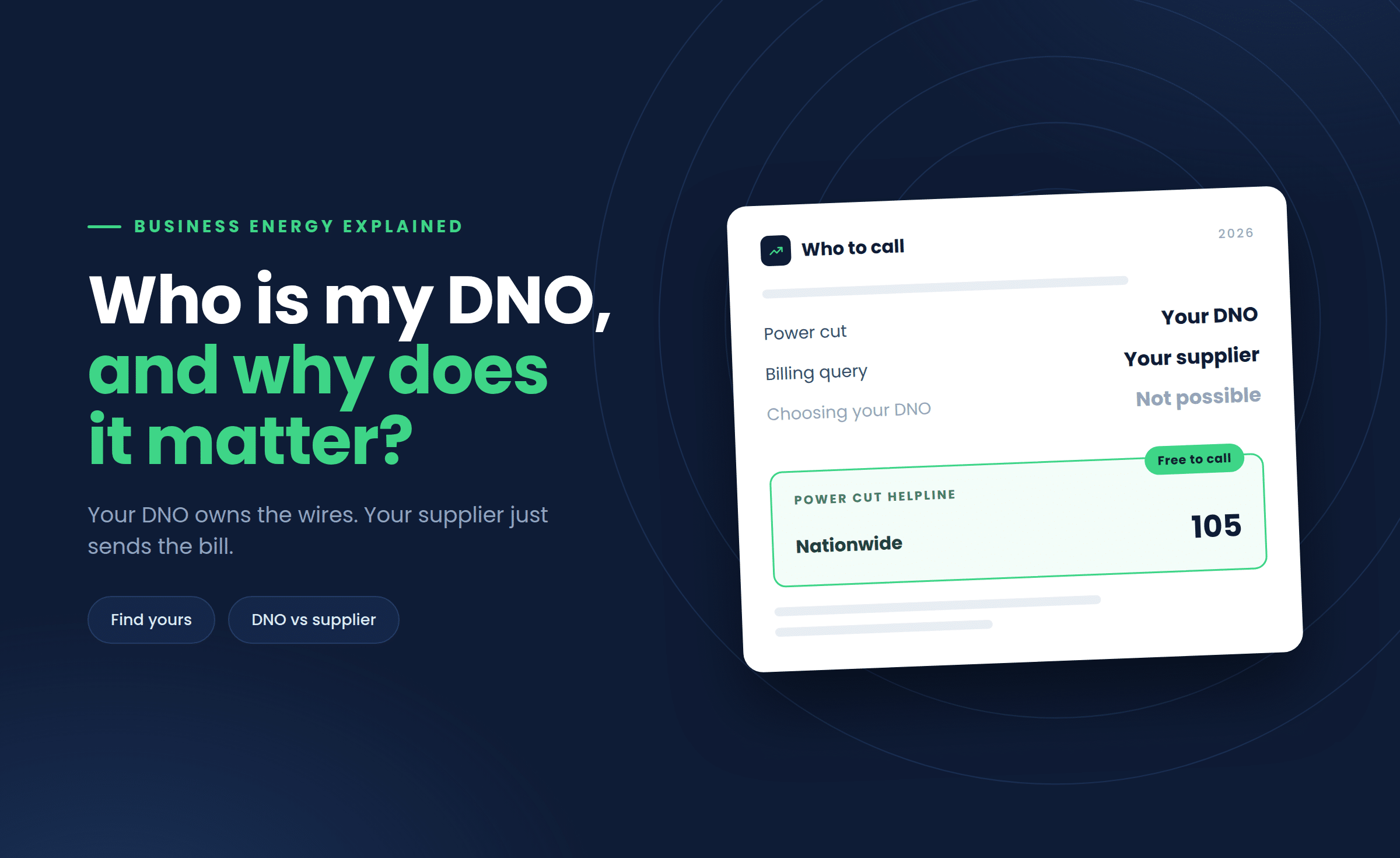
| DUoS (Distribution Use of System) | Power through local cables to your premises | Your regional DNO |
| TNUoS (Transmission Use of System) | The national high-voltage grid | NESO |
| BSUoS (Balancing Services) | Keeping supply and demand balanced | NESO |
| Climate Change Levy (CCL) | Environmental tax on business energy | HMRC |
| Renewables Obligation / FiT | Renewable generation support schemes | Ofgem / DESNZ |
| Metering and settlement | Meter operation, data and settlement | MOP and settlement bodies |
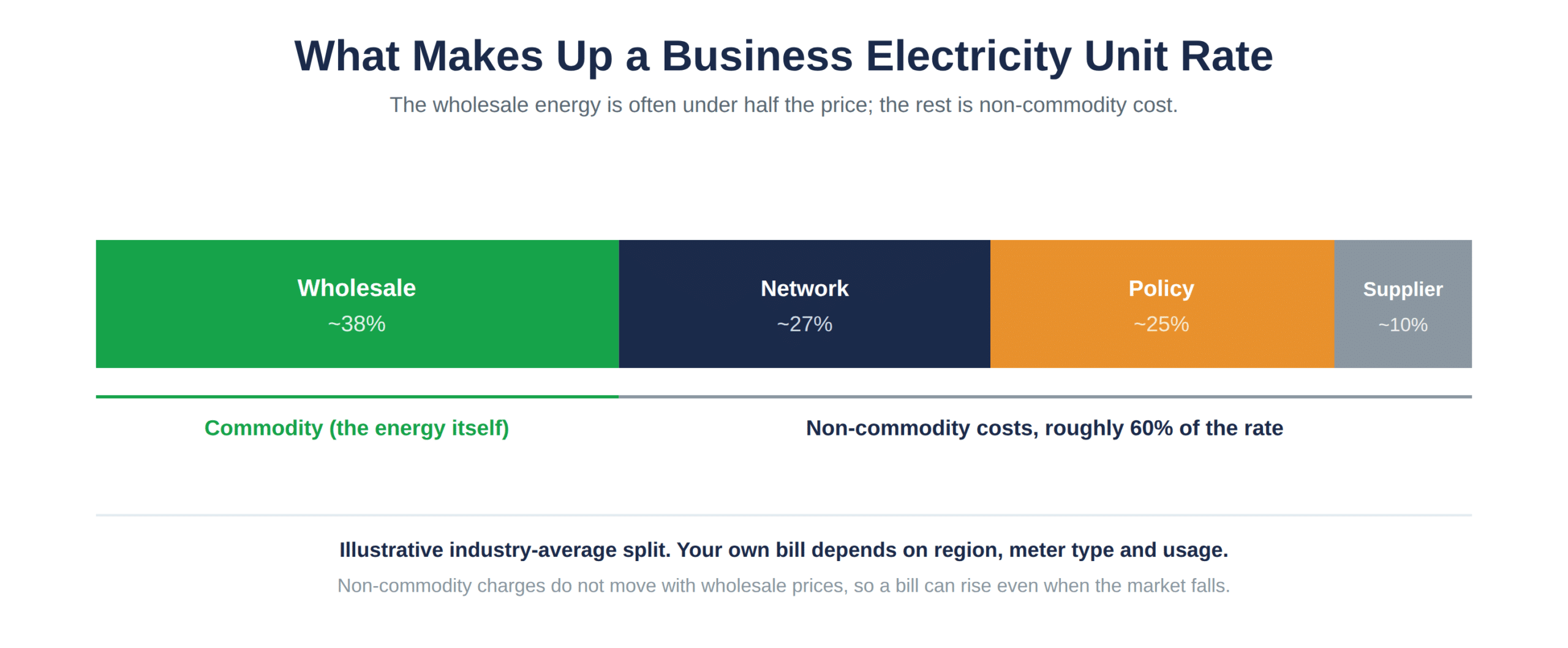
None of these move in line with wholesale prices, which is why a bill can rise even when the market falls. Your supplier collects them for the bodies that set them, alongside the Climate Change Levy, and adds a margin for administering the process.
Why do third party charges on energy bills keep rising?
Third party charges rise mainly because distribution network operators and NESO increase DUoS, TNUoS and BSUoS to fund grid investment and balancing, while government policy charges like the CCL are set independently of the wholesale market.
Do these charges vary by region?
The UK’s electricity network is being upgraded for more renewable generation, EV charging and heat pumps, and that investment is recovered through DUoS, reviewed periodically by Ofgem, as its network charges guidance sets out.
DUoS rates differ between DNO regions, and even within a region they vary by time of day and voltage level. Two businesses on identical unit rates from the same supplier can still see different non-commodity totals depending on their DNO area.
How much of your bill is wholesale energy versus everything else?
The split varies by contract, consumption pattern and meter type, so the only reliable way to see your own breakdown is a detailed bill audit rather than a generic industry percentage.
Why your site’s split looks different
As rough context, wholesale energy is often only around 38% of a unit rate, with network, policy and supplier costs making up the rest. A half-hourly site with heavy daytime demand carries a different profile to a small shop on a standard profile class, so treat any industry average as context, not a promise.
Our guide to how to read a business energy bill shows where each charge type appears on a typical statement. Your MPAN or MPRN determines the exact charges that actually apply to you.
Can you reduce non-commodity costs on your business energy bill?
You cannot negotiate network or policy charges directly, but choosing the right kVA capacity, meter type and settlement arrangement can genuinely lower how much you are billed for DUoS and capacity-related charges.
What is actually within your control
- Review your kVA capacity: if you have downsized or changed equipment.
- Check your profile class: ask whether your site is on the right profile class for its usage pattern.
- Consider half-hourly settlement: if your usage data shows real peak-shifting potential on a half-hourly meter.
None of these shrink the wholesale unit rate; they target the non-commodity portion most owners assume is fixed. Our energy procurement service can model whether a change is worth making for your site.
How do non-commodity costs affect a fixed price energy contract?
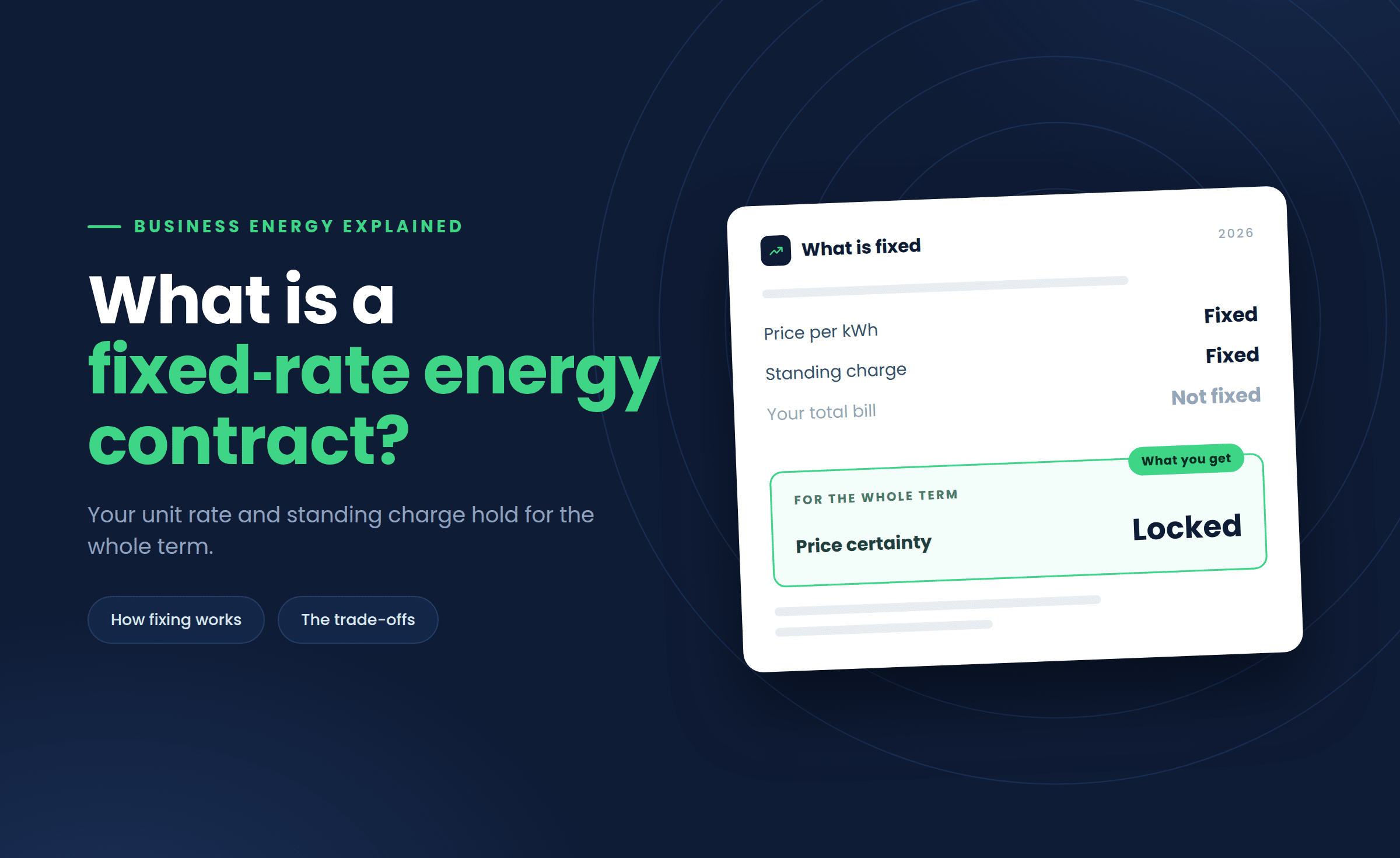
Most fixed-price contracts still pass through certain non-commodity costs at whatever rate applies during the term, meaning a technically fixed bill can still move if a pass-through charge changes mid-contract.
Check what is fixed and what passes through
This catches people out. A fixed unit rate sounds like total price certainty, but the contract wording usually separates the wholesale element from pass-through network and policy costs.
Checking your terms for exactly which charges are fixed and which pass through is worth ten minutes before you sign, particularly on longer deals. Settlement of those charges runs through Elexon and NESO behind the scenes.