
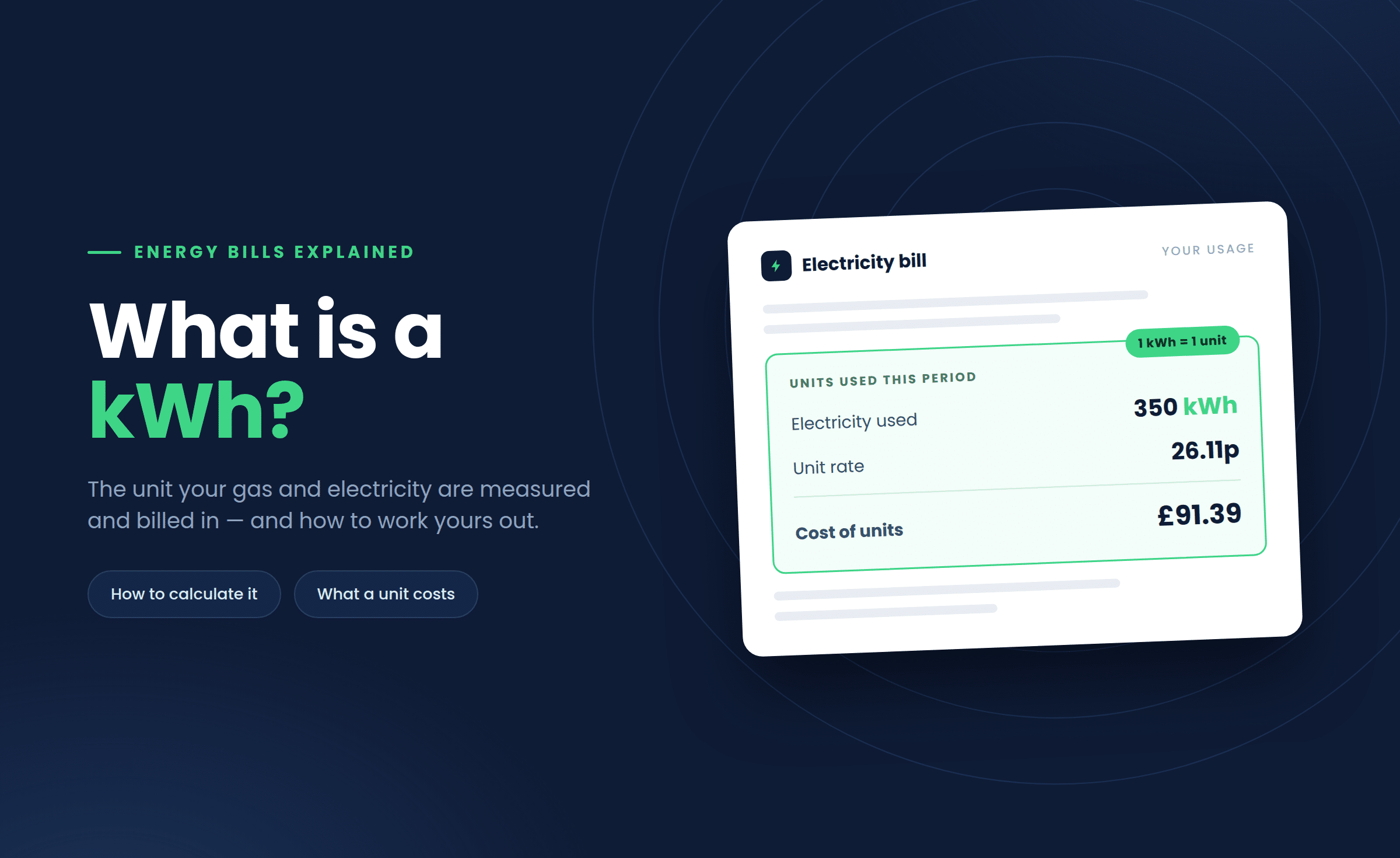
A kilowatt-hour (kWh) is a unit of energy: the amount used by a 1 kW appliance running for one hour, which equals 3.6 megajoules. It is the unit your gas and electricity are measured and billed in.
One kWh is often called a ‘unit’ of electricity. Both your electricity and your gas usage are shown in kWh on your bill.
Understanding kWh helps you read your bill, compare tariffs and cut waste. It also makes it easier to compare business energy on a like-for-like basis.
What is the difference between a kW and a kWh?
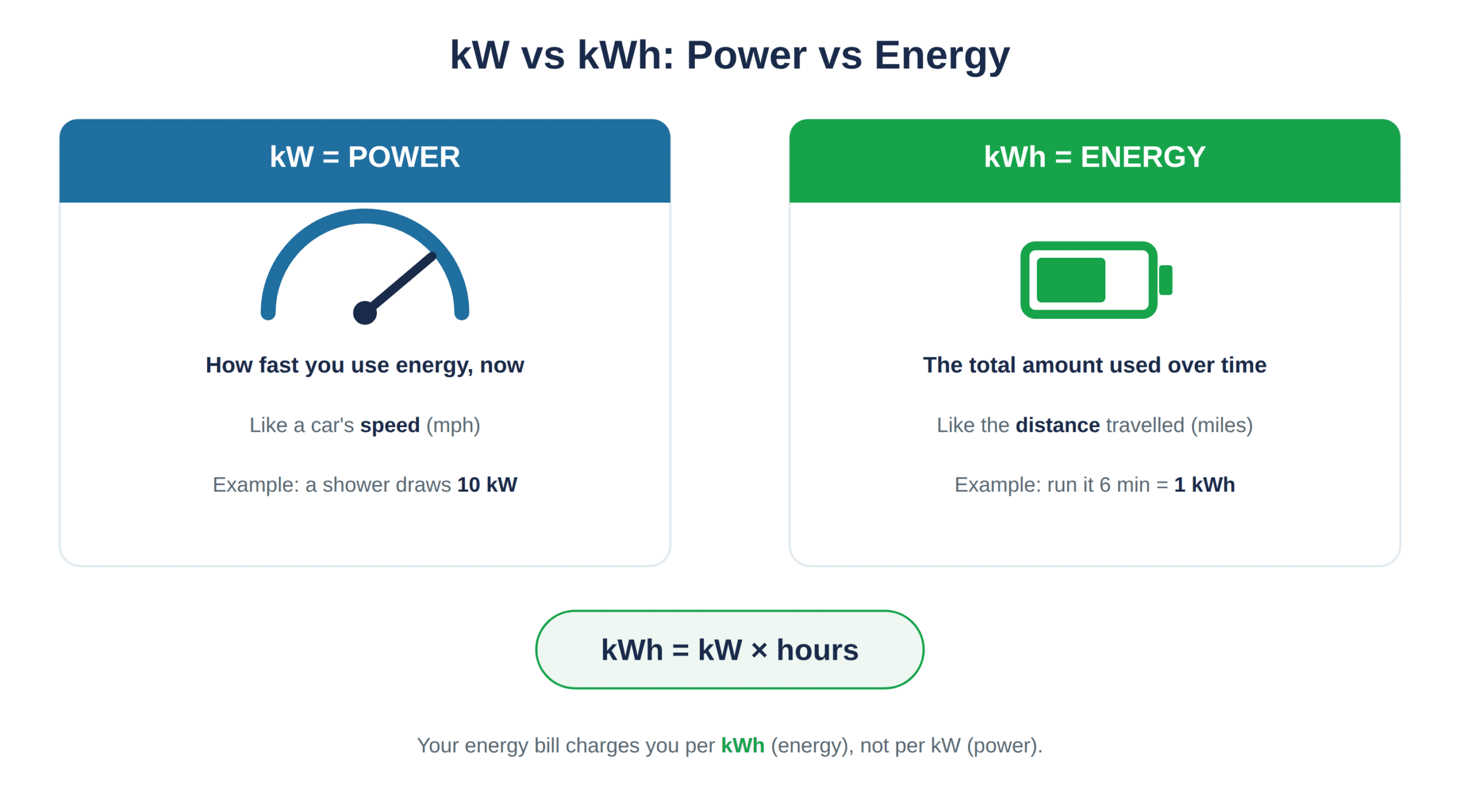
A kW is a measure of power, or how fast you use energy, while a kWh is a measure of energy, or how much you use over time. Your bill charges you per kWh, not per kW.
The simple way to remember it
Think of a car: the kW is like your speed, and the kWh is like the distance you travel. A 10 kW shower uses power quickly, and running it for six minutes uses about 1 kWh of energy.
Why the difference matters
The power rating (kW) tells you how hungry an appliance is, but the energy used (kWh) is what you pay for. A high-power device used briefly can cost less than a low-power one left on all day.
So the power rating alone does not tell you the cost. What lands on your bill is the total kWh, which depends on how long something runs.
How do you calculate kWh?
To work out kWh, multiply an appliance’s wattage by the hours it runs, then divide by 1,000. So a 3,000 watt kettle run for five minutes uses 0.25 kWh.
The formula with an example
The formula is kWh = watts times hours, divided by 1,000. For that kettle, 3,000 watts times 0.083 hours, divided by 1,000, gives 0.25 kWh.
How much energy everyday appliances use
Different appliances use very different amounts, as the table shows. For more detailed running costs, the Energy Saving Trust keeps up-to-date figures.
| Appliance | Typical power | Energy per use |
|---|---|---|
| Kettle | 3,000 W | ~0.1 kWh per boil |
| Electric shower | 8,500 to 10,500 W | ~1.5 kWh per 10 minutes |
| Oven | 2,000 to 2,100 W | ~0.7 to 1.5 kWh |
| Washing machine | ~2,100 W peak | ~0.7 to 1.5 kWh per cycle |
| Fridge-freezer | ~150 W (cycles) | ~0.3 to 1 kWh per day |
| LED bulb | 5 to 10 W | ~0.06 to 0.1 kWh over 10 hours |
Standby power adds up across a home or office, even when devices look switched off. Turning appliances off at the plug can trim a surprising number of units over a year.
How much does a kWh cost in the UK?
Under the energy price cap for 1 July to 30 September 2026, electricity is 26.11p per kWh and gas is 7.33p per kWh on a direct debit tariff. Standing charges are added on top.
The energy price cap
The Ofgem price cap sets a maximum unit rate for domestic customers, shown below including 5% VAT. The cap changes quarterly, and the October 2026 rates are due to be announced by late August 2026.
| Fuel (price cap, Jul to Sep 2026) | Unit rate | Standing charge |
|---|---|---|
| Electricity | 26.11p per kWh | 57.19p per day |
| Gas | 7.33p per kWh | 29.04p per day |
Rates also vary by region and payment method, so prepayment and standard credit differ from direct debit. The figures above are the direct debit averages for Great Britain.
Business energy prices
There is no price cap on business energy, so rates depend on your contract. Typical business electricity runs around 22p to 30p per kWh, and business gas around 6.5p to 9p per kWh, which is why it pays to compare.
How is your energy bill calculated?
Your bill is your usage in kWh multiplied by the unit rate, plus a daily standing charge for each day of the period. Both parts matter when you compare deals.
A worked example
Using the current cap and a medium home over a full year, the two fuels work out as follows. The standing charge is the fixed daily cost of being connected, whether you use energy or not.
| Annual bill (medium home, current cap) | Usage cost | Standing charge | Total |
|---|---|---|---|
| Electricity (2,500 kWh) | £652.75 | £208.74 | £861.49 |
| Gas (9,500 kWh) | £696.35 | £106.00 | £802.35 |
| Dual fuel | ~£1,664 |
That total matches Ofgem’s headline figure for a typical home, a useful check. Switching to a better unit rate is one of the simplest ways to cut it, as our guide to switching business energy explains for companies.
How much energy does a typical home or business use?
Ofgem says a medium home uses about 2,500 kWh of electricity and 9,500 kWh of gas a year, from 1 July 2026. These figures were lowered from the previous 2,700 kWh and 11,500 kWh.
Typical household usage
The typical domestic consumption values below are what suppliers use to estimate a home’s usage. Many older guides still quote the previous higher figures, so it is worth knowing both.
| Usage level | Electricity per year | Gas per year |
|---|---|---|
| Low | 1,600 kWh | 6,000 kWh |
| Medium | 2,500 kWh | 9,500 kWh |
| High | 3,800 kWh | 14,000 kWh |
Your own usage depends on the size of your home, how you heat it and how many people live there. Reading your meter regularly is the best way to know your real figure.
Business usage
Businesses vary far more, from a small shop using a few thousand kWh to a factory using millions. Your profile class reflects how your site uses electricity, and larger users are metered half-hourly.
How is gas measured and converted to kWh?
Your gas meter records volume in cubic metres, not energy, so the reading is converted to kWh on your bill. Each cubic metre is worth roughly 11.2 kWh.
The conversion formula
The standard conversion is cubic metres times 1.02264, times the calorific value, divided by 3.6. The calorific value is printed on your bill and averages around 39.5 in 2026.
As an example, 100 cubic metres converts to about 1,122 kWh. Older imperial meters read in cubic feet, which are converted to cubic metres first.
Reading your meter
An electricity meter shows kWh directly, so your usage is the latest reading minus the previous one. A gas meter shows volume, which is then converted using the formula above.
A smart meter shows your usage in kWh and in pounds in near real time, on the meter or an in-home display. That makes it easier to see which habits use the most energy.
Your MPAN and supplier details are on the bill if you need them. Not sure who supplies you? See who supplies your electricity and gas.
What do kWh mean for EVs, solar and heat pumps?
Electric cars, solar panels and heat pumps are all measured in kWh, which makes the unit more useful than ever. Knowing the kWh helps you compare running costs across all three.
Electric vehicles
An EV battery is sized in kWh, usually 40 to 80 kWh, and most cars travel about 3 to 4 miles per kWh. Charging a 60 kWh battery at the current cap costs around £16, or far less on a cheaper overnight EV rate.
A dedicated EV tariff can price overnight units at roughly 7p to 11p per kWh. Public rapid chargers cost the most per kWh, so home charging is usually the cheapest.
Solar panels
Solar output is measured in kWh generated, at roughly 900 kWh per kW of panels each year. A 4 kW system produces about 3,600 kWh, and commercial solar can cover a large share of a business’s electricity.
Any solar energy you do not use can be exported to the grid for payment. Sizing a system to your daytime usage gets the most value from each kWh you generate.
Heat pumps
A heat pump turns 1 kWh of electricity into around 3 kWh of heat, because it moves heat rather than burning fuel. A gas boiler gives about 0.9 kWh of heat per kWh of gas, so the efficiency gap narrows the running-cost gap.
So although a kWh of electricity costs more than a kWh of gas, a heat pump needs far fewer kWh for the same heat. That is why the running costs can end up close once efficiency is counted.
What are the other units of energy?
Energy scales up from watt-hours to kilowatt-hours, megawatt-hours, gigawatt-hours and terawatt-hours. Homes are billed in kWh, while national figures are quoted in GWh and TWh.
From watt-hours to terawatt-hours
Each step up multiplies by 1,000, so the numbers grow quickly. The table shows how the units relate.
| Unit | Equals | Used for |
|---|---|---|
| Watt-hour (Wh) | 0.001 kWh | Small devices |
| Kilowatt-hour (kWh) | 1,000 Wh | Home and business bills |
| Megawatt-hour (MWh) | 1,000 kWh | Large sites and trading |
| Gigawatt-hour (GWh) | 1,000 MWh | Power stations |
| Terawatt-hour (TWh) | 1,000 GWh | National consumption |
How can you reduce your kWh usage and costs?
You can cut your kWh two ways: use fewer units, and pay less for each unit you use. The biggest savings usually come from doing both.
Use fewer units
Small changes add up, such as switching to LED bulbs, running full washing loads and turning off standby. Heating and hot water are the largest users, so timing and insulation make the biggest difference.
Pay less per unit
Once you have cut waste, make sure your rate is competitive by comparing energy suppliers for your usage. A lower price per kWh reduces the cost of every unit you use.