
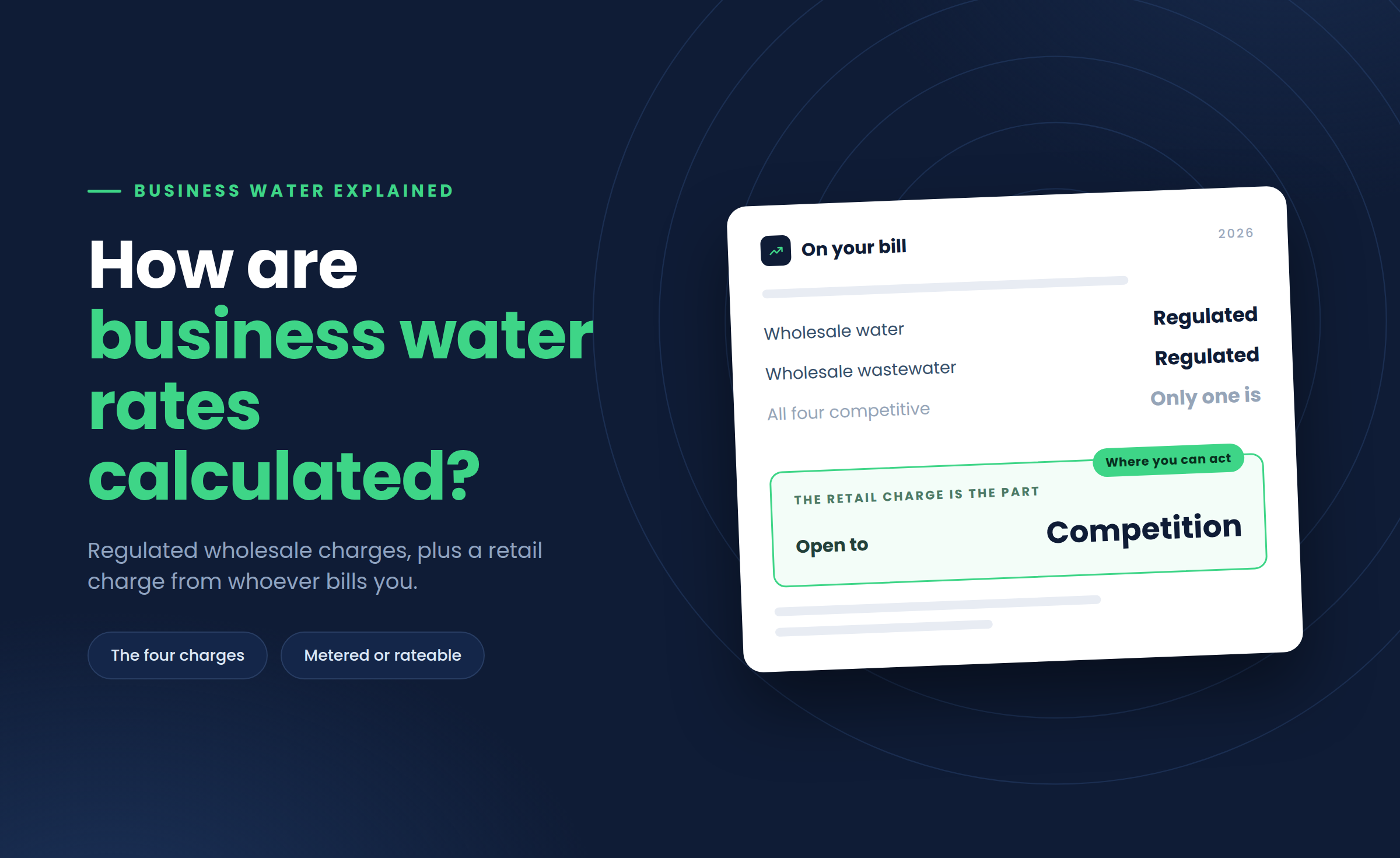
A business water bill combines a regulated wholesale charge, set by your regional water company, and a retail charge from the retailer that bills you. The wholesale part covers treating and delivering water and removing wastewater; the retail part covers billing and service.
Understanding the split matters because only one part is open to competition. The wholesale charge is fixed and regulated, so switching retailer only moves the smaller retail slice.
That does not make switching pointless, but it does set realistic expectations, and our guide to who your water supplier is explains the two-supplier structure behind the bill.
Charges are also driven by how much water you use and whether the site is metered, so two similar businesses can pay quite differently.
Wastewater and drainage components add further variation. Two units on the same street can carry different bills purely because of how their surface water and effluent are handled.
What are the different charges on a business water bill?
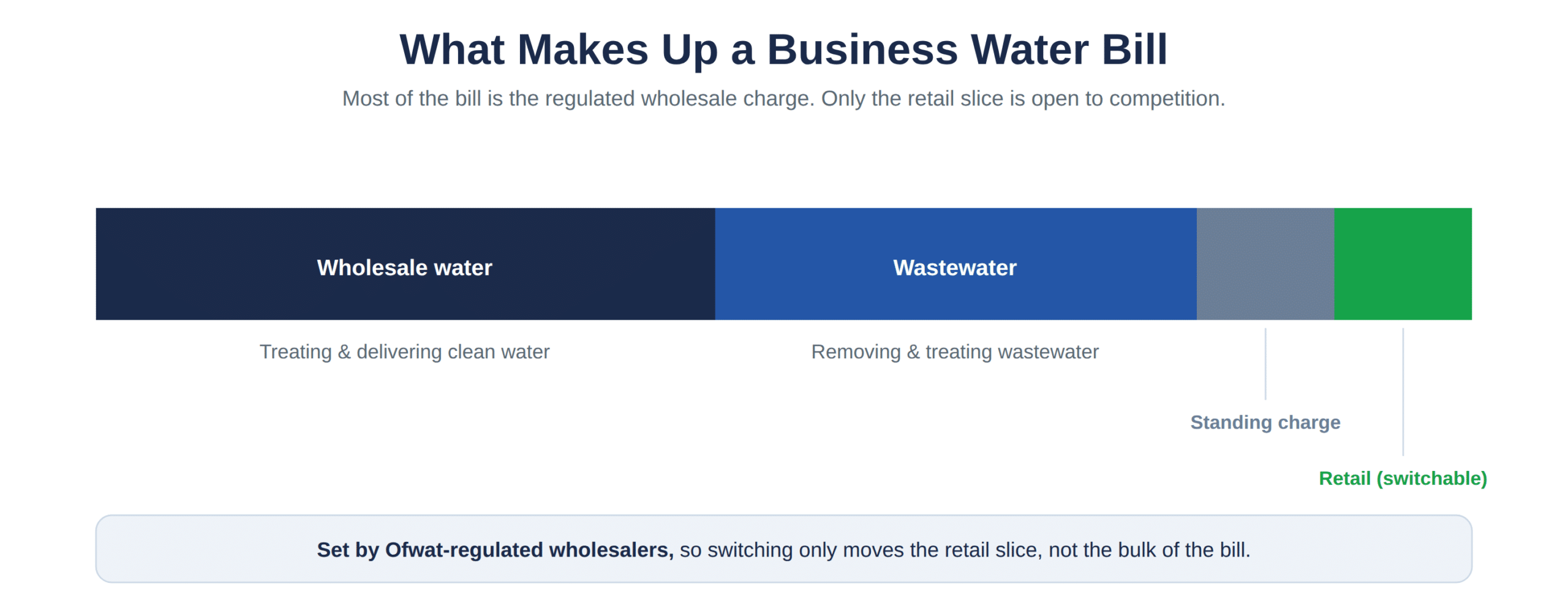
A typical bill has four elements: a wholesale water charge, a wholesale wastewater charge, a retail service charge, and a fixed standing charge. The first two are regulated; the retail charge is where competition applies.
The four charge types
| Charge type | Set by | What it covers |
|---|---|---|
| Wholesale water | Regional wholesaler (Ofwat-regulated) | Treatment and delivery of clean water to your premises |
| Wholesale wastewater | Regional wholesaler (Ofwat-regulated) | Removal and treatment of wastewater, including trade effluent |
| Retail service | Your chosen retailer | Billing, customer service, account management, switching |
| Standing charge | Wholesaler, passed through by retailer | The fixed cost of maintaining the connection |
How does the wholesale charge get set?
Wholesale charges are set by your regional water company within price limits that Ofwat reviews on a multi-year cycle, so they are broadly the same whichever retailer bills you.
Why switching only affects retail costs
Because the wholesale element is regulated by Ofwat, competition cannot touch it. That is why the headline saving from switching is modest, and why service quality and billing accuracy matter as much as price.
It also means a quote that looks dramatically cheaper on the wholesale line is worth questioning, since that part should be broadly consistent across retailers for the same site.
Ofwat reviews these wholesale price limits on a five-year cycle, so charges tend to move in steps at each review rather than fluctuating month to month like wholesale energy.
What does the retail charge cover?
The retail charge covers everything the retailer does: producing bills, handling queries, managing your account, arranging meter work and supporting a switch. It is the only part a retailer competes on.
Where a better retailer earns its place
A sharper retailer means fewer estimated bills, quicker query resolution and help claiming rebates you are due. Comparing business water rates is really a comparison of that retail margin and the service behind it, as our guide to switching business water explains.
For a multi-site business the retail margin compounds across every account, so even a small per-site improvement can add up. Consolidated billing under one retailer also cuts administration time.
Is a business water bill based on rateable value or metered use?
Most business water is now charged on metered consumption, with a volumetric rate per cubic metre plus a standing charge. Some older or hard-to-meter sites are still billed on the property’s rateable value.
Asking your wholesaler for a meter
Metered billing is usually fairer for lower-usage sites, since you pay for what you actually use rather than an assessment based on the property. If your site is on rateable value, you can ask about having a meter fitted.
A meter also makes leaks and waste visible, which an unmetered charge never will. For most modern businesses, metered billing is the norm.
Reading the meter regularly and submitting actual figures, rather than accepting estimates, keeps the volumetric charge accurate and stops a large correction landing later.
Does VAT apply to business water bills?
Water supply is zero-rated for most businesses, so no VAT is added. The exception is businesses whose main activity falls within specific industrial categories, which are charged the standard 20% rate on their water.
Check your SIC code is correct
The industrial categories come from the 1980 Standard Industrial Classification, covering manufacturing, construction, engineering, mining and utilities, as HMRC’s water VAT notice sets out. Our guide to VAT on business water bills covers who pays and how to check.
Sewerage services are zero-rated for all customers, so VAT, where it applies at all, lands on the clean-water supply rather than the wastewater side. It is worth checking your bill is coded correctly, since errors here are common.