
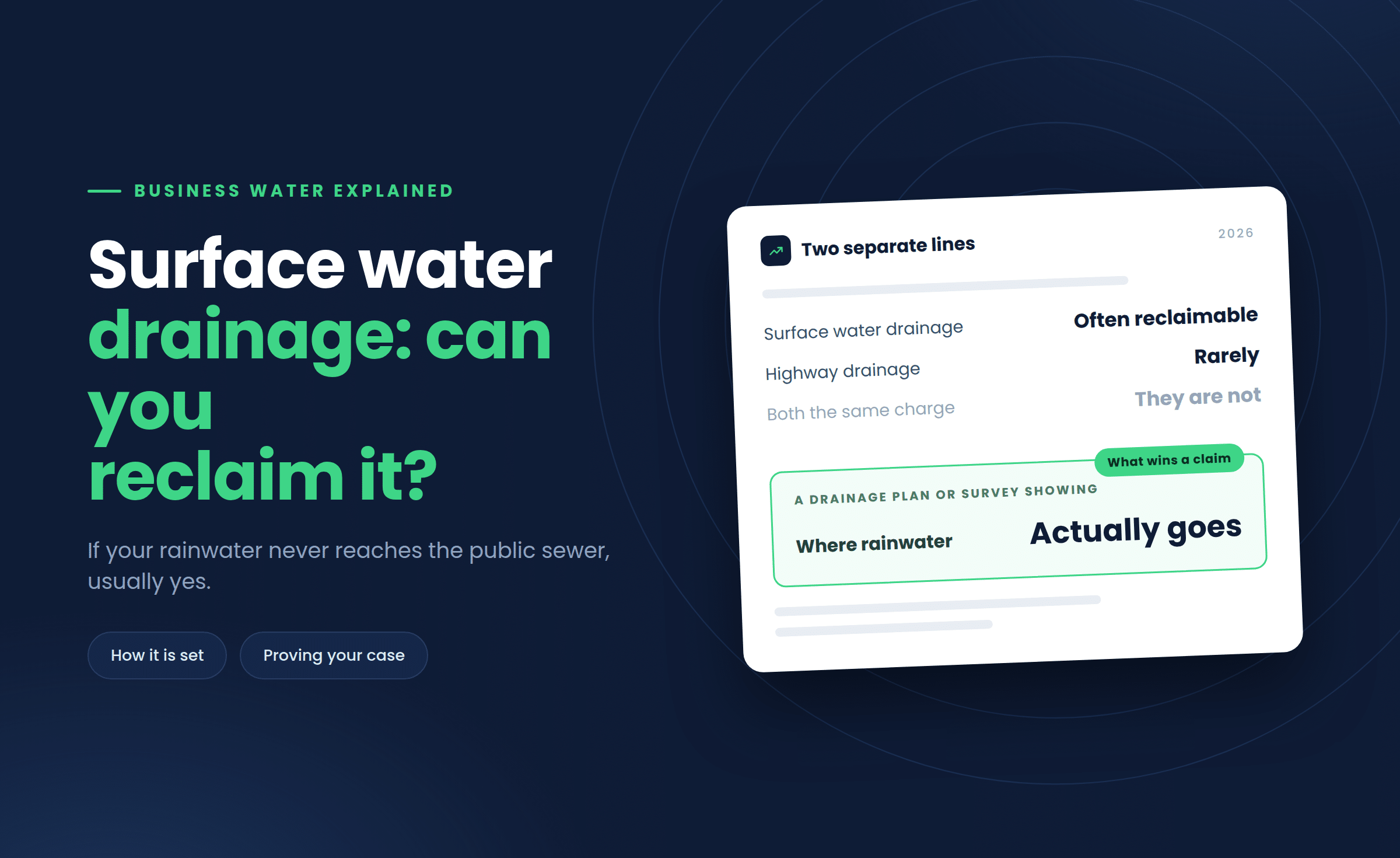
A surface water drainage charge covers the cost of rainwater running off your roof, car park and other hard surfaces into the public sewer. If your site’s rainwater never reaches that network, because it drains to a soakaway, a watercourse or private storage, you can usually apply to have the charge reduced or removed.
Most business water bills bundle this charge in without much explanation, sitting quietly alongside the water-in and wastewater-out lines. It is easy to pay for years without ever questioning it.
It is assessed separately from how much water you use, because it is based on how much of your site sheds rainwater into the public system. Our guide to how business water rates are calculated explains where each line sits.
Warehouses, retail parks and any premises with a large roof or car park tend to pay proportionally more here than a small office. That also means they have the most to reclaim, which is why it belongs on any lower a business water bill checklist.
This guide covers how the charge is worked out, when a rebate applies, and how it differs from the related highway drainage charge.
What’s the difference between surface water and highway drainage?
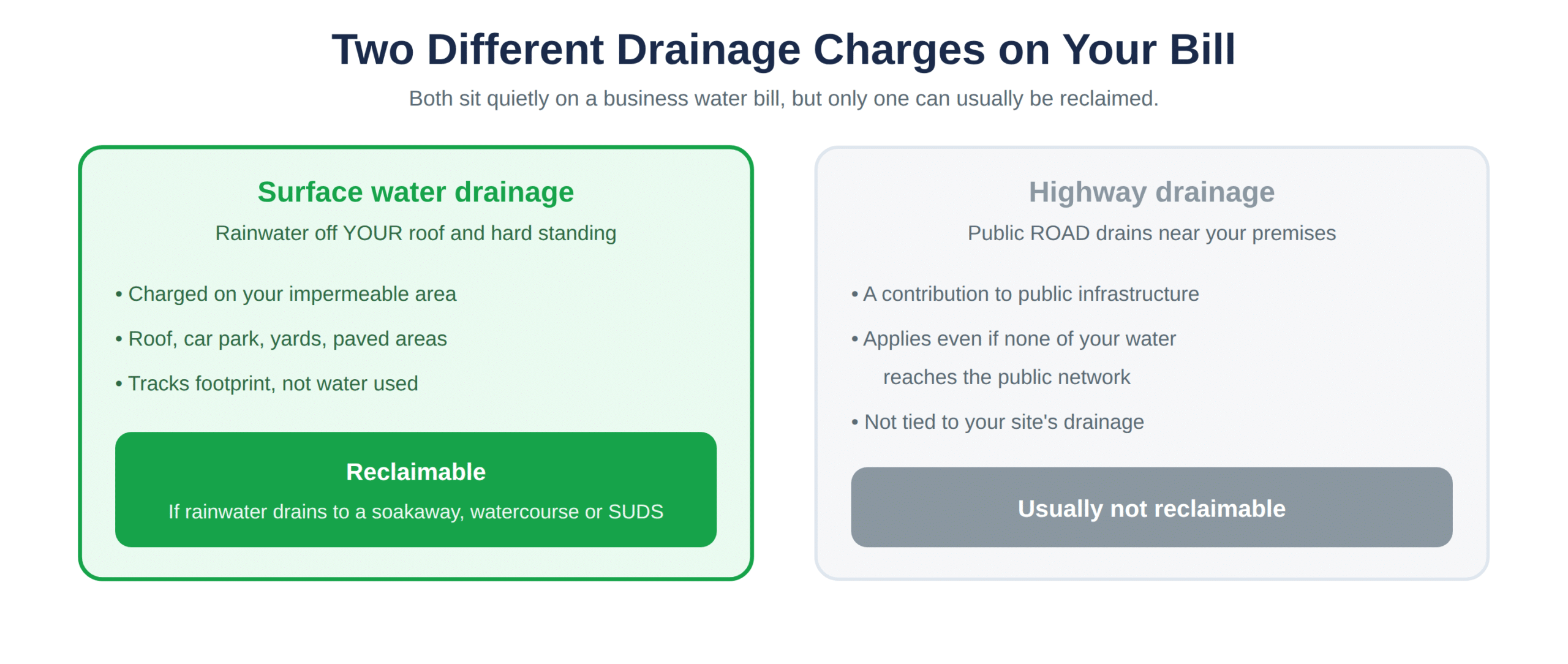
Surface water drainage covers rainwater from your own site entering the public sewer. Highway drainage is a separate contribution towards maintaining public road drains near your premises, and it applies even if none of your own rainwater reaches the network.
Two separate lines, two different rules
These appear as two distinct charges on a business water bill, and it is entirely possible to be exempt from one while still liable for the other. Most rebate activity focuses on the surface water line.
A highway drainage charge usually cannot be avoided the way a surface water charge can, because it relates to public infrastructure rather than your own site’s drainage arrangements. Do not expect the same outcome for both lines.
How is your surface water drainage charge calculated?
Most wholesalers base the charge on the impermeable area of your site: the total roof and hard standing that sheds rainwater. Some band it by property size or rateable value depending on the region, so a larger car park or roof generally means a higher charge.
What typically counts as impermeable area
- Roof space: on any building at the site.
- Car parks and yards: plus other hard standing.
- Paved paths and loading areas: anywhere vehicles or people move over sealed ground.
- Any sealed surface: that sheds rainwater rather than absorbing it.
This is why a warehouse or a retail unit with a large car park often sees a surprisingly high drainage line compared to its actual water usage, because the charge tracks footprint rather than consumption.
Methods vary slightly by wholesaler, so the exact banding on your bill depends on which regional company serves your site. Two similar businesses in different areas can pay quite different amounts.
Some regions use a fixed set of bands based on the property’s rateable value, while others measure the actual sealed area in square metres. If your bill only shows a band rather than a figure, ask your retailer which method applies.
When does a business qualify for a rebate or exemption?
You typically qualify when your site’s rainwater drains to a soakaway, a private watercourse, an attenuation tank or a sustainable drainage system rather than the public sewer. If none of your rainwater reaches the public network, you may be owed a full rebate.
How full and partial exemptions work
Partial exemptions also exist. If only part of your site drains privately, for example a soakaway serving the car park while the roof still connects to the sewer, you may get a partial rebate for the private portion.
| Drainage arrangement | Rebate outcome |
|---|---|
| All rainwater to soakaway or watercourse | Likely full rebate |
| Car park private, roof to sewer | Likely partial rebate |
| Attenuation tank or SUDS on site | Full or partial rebate |
| All rainwater to public sewer | No rebate |
Newer developments built with sustainable drainage as standard are increasingly common candidates, because modern planning rules often require rainwater to be managed on site rather than sent straight to the sewer.
A rebate is not always permanent, either. If you later resurface a yard or extend a roof so that more water reaches the sewer, the charge can be revised, so keep your evidence current when the site changes.
What evidence do you need to reclaim the charge?
A drainage plan showing exactly where your site’s rainwater goes is the core evidence, ideally backed by a professional drainage survey. Wholesalers want it documented rather than taking your word for it.
Evidence that supports a claim
Older sites without clear records sometimes need a CCTV drainage survey to trace pipework and confirm the final destination of surface water. It costs money, but a successful backdated claim usually recovers it many times over.
Photographs of a soakaway, an attenuation tank or an open watercourse on site are simple corroborating evidence too. They rarely stand alone, but they strengthen a plan or survey and speed up the wholesaler’s decision.
Planning documents from when the site was developed, particularly anything referencing a SUDS scheme or a private drainage condition, also help. A sewerage rebate claim often draws on the same survey, so it is worth checking both at once.
How do you apply for a surface water drainage rebate?
Contact your retailer, request the surface water rebate application process, and submit your drainage evidence for assessment by the wholesaler. Most wholesalers publish a specific form or process for this exact claim.
The steps from claim to refund
- Request the form: ask your retailer for the surface water rebate application.
- Submit evidence: send a drainage plan or professional survey.
- Answer follow-ups: respond promptly to any questions or a site visit request.
- Confirm the outcome: check the rebate amount and whether it is backdated.
Expect the wholesaler to review the evidence and sometimes request a site visit before confirming a full or partial rebate. If a retailer is slow or unhelpful, the Consumer Council for Water can step in, and the Ofwat market rules govern how retailers must handle it.