
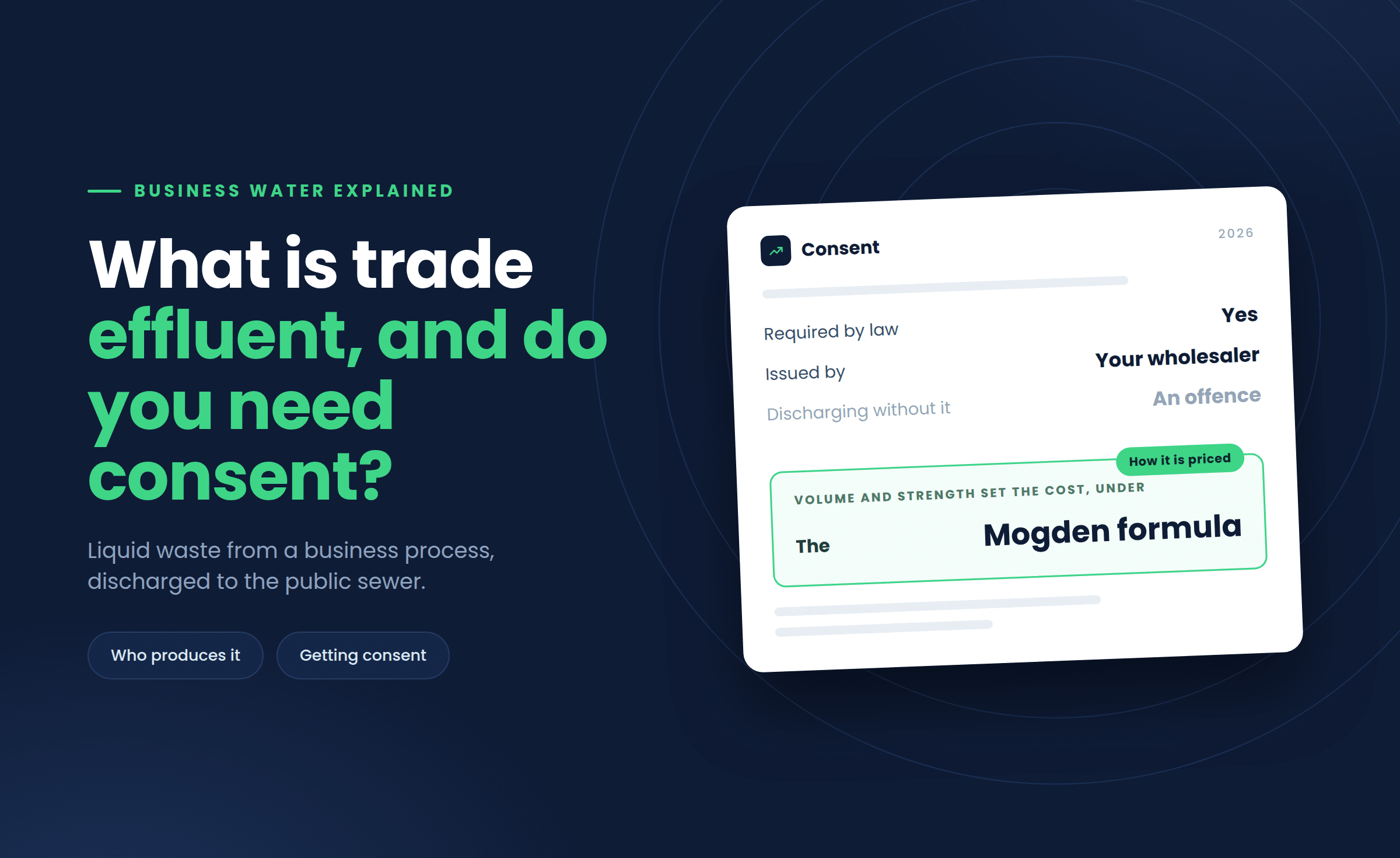
Trade effluent is any liquid waste produced by a business process and discharged to the public sewer, excluding ordinary domestic sewage. Discharging it requires prior consent from your wholesaler under the Water Industry Act 1991.
The term covers far more than obvious industrial waste. Wash-down water, cooling water, and liquid from food and drink production can all count, which catches out businesses that never think of themselves as producing effluent.
Consent is not optional: discharging without it is an offence and can carry penalties. This guide explains who produces trade effluent, how to get consent, and how the charge is worked out, alongside our wider business water guidance.
Getting it right matters twice over, because consent keeps you compliant and understanding the charge helps you keep it down.
It is also one of the larger single lines on a water-heavy site’s bill. For a food producer or metal finisher, trade effluent can rival the cost of the clean water coming in.
Which businesses typically produce trade effluent?
Food and drink producers, breweries, launderies, car washes, metal finishers, chemical processors and printers are the businesses most likely to produce trade effluent, along with many manufacturing and catering operations.
Sectors most affected
| Sector | Typical trade effluent source |
|---|---|
| Food and drink production | Process water, wash-down, cleaning |
| Breweries and distilleries | Spent liquids, cleaning-in-place water |
| Launderies and car washes | Detergent-laden wash water |
| Metal finishing and plating | Process chemicals and rinse water |
| Commercial kitchens | Grease-laden and food-waste water |
Many catering and hospitality and leisure sites produce trade effluent without realising, particularly where kitchens or pools are involved, so it is worth checking rather than assuming you are exempt.
How do you apply for trade effluent consent?
You apply to your regional wholesaler, the sewerage undertaker for your area, giving details of what you intend to discharge. The wholesaler assesses the application and issues a consent setting limits on your discharge.
Information a wholesaler will typically want
Expect to provide the volume, flow rate and timing of the discharge, its chemical composition, pH, temperature and any treatment you apply before it leaves the site. The more accurate your application, the smoother the process.
Consent conditions are site-specific and legally binding, so read them carefully. Breaching a limit, even accidentally, can lead to enforcement, so build in monitoring from the start.
Processing an application takes time, often a couple of months, so factor it into any plans for a new process or an expansion. Discharging first and applying later is not an option the rules allow.
How is trade effluent discharge charged?
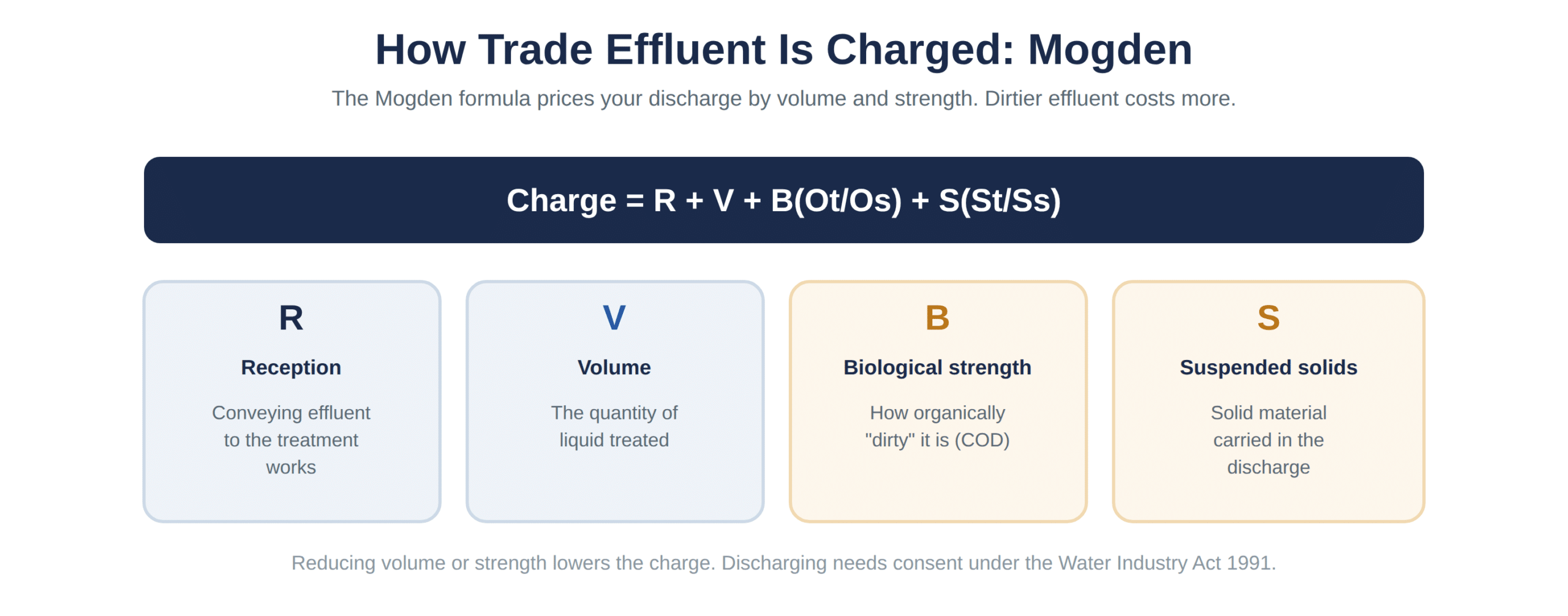
Trade effluent is charged using the Mogden formula, which prices your discharge by its volume and its strength. Dirtier, higher-volume effluent costs more to treat and therefore costs more to discharge.
Ways businesses commonly reduce their charge
Because strength and volume both drive the charge, on-site treatment, screening out solids and cutting water use all reduce it. Our guide to lowering a business water bill covers the wider savings alongside effluent.
Even simple measures like grease traps in a kitchen or settlement of solids before discharge can move the strength terms in the formula and cut the bill over time.
Larger dischargers sometimes install balancing tanks or on-site pre-treatment. The capital cost is real, but so is the saving, and a specialist can model the payback against your current Mogden charge.
What happens if you discharge without consent?
Discharging trade effluent without consent, or breaching your consent conditions, is a criminal offence under the Water Industry Act 1991 and can result in prosecution, fines and the cost of any damage caused.
Why compliance matters
The rules exist because untreated or overly strong effluent can damage the sewer network and the treatment process, as the Water Industry Act 1991 sets out. Getting consent first is far cheaper than facing enforcement later.
Wholesalers can also require you to install monitoring or sampling equipment as a condition of consent. Keeping your own records of what you discharge protects you if a reading is ever queried.
Does the environment agency get involved too?
The wholesaler regulates discharges to the public sewer, but the Environment Agency regulates discharges to controlled waters such as rivers and streams. Which one applies depends on where your effluent goes.
Sewer versus watercourse
If you discharge to the public sewer, your wholesaler handles consent. If you discharge to a river, stream or the ground, you need a permit from the Environment Agency instead, and the Ofwat market framework governs the retail side of your water account throughout.