
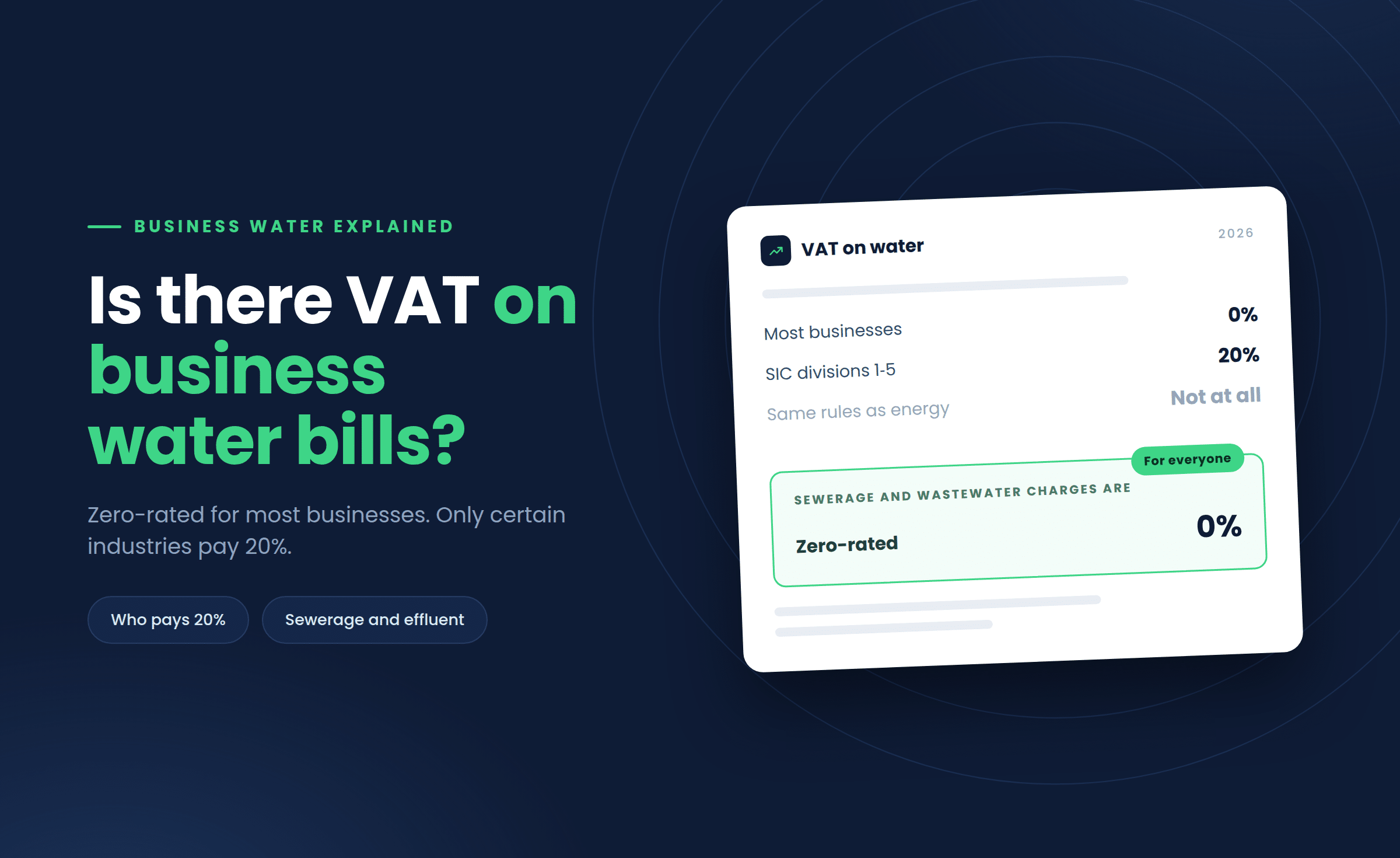
For most businesses there is no VAT on water: the supply of water is zero-rated. The exception is businesses whose main activity falls within specific industrial categories, which are charged the standard 20% rate on their water.
This surprises people, because business energy always carries VAT. Water is treated differently, and the rule turns on what your business does, not how the water is used.
Getting the VAT rate wrong on a water bill is common, and it works both ways: some businesses are charged VAT they should not pay, while some industrial sites are under-charged. Our guide to VAT on business energy bills covers the very different energy position.
This guide sets out who pays, how sewerage and trade effluent are treated, and how to check the rate on your own bill.
The distinction matters more than it sounds. On a large water bill, wrongly applied VAT is a real sum, and because it can often be corrected and backdated, it is worth five minutes to check.
How is VAT on business water different from VAT on energy?
Business energy always carries VAT, usually at 20% and sometimes at a reduced 5% rate. Water is the opposite: it is zero-rated by default, with the standard rate applying only to specific industrial activities.
Two different rulebooks
The two are governed by separate HMRC rules, so you cannot assume the energy position tells you anything about the water position. A business paying 20% on energy may pay nothing on water, and that is entirely normal.
The reason is historical: water for general use was treated as a basic necessity and zero-rated, with only industrial process use brought into the standard rate. Energy never had that carve-out.
Which businesses pay standard-rate VAT on their water?
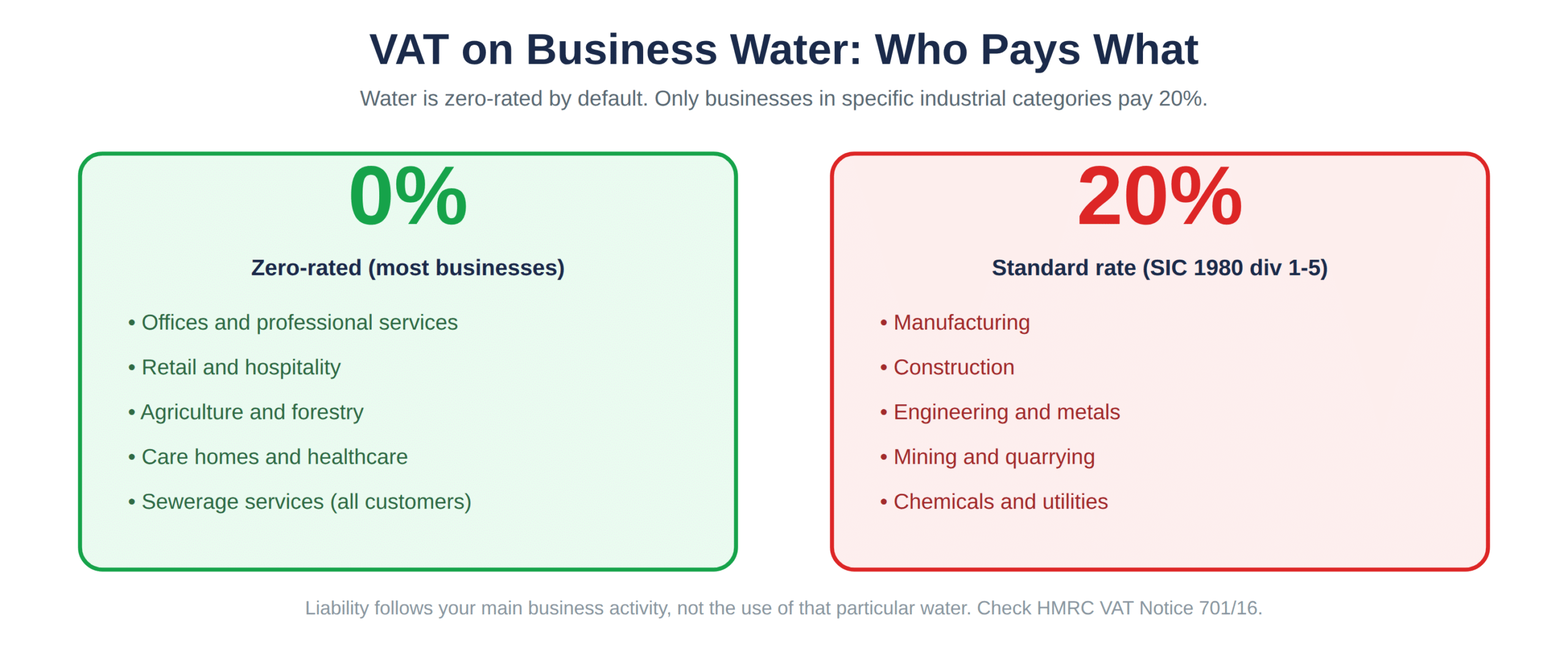
Businesses whose main activity falls within divisions 1 to 5 of the 1980 Standard Industrial Classification pay the standard 20% rate on water. That covers manufacturing, construction, engineering, mining and quarrying, and utilities.
What if a site has mixed activities?
| Business type (illustrative) | Typical VAT on water |
|---|---|
| Manufacturing, engineering, metal processing | Standard rate (20%) |
| Construction sites | Standard rate (20%) |
| Offices, retail, hospitality | No VAT (0%) |
| Agriculture, forestry, care homes | No VAT (0%) |
| Trade effluent (industrial dischargers) | Standard rate (20%) |
Liability follows the predominant business activity across the whole undertaking, not the use of one particular supply, as HMRC’s water and sewerage manual sets out. A mixed-use site is judged on its main activity.
The test deliberately uses the 1980 classification, not a later revision, so an old code can decide the outcome. If your activity has changed since the account was set up, it is worth confirming the classification still fits.
What about VAT on sewerage and wastewater charges?
Sewerage and wastewater services are zero-rated for all business customers, industrial or not. So even a manufacturer paying 20% on its clean water pays no VAT on the sewerage element of the bill.
Where the VAT actually lands
This means VAT, where it applies at all, sits on the clean-water supply rather than the wastewater side, as HMRC VAT Notice 701/16 confirms. It is worth checking your bill separates the two correctly.
A bill that lumps water and sewerage together under a single VAT line is a warning sign, because the two elements are taxed differently and should be shown separately.
Does trade effluent get taxed differently?
Trade effluent charges broadly follow the same industrial test as water: an industrial discharger in the standard-rated categories pays 20%, while a non-industrial business pays no VAT on the effluent element.
Businesses commonly affected
Food and drink producers, chemical processors and metal finishers are the sites most likely to discharge trade effluent and to fall in the standard-rated categories, as our guide to trade effluent explains. If you are unsure, confirm your classification rather than assuming.
How do you check the VAT rate on your own bill?
Look at the VAT line on a recent water bill. If it shows 20% and your business is not in one of the industrial categories, you may be paying VAT you should not, and can ask your retailer to correct it.
Correcting a wrong rate
Corrections can often be backdated, so it is worth raising with your retailer if the rate looks wrong. While you are checking the bill, our guides to lowering a business water bill and to claiming a sewerage rebate cover other charges worth querying.