
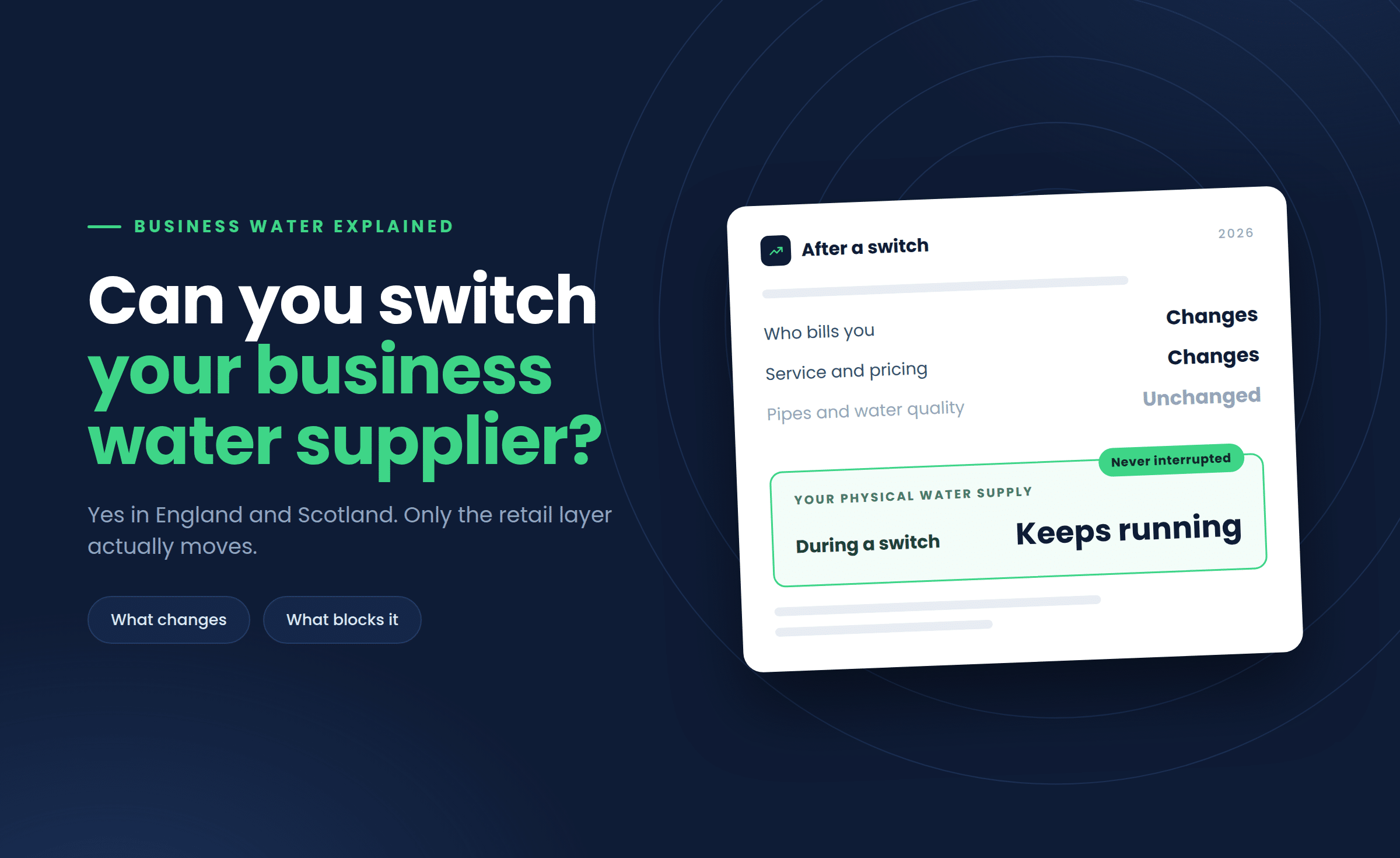
Yes, most businesses in England and Scotland can switch their water retailer, though only the retail layer changes: billing, service and pricing. The pipes, water quality and wastewater treatment stay with your regional wholesaler.
Water competition is newer and less well known than energy switching, so plenty of businesses do not realise the option exists at all. It has been live in England since 2017 and in Scotland since 2008.
The saving is usually smaller than an energy switch, but it is still worth claiming, particularly for higher-usage sites. This guide covers what changes, who can switch, and how, alongside our guide to business water rates.
For multi-site businesses the case is stronger still. Consolidating several sites onto one retailer simplifies billing and often unlocks a better retail margin than each site negotiating alone.
What changes when you switch business water retailer?
Only the retail side changes: who bills you, the customer service you receive, the account management and the price you pay for that retail layer. The physical supply, water quality and wastewater treatment stay exactly as they are.
Retail versus wholesale
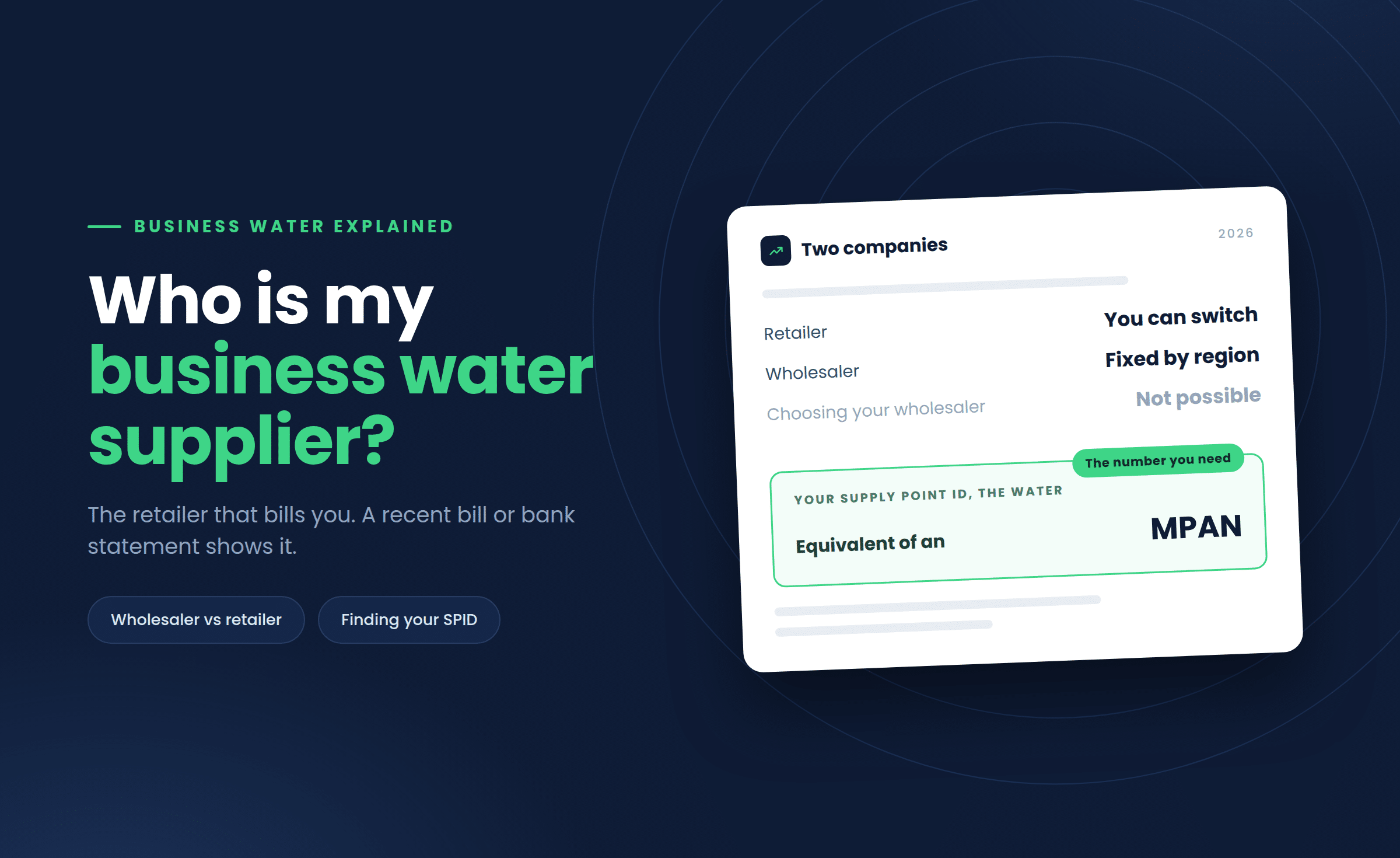
Your regional wholesaler still owns the network and treats the water, regulated by Ofwat. The retailer simply buys wholesale services and sells you billing and support, much as our guide to who your business water supplier is explains.
Because the wholesale charge is fixed and regulated, competition only bites on the retail margin and the quality of service. That is why the headline saving is modest, but a sharper retailer also means fewer billing errors and quicker query resolution.
Which parts of the UK allow a business water switch?
England and Scotland both run open non-household water retail markets, so eligible businesses can switch retailer. Wales is largely closed, with only the very largest users able to switch.
Market by nation
| Nation | Retail market open? | Typical wholesaler | Open since |
|---|---|---|---|
| England | Yes | Regional company (Thames, Severn Trent, United Utilities) | 2017 |
| Scotland | Yes | Scottish Water | 2008 |
| Wales | Largely no | Welsh Water (Dwr Cymru) | Only very large users |
Scotland was the first country in the world to open non-household water to competition, and remains the longest-running such market, as our guide to switching water in Scotland covers.
Wales is the outlier. Only non-household customers using more than 50 million litres a year can switch there, so the vast majority of Welsh businesses stay with their incumbent water company by default.
How do you check if you’re eligible to switch?
If your premises are in England or Scotland and used for non-household purposes, you are almost certainly eligible. The quickest check is to find your Supply Point ID, or SPID, on a recent water bill.
Finding your SPID
The SPID is the water equivalent of an energy MPAN or MPRN, identifying your supply point in the central market systems run by MOSL. A retailer or comparison service can confirm your eligibility from it.
Household premises and mixed-use sites can be more complicated, but a standard commercial unit, shop, office or industrial site is almost always eligible. If in doubt, a quick call to a retailer settles it in minutes.
What’s the process for changing water supplier for a business?
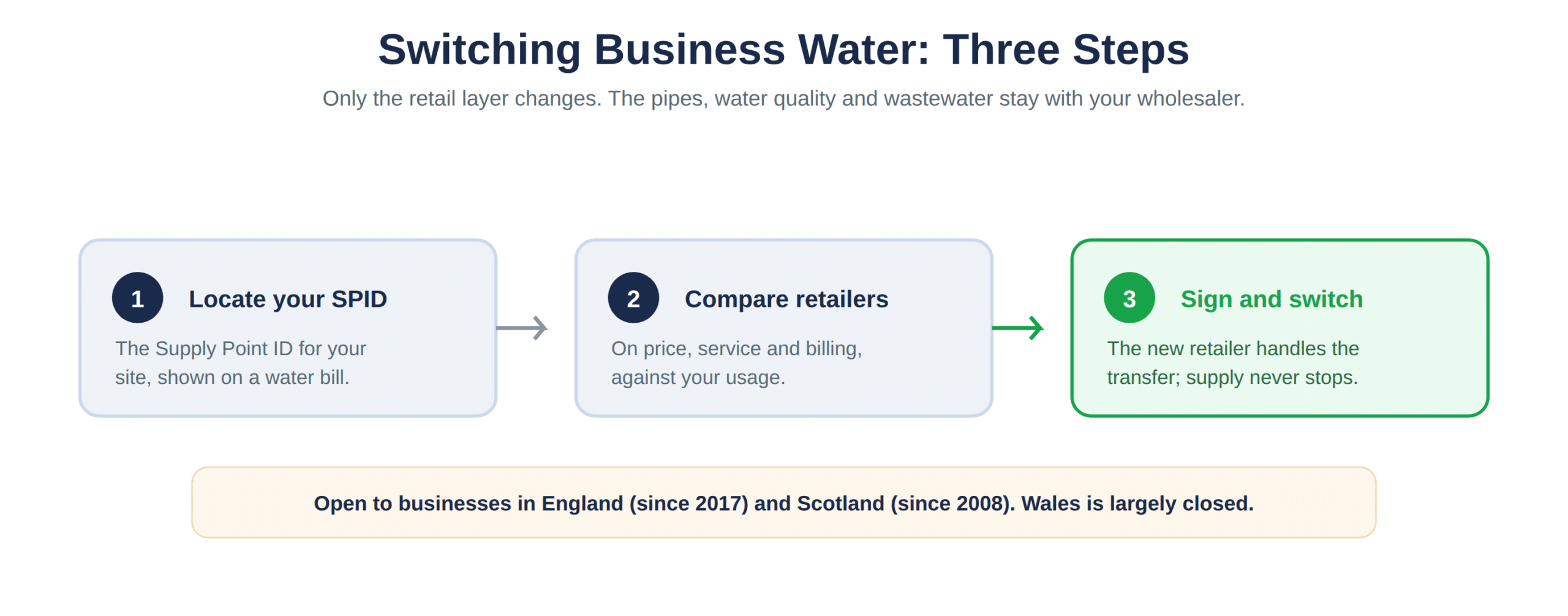
Locate your SPID, compare retailers on price and service, then sign, and the new retailer manages the transfer through the central market systems without any interruption to supply.
Three simple steps
- Locate your SPID: from a recent water bill or by asking your current retailer.
- Compare retailers: on price, billing and service against your actual usage.
- Sign and switch: the new retailer handles the transfer end to end.
The whole thing works much like an energy switch, and the Ofwat business retail market framework keeps it consistent across suppliers.
A switch typically completes within a few weeks, and there is no physical work at the premises. Take a meter reading on the changeover date so the opening balance with the new retailer is accurate.
What could stop you from switching?
The main blockers are an outstanding balance with your current retailer, a live fixed-term retail contract, or an unresolved change of tenancy at the site.
Clear these first
An unpaid balance is the most common blocker, so clear it or agree a plan first. A recent change of tenancy needs sorting so the account sits in the right name, and a broker acting for you needs a signed letter of authority.
A live fixed-term retail contract can also carry a notice period, so check when yours ends before committing. None of these are permanent barriers; they simply need clearing before the transfer can complete.