
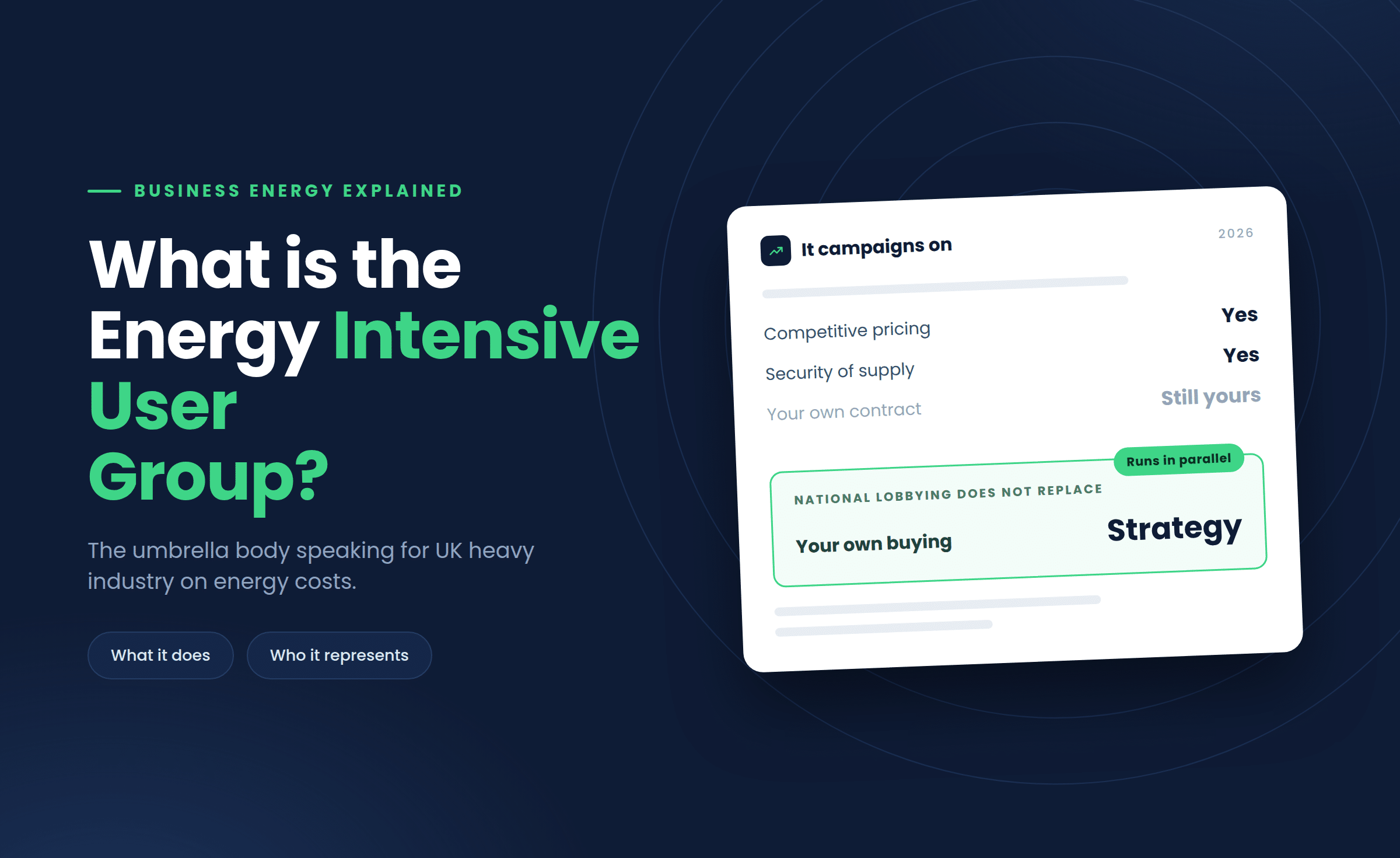
The Energy Intensive User Group is an umbrella body that represents the UK’s energy-intensive industries, lobbying for fair and competitive energy prices, secure supply, and cost-effective decarbonisation so that heavy industry stays internationally competitive.
For sectors like steel, glass and chemicals, energy is not a background overhead. It is one of the largest single costs of doing business, and a small movement in the wholesale price can decide whether a plant is viable.
The group exists so those industries speak to government with one voice rather than individually. It matters to any business watching business electricity costs, but most of all to the largest users.
This guide covers what the group does, which industries it represents, how it influences policy, and where a large energy user fits alongside it.
What does the energy intensive user group actually do?
It represents the collective interests of energy-intensive industries to government, campaigning for competitive energy pricing, security of supply, and decarbonisation that industry can actually afford.
The three core aims
It works by engaging directly with policymakers, responding to consultations, and backing its arguments with data on how energy costs affect competitiveness. The group’s own publications set out its positions in detail.
The aim is balanced regulation, not exemption from environmental goals. Members collectively add billions to the economy and support hundreds of thousands of jobs, which is the weight behind the lobbying.
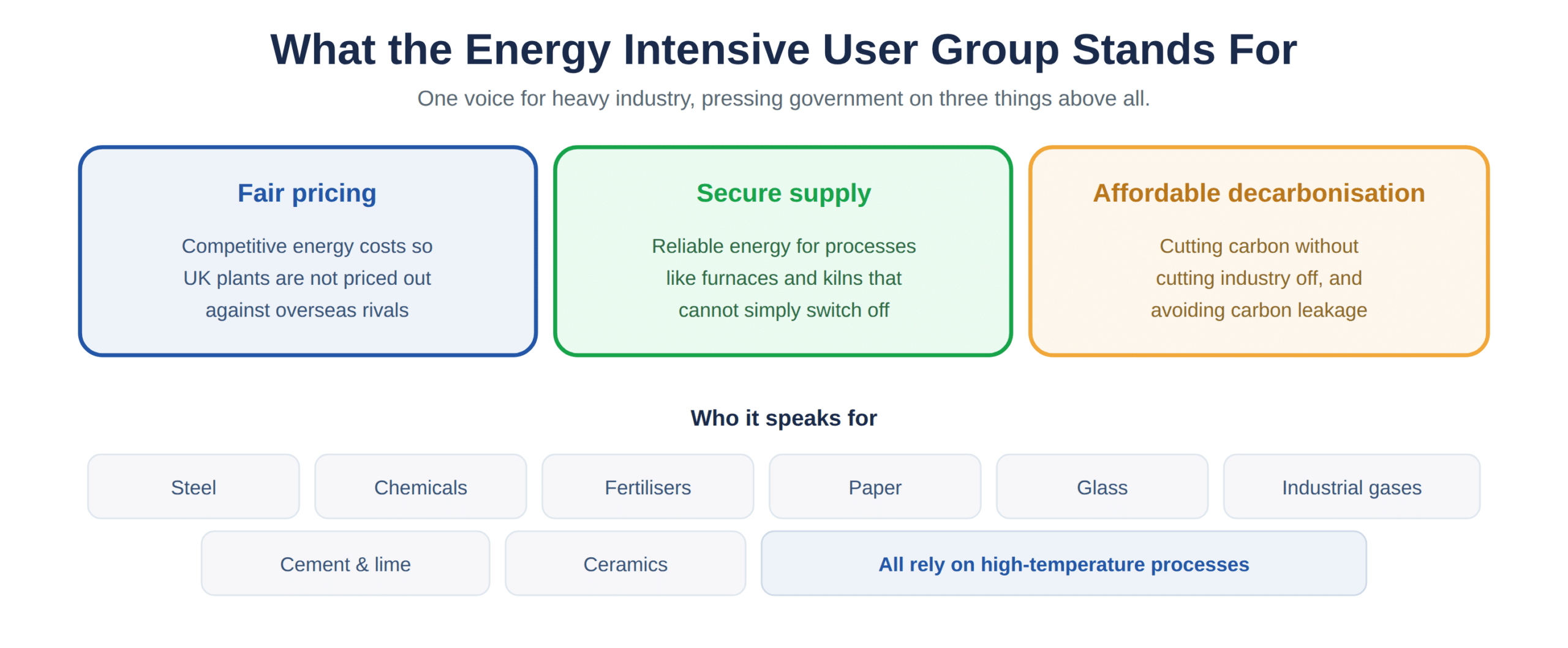
- Fair, competitive pricing: so UK plants are not priced out against overseas rivals.
- Security of supply: reliable energy for processes that cannot simply stop.
- Affordable decarbonisation: cutting carbon without cutting industry off at the knees.
Which industries does it represent?
Its members are large-scale energy users whose production depends heavily on the cost and availability of energy: steel, chemicals, fertilisers, paper, glass, cement, lime, ceramics and industrial gases.
Why these sectors are energy-intensive
Most of these industries rely on high-temperature processes: smelting steel, melting glass, firing kilns for cement and ceramics. Energy is a raw input, not a support cost, which is why price moves hit them first.
These sectors also underpin the wider supply chain, from construction materials to the components other manufacturers depend on. A shock to their energy costs ripples well beyond the factory gate.
| Sector | Why energy is a major cost |
|---|---|
| Steel | Smelting and shaping at very high temperatures |
| Glass | Melting raw materials in continuous furnaces |
| Cement, lime, ceramics | High-temperature kilns running near constantly |
| Chemicals and fertilisers | Heating and energy-intensive reactions |
| Paper and industrial gases | Pulping, drying and gas separation |
How does the group influence energy policy?
It acts as a single expert voice for heavy industry, providing evidence to government on how energy costs and regulation affect competitiveness, and pressing for measures that protect jobs without abandoning climate targets.
Where its influence shows up
A recurring theme is carbon leakage: the risk that strict rules simply push production abroad, losing UK jobs without cutting global emissions. It also shaped support like the British Industry Supercharger, which reduces network charges for eligible energy-intensive users.
That kind of relief sits alongside the Climate Change Levy and Climate Change Agreements, which together shape what a heavy user actually pays on top of the wholesale rate.
The group also works with industry associations, research bodies and government rather than acting alone. Broad consensus carries more weight in a consultation than a single sector pushing its own case.
What challenges do energy-intensive industries face?
The biggest are high energy costs, the risk of carbon leakage, and staying competitive against international rivals who may face lower energy prices or looser environmental rules.
Why the contract still matters most day to day
Policy support helps, but the largest lever any manufacturer controls directly is how it buys energy. Our guide to manufacturing energy costs covers the on-site fixes, from compressed air to motors.
On the buying side, large variable users often use flexible energy procurement to spread purchases across the year rather than fixing everything on one date. The UK Emissions Trading Scheme adds a further cost that the largest sites must manage.
Global competitiveness ties all of this together. If a UK plant pays more for energy than a rival abroad, it must be more efficient elsewhere to compete, which is exactly the pressure the group tries to ease at the policy level.
Where does a large energy user fit alongside the group?
The group lobbies at the national level, but an individual business still controls its own contract, its buying strategy and its efficiency. The two work in parallel rather than one replacing the other.
Acting on your own account
The group’s early roots were a simple realisation: individual firms had little influence on energy policy alone, but a united front carried real weight. The same logic applies to buying, where scale and structure change the rate available.
Even the most energy-intensive site benefits from comparing its business energy suppliers and structuring a contract around real demand, which is where a proper energy procurement approach pays off.
Check eligibility for relief schemes, keep an eye on your UK Emissions Trading Scheme obligations if they apply, and treat the contract as an active decision rather than an annual formality.