
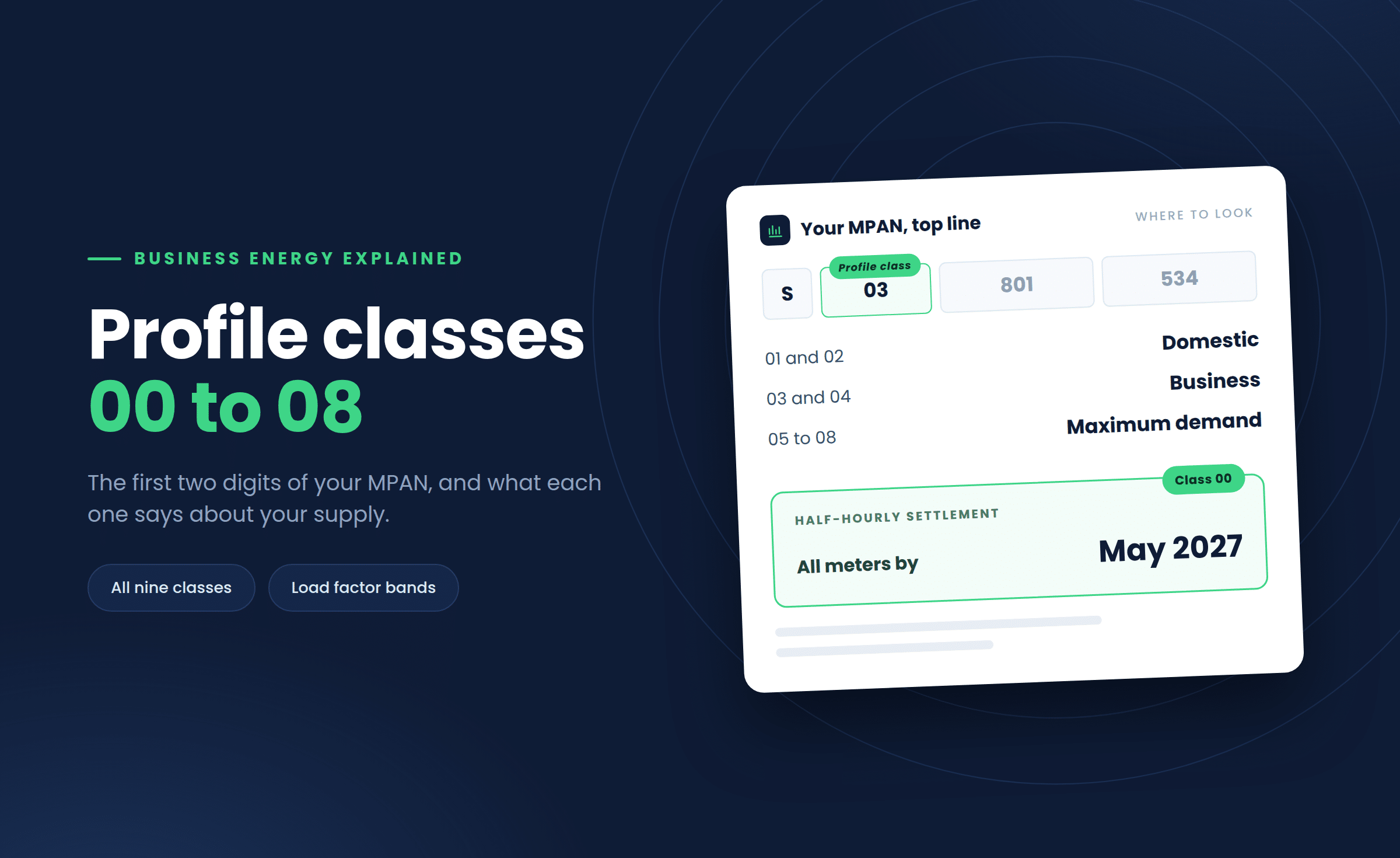
A profile class is the two-digit code at the start of your MPAN that tells the industry how your business uses electricity. It runs from 00 to 08, and it shapes how your usage is estimated and how your supply is settled.
Classes 01 and 02 are for homes, and 03 to 08 are for businesses. Knowing yours helps you understand your bill and whether you need half-hourly metering.
It also helps when you compare business energy, because your profile class is one of the details a supplier uses to price your supply.
What is an energy profile class?
An energy profile class is a code that groups electricity supplies by the typical shape of their demand. It lets suppliers estimate when and how much energy a meter uses between readings.
How profile classes are used in settlement
Meters that are not read every half hour are settled using an estimated profile rather than live data. The industry body Elexon uses your profile class to model that half-hourly shape from your annual usage.
That estimate decides how much energy is bought for your meter in the wholesale market. If you want a refresher on units, our guide to what a kWh is explains how usage is measured.
Where the profile class sits in your MPAN
Your profile class is the first two digits of the top line of your MPAN, the 21-digit supply number on your electricity bill. So an MPAN starting S 03 identifies a non-domestic single-rate supply.
What are the profile classes from 00 to 08?
There are nine profile classes, numbered 00 to 08. Two are for homes, six are for businesses, and 00 covers half-hourly metered supplies.
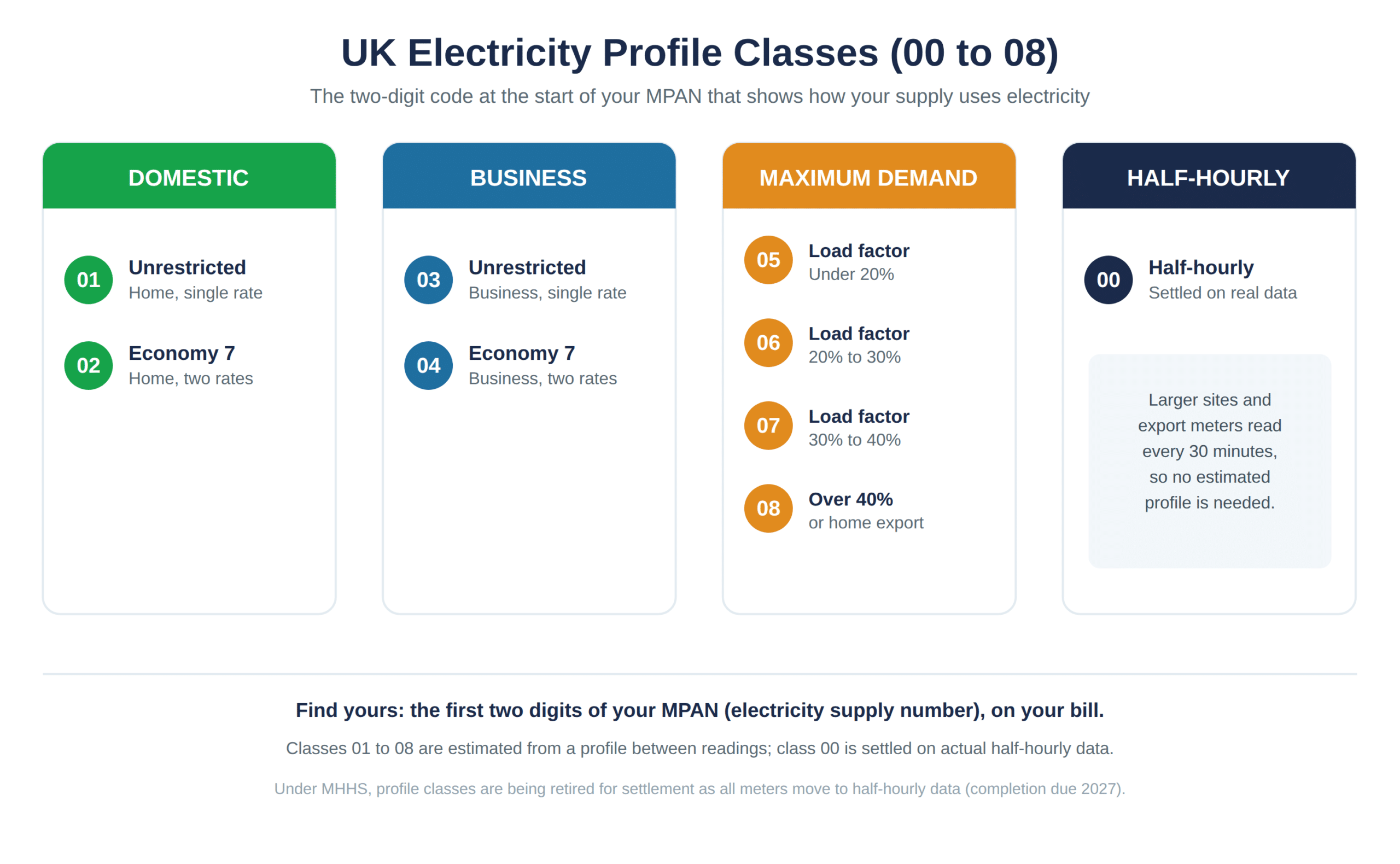
| Class | Type | Rate or metering | Applies to |
|---|---|---|---|
| 00 | Half-hourly | Settled on actual half-hourly data | Larger sites and export meters |
| 01 | Domestic | Single rate (unrestricted) | Homes on one rate |
| 02 | Domestic | Economy 7, two rates | Homes with an off-peak night rate |
| 03 | Business | Single rate (unrestricted) | Smaller non-domestic sites |
| 04 | Business | Economy 7, two rates | Non-domestic with an off-peak rate |
| 05 | Business | Maximum demand, load factor under 20% | Non-domestic, peaky use |
| 06 | Business | Maximum demand, load factor 20 to 30% | Non-domestic |
| 07 | Business | Maximum demand, load factor 30 to 40% | Non-domestic |
| 08 | Business | Maximum demand, load factor over 40% | Non-domestic (also domestic export) |
Domestic classes (01 and 02)
Class 01 is a standard single-rate home supply, and class 02 is a home on Economy 7 with cheaper night-time units. These are the two classes you will see on household bills.
Economy 7 gives around seven cheaper hours overnight, which suits homes that heat water or charge a car after midnight. The trade-off is a higher unit rate during the day.
Non-domestic classes (03 and 04)
Class 03 is a standard single-rate business supply, and class 04 is a business on a two-rate Economy 7 tariff. Most small shops and offices fall into class 03.
Maximum demand classes (05 to 08)
Classes 05 to 08 are larger non-domestic sites billed on maximum demand, split by load factor. Energy-intensive operations, such as those in the Energy Intensive Users Group, usually sit at the higher end of this range.
One quirk is class 08, which also covers domestic export meters, such as homes selling solar power back to the grid. So an 08 is not always a large business.
What do maximum demand and load factor mean?
Maximum demand is the highest amount of power your site draws at once, and load factor compares your average demand to that peak. Together they decide which of classes 05 to 08 a business falls into.
Maximum demand (MD)
Maximum demand is the highest half-hourly power draw recorded over a period, measured in kW or kVA. Larger sites pay capacity charges based on it, which is why controlling peaks can cut costs.
Capacity is often set as an agreed level in kVA that the network makes available to you. Keeping that agreed capacity close to your real peak avoids paying for headroom you never use.
Load factor and the 05 to 08 bands
Load factor is your average demand shown as a percentage of your maximum demand. A low load factor means short, sharp peaks, while a high load factor means steady, sustained use.
| Class | Load factor | What it suggests |
|---|---|---|
| 05 | Under 20% | Short, sharp peaks with low overall use |
| 06 | 20% to 30% | Moderate, uneven demand |
| 07 | 30% to 40% | Fairly steady demand |
| 08 | Over 40% | High, sustained demand |
For example, a site with a 100 kW maximum demand using 200,000 kWh a year averages about 23 kW. That is a load factor of roughly 23%, which would place it in class 06.
How does a profile class relate to your SSC and meter type?
Your profile class sets the shape of your demand, while your standard settlement configuration, or SSC, sets your rate and register structure. Together with your meter type, they decide how your supply is billed.
Profile class versus SSC
The profile class describes when you use energy, and the SSC describes how your meter records it, such as a single register or separate day and night registers. A class 04 supply, for example, pairs a business profile with a two-rate Economy 7 configuration.
Non-half-hourly versus half-hourly meters
Classes 01 to 08 are non-half-hourly, so their usage is estimated from a profile between readings. Class 00 and larger demand sites are half-hourly, settled on actual data recorded every 30 minutes.
How do you find your profile class?
Your profile class is the first two digits of your MPAN, printed on your electricity bill. You do not need to contact anyone to read it.
On your bill and MPAN
Find the supply number grid marked with an S on your bill, and read the first two digits of the top line. If you cannot find a bill, your supplier can tell you, and our guide to who supplies your electricity and gas helps if you are not sure who to ask.
Why does your profile class matter?
Your profile class affects how your usage is settled, what tariffs suit you and whether you need half-hourly metering. It also feeds into the price a supplier quotes.
Settlement, tariffs and metering
The class signals whether you are single-rate or on Economy 7, and whether your site is small or demand-metered. A wrong class can lead to the wrong charges, so it is worth checking.
Business energy pricing and quotes
Suppliers use your profile class to price your business electricity accurately, alongside your usage and meter type. Having it ready makes it quicker to switch your business energy supplier and line up a new energy supplier.
Are profile classes being scrapped under MHHS?
Yes, profile classes are being retired for settlement as every meter moves to half-hourly data under MHHS. The change is about how supplies are settled, not about switching off your electricity.
What MHHS changes
The MHHS programme settles all supplies on actual half-hourly usage, so estimated profiles are no longer needed. Profiling detail is kept mainly for legacy Economy 7 and Economy 10 meters during the switchover.
Migration runs from late 2025, with completion due in May 2027, as Energy UK explains. You do not need to do anything, and your MPAN core stays the same.
P272, the first wave
This is not the first move of its kind. Under P272, larger businesses in classes 05 to 08 already moved to mandatory half-hourly settlement by 2017, a change Ofgem oversaw.
MHHS now extends that same principle to every electricity supply.