
The fastest ways to lower a business water bill are to check for leaks, claim any drainage or return-to-sewer rebates you are owed, submit accurate meter readings, and compare your retailer. Most of these cost little or nothing and several can be backdated.
Water bills tend to get less attention than energy, which is exactly why savings sit unclaimed for years. A charge set when the account opened often runs untouched long after the site has changed.
There are two separate levers: the charges themselves and the volume you use. Both matter, and our guide to how business water rates are calculated explains where each one sits on the bill.
This guide works through where bills quietly creep up, and the fixes ranked by how much effort each takes.
The order matters. The free, high-impact checks come first, because there is no reason to spend on fittings before you have confirmed you are not overpaying on charges you could have removed for nothing.
Why do business water bills creep up in the first place?
Bills creep up through estimated readings that overstate usage, undetected leaks, charges for drainage that does not apply to your site, and a retail rate that has never been compared since the market opened.
The usual suspects
A slow leak on a large site can run for months unnoticed, quietly inflating every bill. An estimated reading that has never been corrected does the same, and a surface water charge on a site that drains to a soakaway is money paid for nothing.
None of these are dramatic on their own, but together they add up, and several can be put right with a phone call. Our guide to what a good water rate looks like covers the benchmarks.
Trading changes are a common trigger. A site that has reduced its hours, changed use or lost a water-heavy process may still be billed on the old pattern until someone updates the readings and the account.
Can switching retailer cut your business water bill?
Yes, though the saving is smaller than energy because only the retail margin is competitive. For higher-usage and multi-site businesses, a leaner retail margin and corrected charges still add up to a worthwhile amount.
Realistic expectations
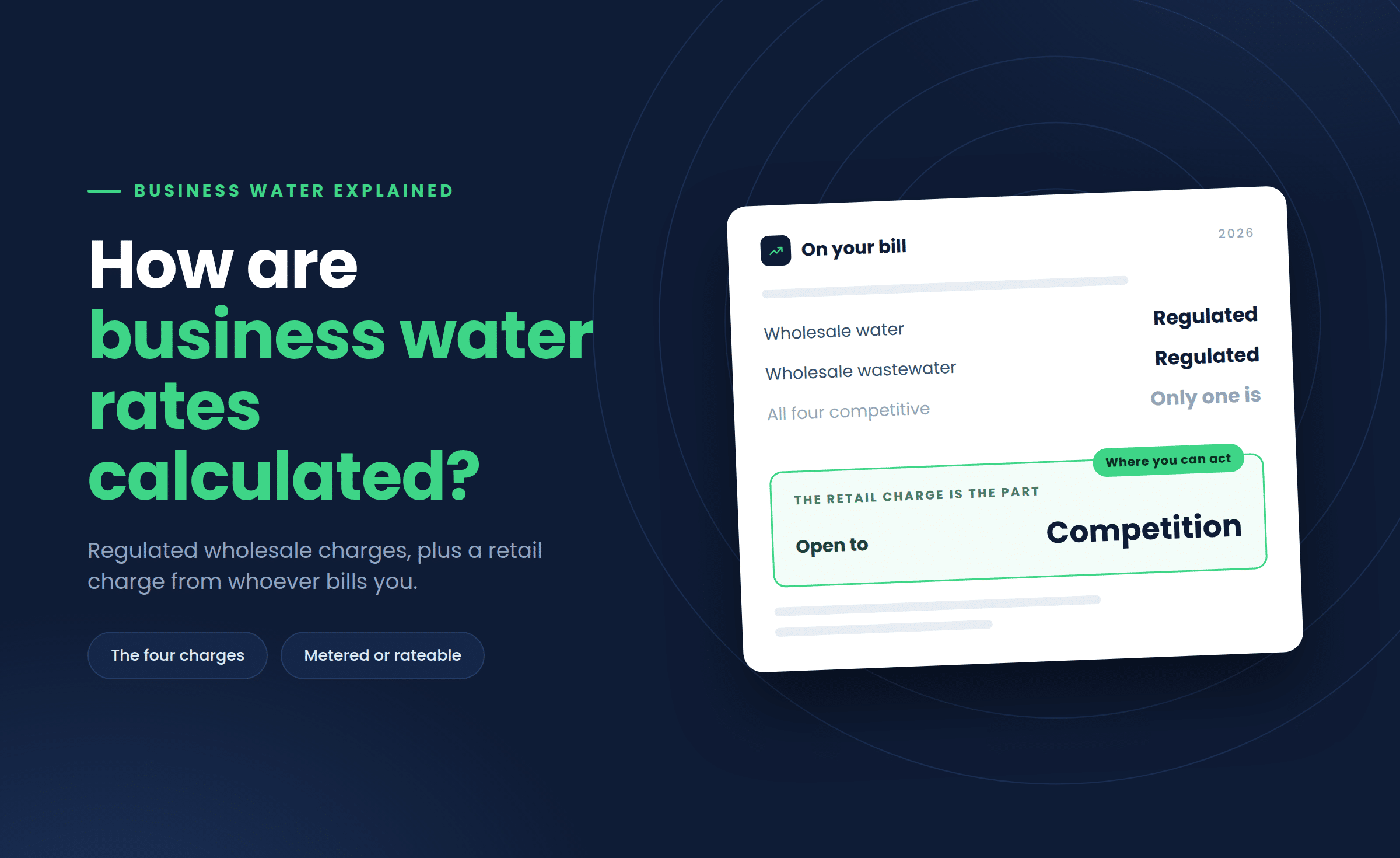
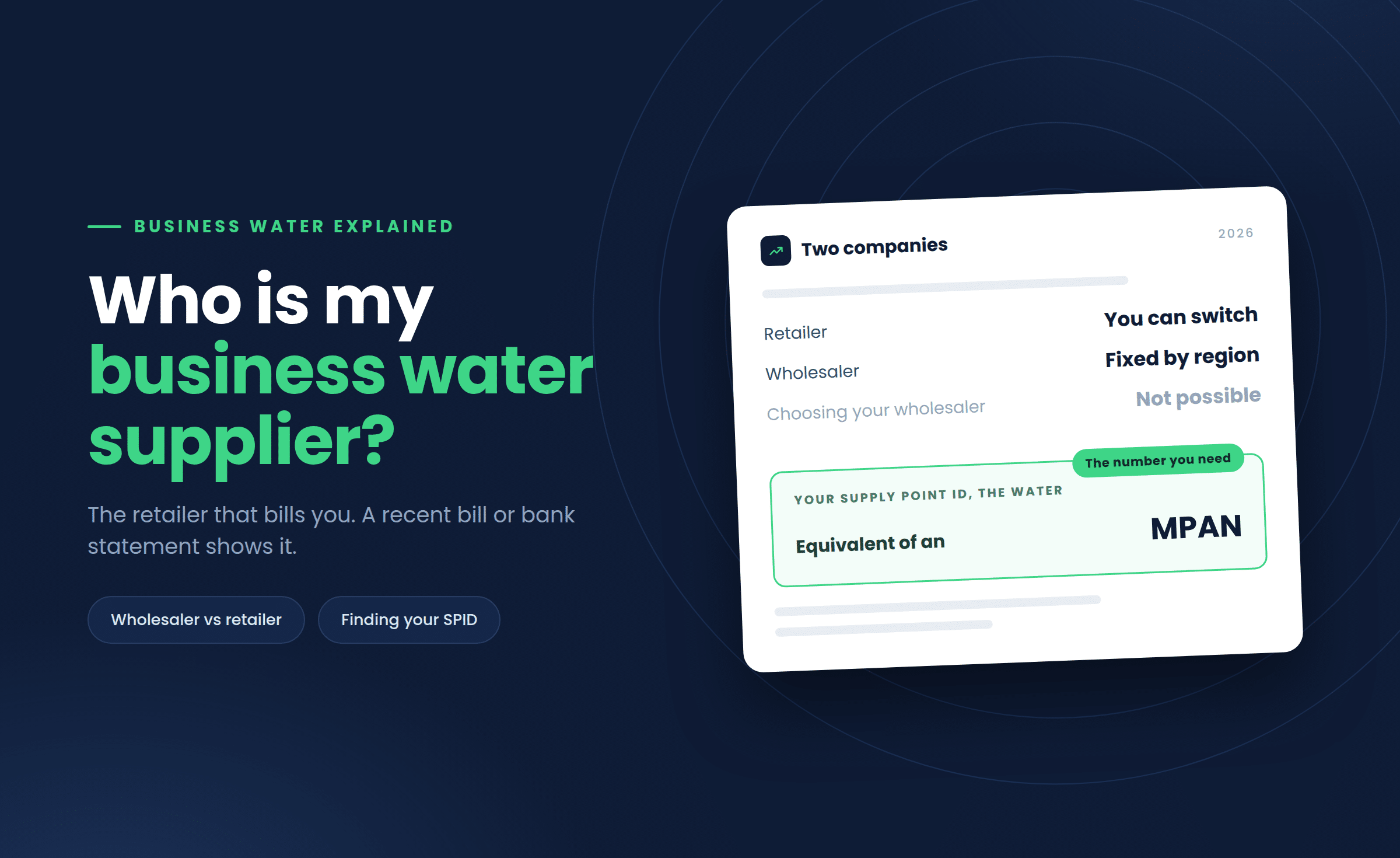
The wholesale charge is regulated and barely moves between retailers, so switching sharpens the retail slice and the service, as our guide to switching business water explains. A sharper retailer also means fewer estimated bills and quicker rebate claims.
Consolidating several sites onto one retailer is worth considering too. It simplifies billing, gives a single point of contact, and often unlocks a better margin than each site negotiating alone.
What quick fixes reduce consumption without any capital spend?
Fixing leaks, submitting real meter readings, and simple low-flow fittings cut consumption for little or no cost, and they show up on the very next bill rather than months later.
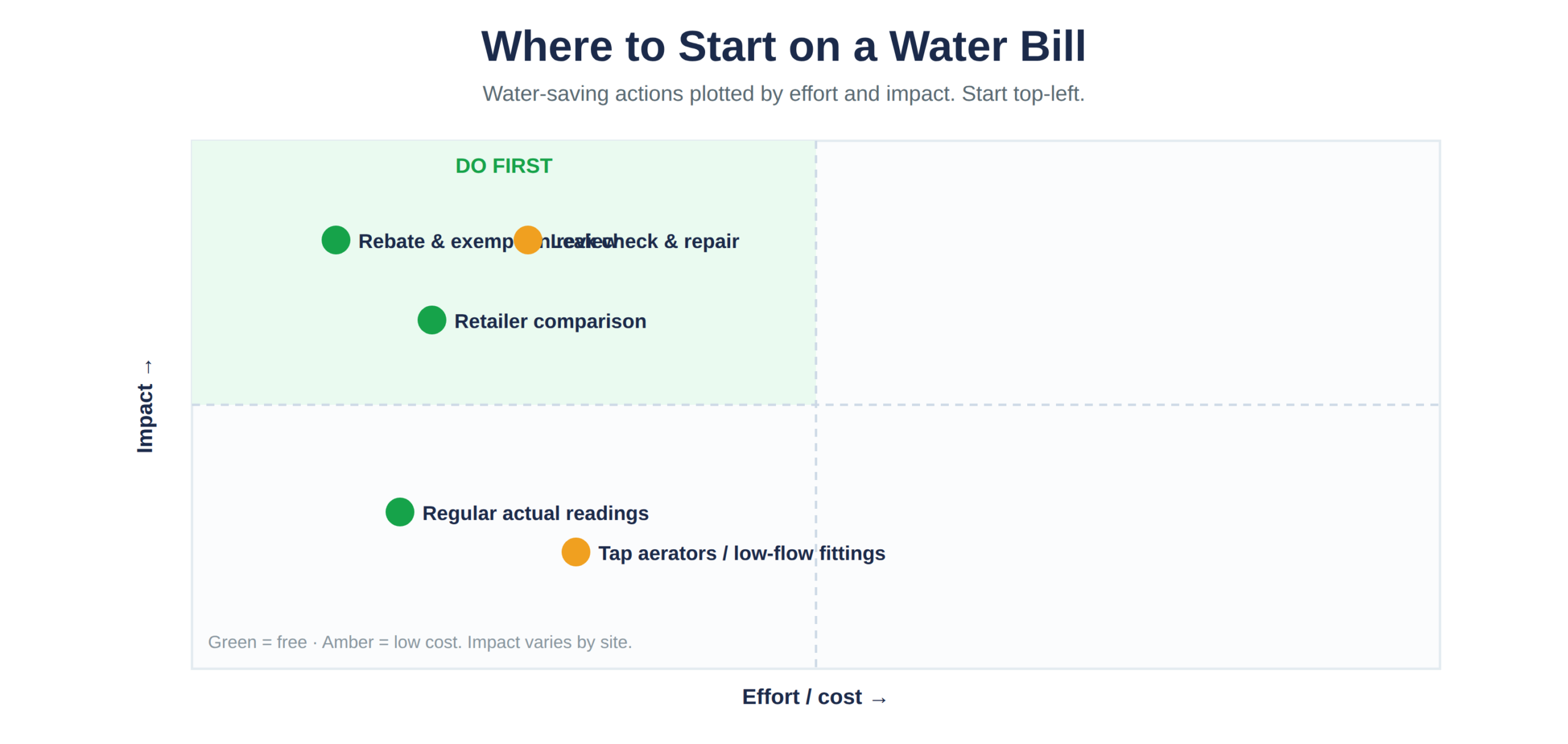
Low-cost or no-cost changes worth trying first
| Action | Typical cost | Typical impact |
|---|---|---|
| Leak check and repair | Low | High |
| Tap aerators / low-flow fittings | Low | Medium |
| Regular actual meter readings | None | Medium |
| Retailer comparison | None | Medium to high |
| Rebate and exemption review | None | Medium to high |
Larger, water-heavy sites see the biggest returns, so a warehouse or industrial unit with washdown or process water has more to gain than a small office.
Which rebates and exemptions do businesses miss most often?
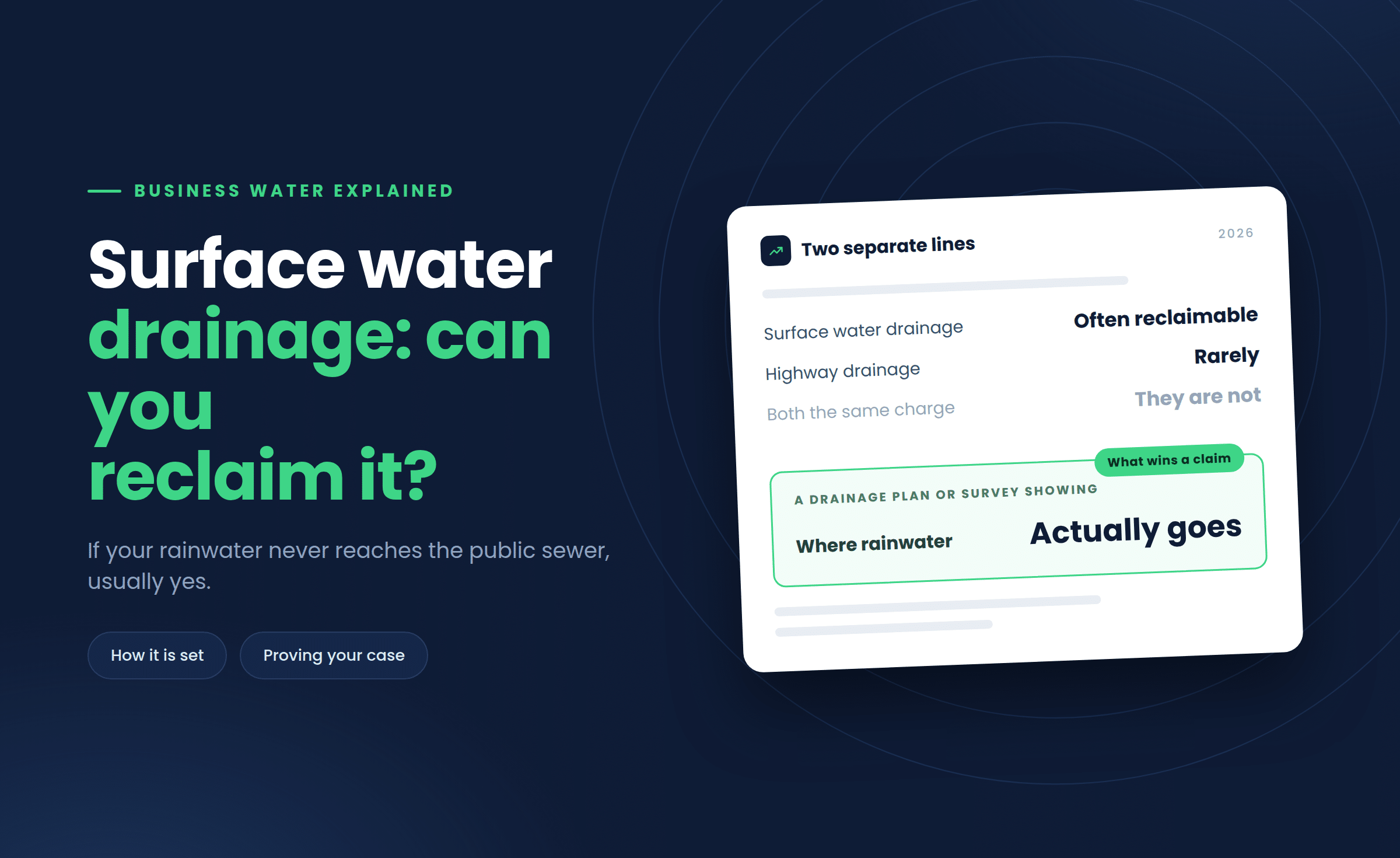
The two most commonly missed are the surface water drainage rebate, where rainwater does not drain to the public sewer, and the return-to-sewer allowance, where water is used but not returned as wastewater.
Signs your bill deserves a closer look
If your site has a soakaway, a private watercourse or a large yard, you may be owed a surface water drainage rebate. If you incorporate water into products or lose it to evaporation, a sewerage rebate allowance may apply.
Both can often be backdated, so a successful claim can return several years of overpayment as well as cutting future bills. It is one of the highest-value checks a water-heavy business can run.
Trade effluent dischargers have a further lever: reducing the strength or volume of what they discharge lowers the Mogden-formula charge. That is a bigger, more technical project, but a real one for the right site.
Is a professional water audit worth it?
For water-heavy sites, yes. A professional audit finds leaks, wrong charges and rebate opportunities that a quick internal check misses, and the fee is usually recovered many times over on a large bill.
When an audit pays for itself
For a small office the free checks in this guide are usually enough. For manufacturing, catering or large multi-site estates, a specialist audit tends to pay for itself, and bodies like Waterwise publish efficiency guidance worth reading first.
Whatever route you take, compare your business water rates against the market at least once so you know where you stand, and raise any wrong charge with the Consumer Council for Water if a retailer will not fix it.