
There is no single good rate for business water, because charges vary by region, usage and site. A good rate is one where the wholesale charges match your area, the retail margin is competitive, and you are not paying for drainage or wastewater you should not be.
Water pricing is less transparent than energy, so businesses rarely know whether their rate is fair. The wholesale element is regulated, which helps, but the retail margin and the wastewater components leave real room for difference.
The most useful benchmark is your own bill compared against the market, and our guide to how business water rates are calculated breaks the charges down line by line.
This guide sets out how pricing works, what makes one rate more competitive than another, and how to tell if you are overpaying.
The honest headline is that the biggest water savings often come from correcting charges, not from switching. A rebate you were owed for years can dwarf the retail margin difference between two retailers.
How does business water pricing work?
Your rate combines a regulated wholesale charge for water and wastewater with a retail charge from the retailer that bills you, plus a fixed standing charge. Only the retail margin is open to competition.
What each charge covers
The wholesale charge, set within Ofwat price limits, covers treating and delivering clean water and removing wastewater. The retail charge covers billing, service and account management, and it is the part a good retailer sharpens.
Because the wholesale part is broadly fixed for your area, a good rate is really about a lean retail margin, accurate charges and any rebates you are entitled to, rather than a dramatically lower headline figure.
This is why a like-for-like comparison matters. A quote that undercuts on the wholesale line for the same site should be treated with suspicion, because that element is regulated and should barely move between retailers.
What makes one business water rate more competitive than another?
A competitive rate reflects your region, your consumption, the wastewater and drainage components, a lean retail margin, and whether you are claiming the rebates and allowances your site qualifies for.
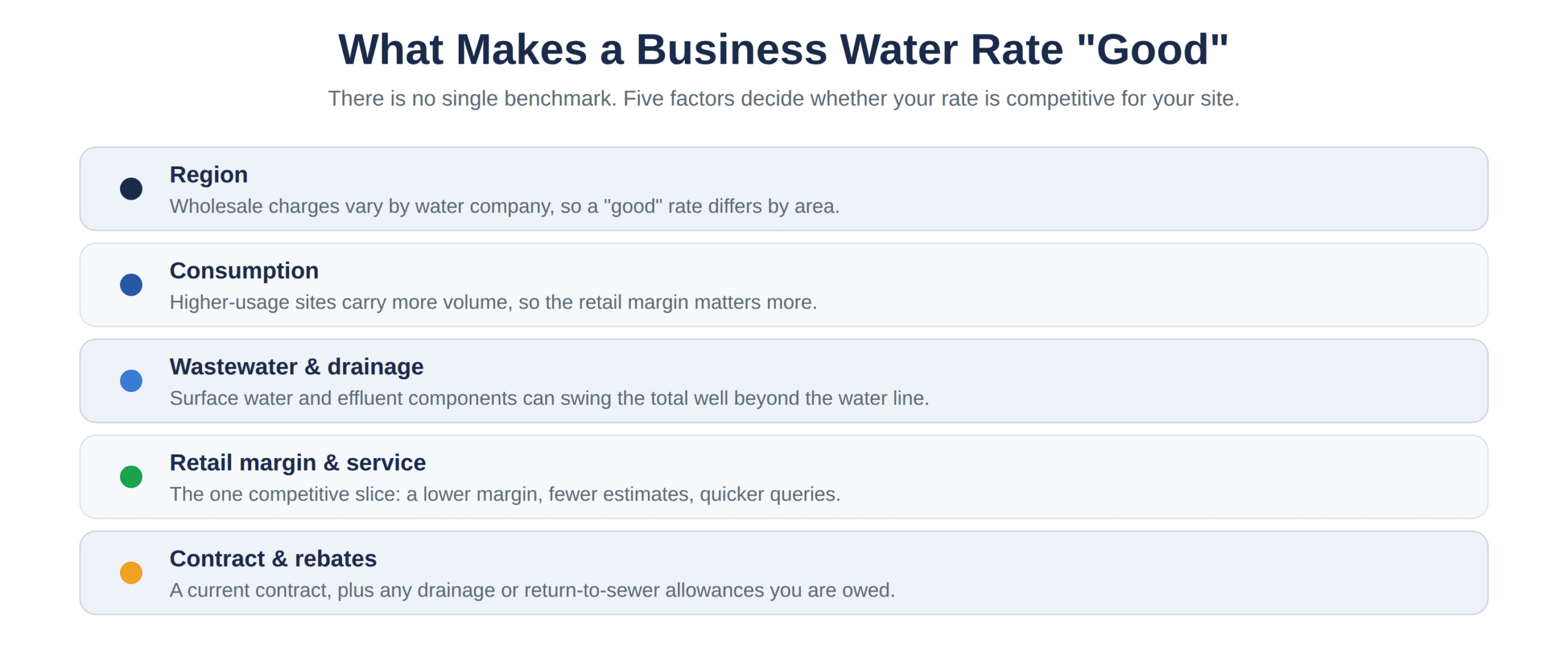
Factors that shape whether your rate is good
Surface water drainage is a common hidden cost: if rainwater from your site does not drain to the public sewer, you may be owed a rebate, as our guide to the surface water drainage charge explains.
Wastewater volume is usually assumed at around 95% of the water you buy, so businesses that use water without returning it to the sewer can be overcharged unless an allowance is in place.
Consumption is the other big lever. A higher-usage site pays more in absolute terms, so a small improvement in the retail margin or a corrected wastewater assumption is worth far more there than at a low-usage unit.
How does the market differ across england, scotland and wales?
England and Scotland both have open non-household water markets, so businesses can switch retailer to sharpen the rate. Wales is largely closed, with only the very largest users able to switch.
The exception in wales
| Nation | Market opened | Wholesaler | Can most businesses switch? |
|---|---|---|---|
| England | April 2017 | Regional company (Thames, Severn Trent, others) | Yes |
| Scotland | 2008 | Scottish Water | Yes |
| Wales | Not fully open | Dwr Cymru Welsh Water | Only very large users |
Scotland’s market, overseen by WICS, was the first of its kind in the world. In Wales only sites using more than 50 million litres a year can switch, so most Welsh businesses stay with their incumbent.
How do you know if you’re overpaying?
The clearest signs are estimated bills never corrected, a surface water charge on a site that does not drain to the sewer, a wastewater charge assuming full return, and a retail rate never compared since the market opened.
Red flags on a water bill
If any of those apply, you are probably paying more than you need to, and our guide to lowering a business water bill covers the fixes. The Consumer Council for Water, CCW, can also help if a charge looks wrong.
A quick self-check is to compare your bill against the same period last year. A jump with no change in activity usually points to an estimated reading or a charge that has crept on, not to genuinely higher usage.
How do you compare business water rates?
Gather a recent bill with your SPID, confirm your usage and wastewater arrangements, then compare retailers on the retail margin and service rather than the regulated wholesale charge.
Comparing like for like
A comparison across retailers, matched to your usage, shows whether your retail margin is competitive. Our guide to switching business water covers the process, and different sectors have very different water profiles worth accounting for.
Do not forget VAT: most businesses pay none on water, but industrial users pay the standard rate, as our guide to VAT on business water bills explains.