
You claim a sewerage rebate by proving to your water retailer that some or all of your wastewater does not reach the public sewer, then applying for the charge to be removed or reduced. Successful claims can often be backdated for several years.
Sewerage charges assume that almost all the water you buy returns to the public sewer as wastewater. When that is not true for your site, you are paying to dispose of water that never enters the network.
It is one of the most commonly missed water savings, particularly for sites with a septic tank or a private treatment plant. This guide covers who qualifies and how to claim, alongside our guide to lowering a business water bill.
Because a claim can be backdated, a successful application often returns a lump sum as well as cutting future bills.
The size of the prize depends on how much of your water genuinely does not return to the sewer. For a rural site on a septic tank, that can be the whole wastewater charge, year after year.
What is a sewerage rebate and who typically qualifies?
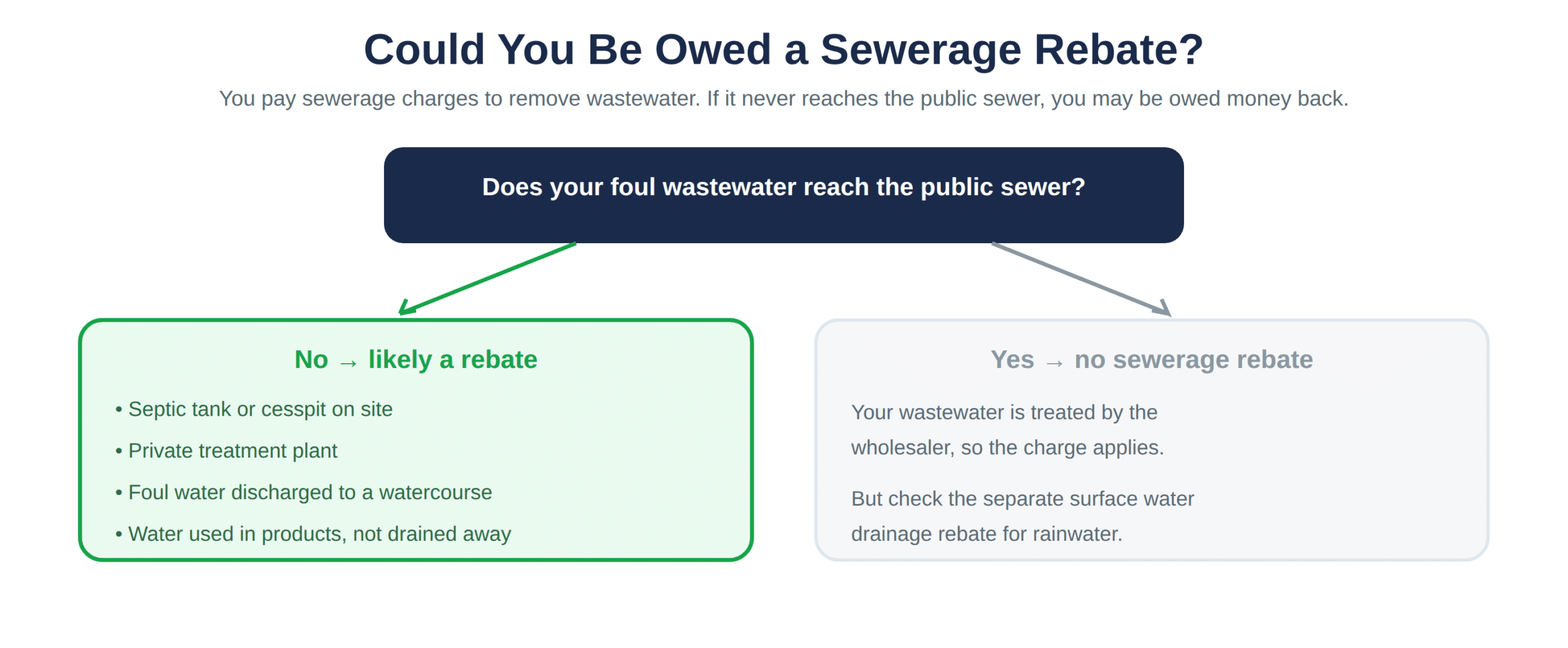
A sewerage rebate reduces or removes the wastewater charge for water that does not return to the public sewer. Sites with a septic tank, cesspit, private treatment plant, or water incorporated into products typically qualify.
Who is most likely to be owed one
Rural sites off the main sewer network are the classic case, but so are food and drink producers whose water goes into products, and businesses that lose water to evaporation. Some care homes and industrial sites also qualify without realising it.
If your wholesaler assumes full return to sewer but your site clearly does not, the gap is exactly what a rebate corrects.
The default assumption is that around 95% of the water you buy comes back as wastewater. Any business that materially breaks that assumption is a candidate for a rebate or a return-to-sewer allowance.
How do you prove your site isn’t connected to the public sewer?
You prove it with drainage evidence: a site drainage plan, septic tank or treatment plant paperwork, planning records, or a drainage survey showing where your foul water actually goes.
Evidence that typically supports a claim
- Drainage plan: showing foul water going to a tank or private system, not the sewer.
- Tank paperwork: septic tank, cesspit or treatment plant installation and emptying records.
- Planning records: that reference the site’s private drainage arrangements.
- Drainage survey: a professional survey where the paperwork is missing.
The stronger and clearer the evidence, the faster the retailer and wholesaler can approve the claim. A drainage survey is worth commissioning where records are thin.
Photographs of the tank or treatment plant, plus emptying invoices from a waste contractor, are simple corroborating evidence that strengthens a claim where formal plans are missing.
How is a sewerage rebate different from a surface water rebate?
A sewerage rebate covers foul wastewater from toilets, sinks and process drains that does not reach the sewer. A surface water rebate covers rainwater from roofs and hard standing, and the two are separate claims.
Two claims, often both available
| Rebate type | What it covers | Typical evidence |
|---|---|---|
| Sewerage rebate | Foul water from toilets, sinks, process drains | Drainage survey, septic tank paperwork, planning records |
| Surface water rebate | Rainwater from roofs, car parks, hard standing | Drainage plan showing soakaway, SUDS or private discharge |
Many sites qualify for both, so it is worth checking each separately, as our guide to the surface water drainage charge explains.
Running the two checks together is efficient, because the same drainage survey or site plan often provides the evidence for both claims at once.
What are the actual steps to submit a claim?
Contact your water retailer, explain that some or all of your wastewater does not reach the public sewer, submit your evidence, and ask for the charge to be reduced and any overpayment refunded.
Keeping the claim moving
The retailer raises the claim with the wholesaler, which assesses the evidence and adjusts the account. If a retailer is slow or unhelpful, the Consumer Council for Water can help, and the Ofwat market rules govern how retailers must handle it.
Can you backdate a successful sewerage rebate claim?
Often yes. Where you can show the charge has been applied wrongly for years, retailers will usually backdate the refund, subject to their own policy and any time limits.
What to have ready before you ask about backdating
Have your account number, SPID, drainage evidence and past bills ready, since a clear paper trail supports a longer backdated period. Our guide to how business water rates are calculated helps you read the charges you are challenging.