

Gnergy is the only company on this record that Ofgem was formally in the middle of shutting down when it collapsed. It was given a final order to pay £673,876.62, it did not pay, Ofgem published a notice saying so, and ten weeks later the company ceased trading.
All of that was on the public record, with the company named and the amount stated, nearly five months before any customer heard anything.
What happened to Gnergy?
Gnergy, styled GnERGY, was a small supplier selling gas and electricity on four simple tariffs under the heading "Providing Gas & Electricity in an Open and Honest Way".
It ceased trading on 18 March 2020 with around 9,000 domestic customers and, in Ofgem's words, a small number of non-domestic customers. Bulb was appointed through the supplier of last resort process and took the customers on over the weekend of 21 and 22 March, and Gnergy's gas and electricity licences were revoked with effect from 22 March.
Credit balances were protected in the usual way. Philippa Pickford, then Ofgem's director for future retail markets, gave the standard reassurance that "Gnergy customers do not need to worry, as under our safety net we'll make sure your energy supplies are secure and domestic customers' credit balances are protected".
What makes Gnergy worth reading about is not the ending, which was orderly. It is everything that happened first.
The enforcement ladder, run to the end
When Ofgem wants to make a supplier do something, it has a sequence of steps, each one published with the company named. Gnergy is the only case here where that sequence ran all the way down.
How the ladder works
- A provisional order requires the supplier to do something immediately, before the case is fully made out, because waiting would cause harm. It lapses unless confirmed.
- A final order is the settled version: a formal legal requirement to do a specific thing by a specific date.
- A notice of failure to comply records that the supplier did not do it. This is the step almost nobody reaches, because companies either pay or collapse first.
- Revocation of the supply licence is what follows, and a supplier without a licence cannot supply energy.
What happened to Gnergy
On 29 October 2019 Ofgem issued Gnergy with a final order requiring it to pay £673,876.62 plus accrued interest into the Renewables Obligation buy-out fund, by 31 October 2019. The Renewables Obligation is the annual payment every electricity supplier owes towards renewable generation, and missing it is the single most common thread running through this record.
Gnergy did not pay, and did not pay afterwards either. On 8 January 2020 Ofgem issued a notice of failure to comply and said publicly that it was "now taking further enforcement action by starting the process that may result in the revocation of the supplier's licence".
Gnergy ceased trading on 18 March 2020. When the licences were revoked four days later, the final order ceased to have effect, having never been complied with.
Compare that with the other Renewables Obligation cases here. Colorado Energy and GOTO Energy, in the same consultation, were both named by Ofgem in October 2021 and ceased trading before any final order was issued, so Ofgem simply dropped the proceedings. Breeze Energy got a provisional order, paid most of what it owed on the final day and collapsed seven weeks later. Gnergy is the one that was ordered, refused, and recorded.
Still selling, two weeks after the deadline
The Internet Archive captured gnergy.co.uk on 15 November 2019. By then the final order deadline had been and gone, and the money had not been paid.
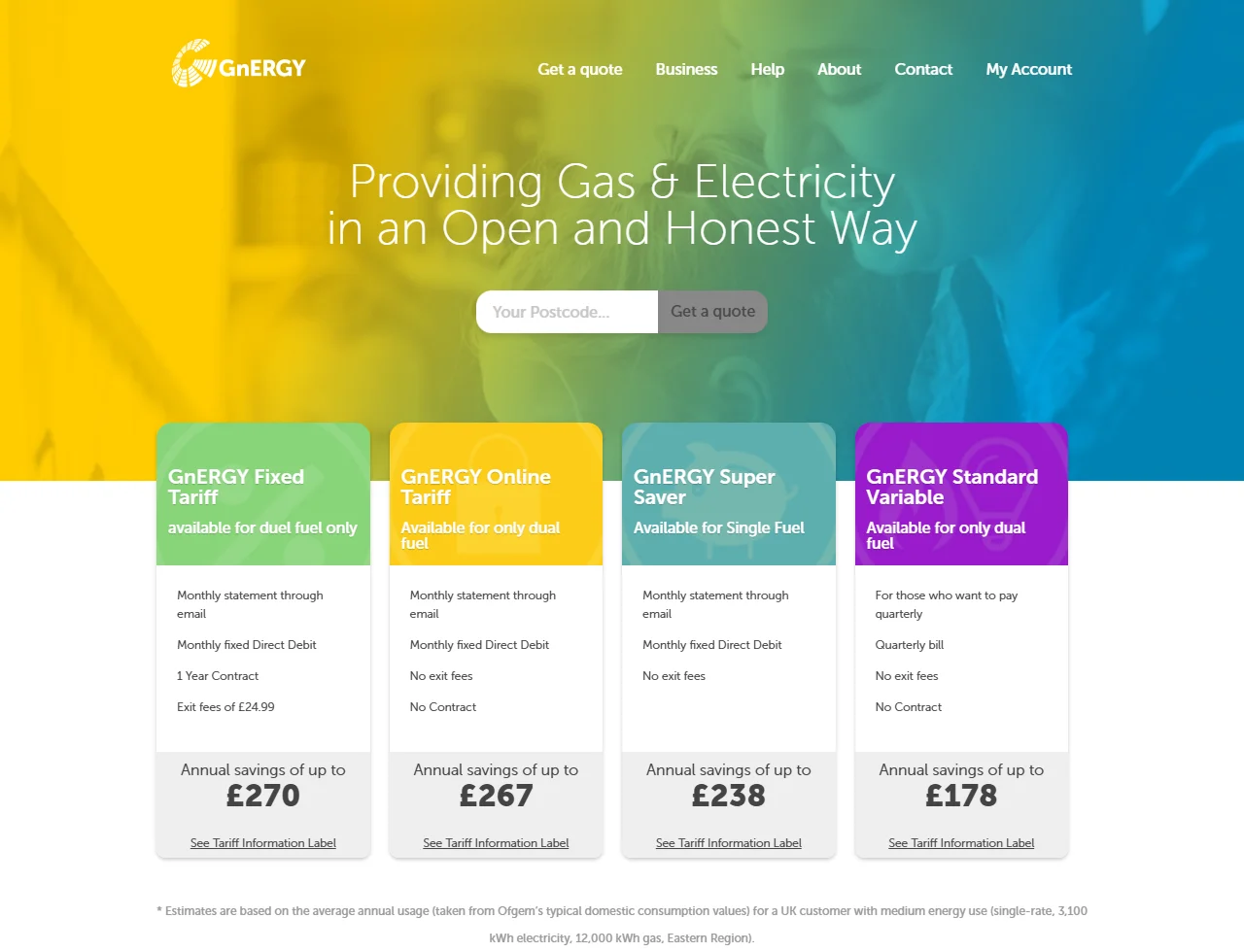
There was no obligation on Gnergy to say any of this on its website, and nothing here suggests the tariffs or the savings figures were anything other than what they claimed. The point is narrower and more useful: a supplier's own website will not tell you it is in trouble. The place that will is the regulator's enforcement page, and it had been saying so for weeks.
The same lesson, from the other end of the ladder and with a much longer warning, is on Tomato Energy, banned from selling months ahead, where a published order stopped a supplier taking new customers seven months before it failed.
Rescued into the largest failure of all
Gnergy's customers moved to Bulb on 21 and 22 March 2020, which was two days before the first national lockdown was announced. The timing is coincidence, not cause: the enforcement trail starts the previous October.
What matters more is who they were moved to. Twenty months later Bulb itself failed, with around 1.5 million customers, and it was too large for the process that had rescued Gnergy. Instead of being transferred to another supplier, Bulb was put into special administration and kept running at public expense until its customers moved to Octopus at the end of 2022.
So Gnergy's 9,000 customers went through the ordinary safety net in 2020 and then, without moving again, found themselves inside the only energy failure in Britain to be handled by the state. The full account of how that worked, and what it cost, is on the Bulb Energy page.
Key dates
| Date | What happened |
|---|---|
| 29 October 2019 | Ofgem issues Gnergy with a final order to pay £673,876.62 plus interest into the Renewables Obligation buy-out fund |
| 31 October 2019 | The deadline in the final order passes without payment |
| 15 November 2019 | Gnergy’s website is trading normally, advertising savings of up to £270 a year |
| 8 January 2020 | Ofgem issues a notice of failure to comply and begins the process that may lead to licence revocation |
| 18 March 2020 | Gnergy ceases trading with around 9,000 domestic customers and a small number of business customers |
| 21 to 22 March 2020 | Bulb takes on the customers |
| 22 March 2020 | Gnergy’s gas and electricity licences are revoked and the final order ceases to have effect |
| 24 November 2021 | Bulb, the supplier that rescued them, enters special administration |
What it means for a business
Gnergy had business customers. Ofgem recorded around 9,000 domestic customers "and a small number of non-domestic customers", and the company's website carried a Business section throughout, with its own menu covering tariffs, meters and agents.
Read Ofgem's reassurance again with that in mind. What it promised was that "domestic customers' credit balances are protected". The small number of businesses on the book got the same guaranteed continuity of supply as everyone else, and no guarantee at all about their money.
That is the ordinary position and it appears on every page here. What Gnergy adds is the practical corollary, because this is the case where the warning was loudest and longest.
- Check the regulator, not the supplier. Ofgem publishes enforcement notices against named suppliers. A final order your supplier has not complied with is about as clear a signal as exists.
- Act on the balance, not on the news. You cannot stop a supplier failing. You can stop having money sitting with it when it does.
- Expect no warning from the company. Gnergy was advertising annual savings two weeks after missing a court-equivalent deadline, and there was nothing improper about that.
| When enforcement action is public | Household | Business |
|---|---|---|
| Supply protected if the supplier fails | Yes | Yes |
| Credit balance protected | Yes | No |
| Reason to act on the warning | Little | Considerable |
| Able to leave without penalty before it fails | Depends on the tariff | Usually not, if in a fixed term |
Where to start
- Current rates for business electricity
- Business gas prices per kWh
- Which suppliers are writing business contracts
If a failure has already moved you, see what you are being charged on a deemed contract.
Gnergy FAQs
What happened to Gnergy?
Why did Gnergy fail?
What is a notice of failure to comply?
Were Gnergy credit balances protected?
Did Gnergy supply businesses?
What happened to Gnergy customers after Bulb took over?
Could customers have known Gnergy was in trouble?
Sources
- Ofgem, Ofgem issues Gnergy Ltd with a notice of failure to comply with a final order over unpaid Renewables Obligation payments, January 2020
- Ofgem, GnERGY Limited: Final Order, 29 October 2019
- Ofgem, Ofgem protects customers of failed supplier Gnergy Ltd, March 2020
- Ofgem, Gnergy Ltd customers: your questions on new supplier Bulb
- gnergy.co.uk, capture of 15 November 2019, Internet Archive