

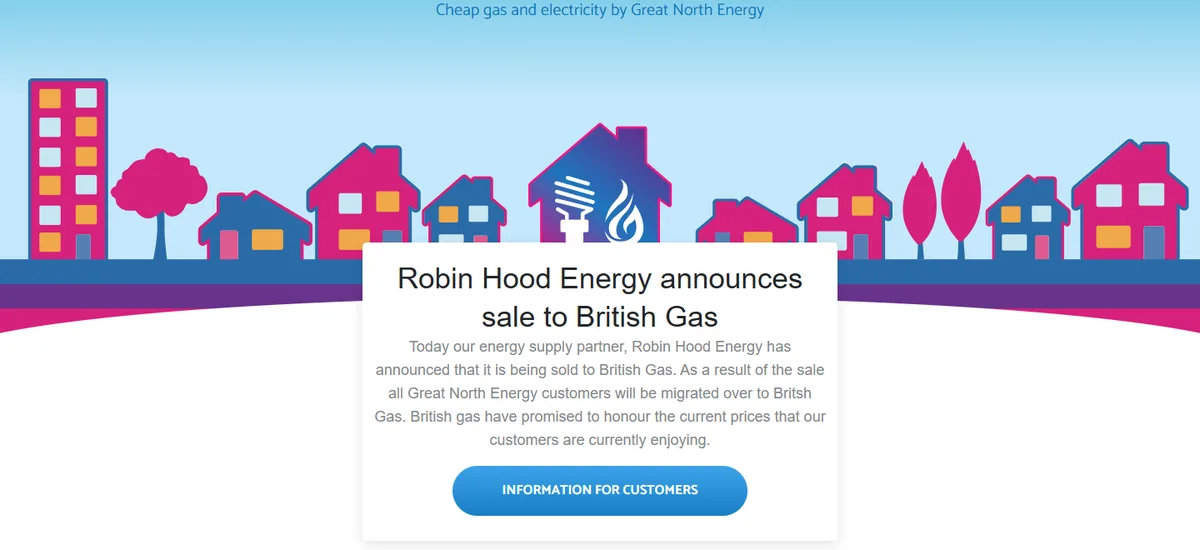
Great North Energy closed in September 2020, when Robin Hood Energy, the supplier whose licence it ran on, was sold to British Gas. Doncaster Council owned it, it served Doncaster, Barnsley and the surrounding area, and it was one of the first of the ten council brands to sign up.
It is also the one where you can watch the whole arrangement being put together. When its launch was reported in October 2017, the same article named three other councils already doing the same thing. If you want to know which licensed supplier would be behind your own contract, you can check who quotes for business energy.
What happened to Great North Energy?
Doncaster Council set up Great North Energy as a not-for-profit brand selling gas and electricity to residents of Doncaster, Barnsley and the surrounding area. The council was not new to the idea: a collective switching exercise it ran in 2014 had taken around £450,000 off local bills, and a permanent brand was the next step.
Like every other brand in this group it held no supply licence. The energy was supplied under the licence of Robin Hood Energy, the Nottingham City Council company. When Nottingham sold that business to British Gas on 4 September 2020, Great North Energy ended along with the nine other brands running on the same licence. It sits on our record of every supplier and brand on this record since 2016.
How ten councils ended up on one licence
Most of these brands are written about as if each council had the idea on its own. The contemporary reporting says otherwise, and Great North Energy is where that is clearest.
On 19 October 2017 The Energyst reported that "Nottingham's Robin Hood Energy will partner two new white label operations": Islington's Angelic Energy, launching that week, and Doncaster's Great North Energy, launching the following month. In the same piece it noted that Derby, Liverpool and Leeds had already opted to white label via Robin Hood.
So by autumn 2017, before most people had heard of any of them, half the eventual group was already signed up:
| Brand | Council | Where it had got to by October 2017 |
|---|---|---|
| RAM Energy | Derby | Already white labelling via Robin Hood |
| The Leccy | Liverpool | Already white labelling via Robin Hood |
| White Rose Energy | Leeds | Already white labelling via Robin Hood |
| Angelic Energy | Islington | Launching that week |
| Great North Energy | Doncaster | Launching the following month |
The rest followed over the next eighteen months: CitizEn Energy in Southampton and Fosse Energy across Leicester and Leicestershire in 2018, Beam Energy in Barking and Dagenham at the start of 2019, alongside Southend and West Sussex.
It was a product Robin Hood Energy was selling to councils, not ten separate inventions. Which is a perfectly reasonable thing for a council to buy. It also means all ten had the same single point of failure, and in September 2020 it failed once for all of them.
What its customers got
Great North Energy's customers were households, and they moved to British Gas with everyone else on Robin Hood Energy's book.
Because the customer base was sold as a going concern rather than collapsing, no supplier of last resort process was involved and nobody was moved onto a deemed rate. Customers were offered rates equal to or better than the tariffs they already had, and there were no exit fees for going elsewhere instead. Supply was never interrupted.
What did not survive was the point of it. A household in Doncaster or Barnsley that had chosen a not-for-profit brand run by its own council, with the money staying local, ended up with the largest supplier in the country on ordinary commercial terms.
If you still had a complaint
The Fosse Energy page sets out where a dispute goes once one of these brands has gone, and the answer is the same here: raise it against British Gas, even for the period you were with Great North Energy.
The Energy Ombudsman's wording on Great North Energy is more explicit than most about who it cannot help, and it is worth quoting because the trap is easy to fall into: "If you switched away from this supplier (when it was still operated by Robin Hood Energy, before British Gas took over your supply) then British Gas will not be responsible for your dispute and unfortunately, on this occasion, we will not be able to offer further assistance."
In other words, the people who read the news, decided not to wait and moved early are the ones who may have no route left. Switching promptly is usually the right call on price. Close out anything unresolved before you do it.
Key dates
| Date | What happened |
|---|---|
| 2014 | Doncaster Council runs a collective switching exercise, reported as cutting local bills by around £450,000 |
| 19 October 2017 | Robin Hood Energy is reported as partnering two new white label operations, Islington’s and Doncaster’s, with Derby, Liverpool and Leeds already signed up |
| November 2017 | Great North Energy launches |
| 4 September 2020 | Nottingham City Council announces the sale of Robin Hood Energy to British Gas |
| September 2020 | Great North Energy closes; customers transfer to British Gas |
What it means for a business
Great North Energy sold to households, so no business was a customer of it. It earns a place on a business energy site for the same reason the others do, and this page makes the sharpest version of the point.
Non-domestic energy is full of brands that are not suppliers. Brokers, buying groups, franchises and trade associations all sell contracts that sit on somebody else's licence, and it is common for one licensed supplier to sit behind many of them at once. That concentration is invisible from the outside. Ten councils found out about theirs on the same afternoon.
Before signing under a brand, the questions are: which licensed supplier holds the contract, what happens to it if that supplier is sold or fails, and who you contact when something goes wrong. If the licence holder fails rather than being sold, the split is the familiar one:
| When your supplier fails | Household | Business |
|---|---|---|
| Supply continues | Yes | Yes |
| Ofgem protects your credit balance | Yes, under the safety net | No |
| A cap limits the rate you move onto | Yes | No |
| You are charged to leave that rate | No | No |
Where to start
- What business electricity costs across suppliers, unit rate and standing charge
- Business gas prices as they stand, bought in a separate market
- Which suppliers hold the licences behind business contracts, so you know who you are dealing with
Our guide explains the rate that takes over with no contract in place.
Great North Energy FAQs
What happened to Great North Energy?
Who took over Great North Energy customers?
Who ran Great North Energy?
Was Great North Energy a real energy supplier?
How many councils were doing this?
I had a complaint about Great North Energy. Who do I take it to?
Did Great North Energy supply businesses?
Sources
- The Energyst, Doncaster and Islington launch local energy companies via Robin Hood, 19 October 2017
- Energy Ombudsman, Great North Energy complaints
- Utility Week, Local energy supplier coming to Doncaster