
A business energy broker is a third-party intermediary that compares suppliers and arranges your gas and electricity contract for you. Most are paid through a commission built into your unit rate, which your supplier must now disclose.
A good broker saves you time and can find a sharper deal than going it alone. This guide explains what they do, how they earn their money, the protections you now have, and how to pick one you can trust.
Utility Saving Expert is a business energy broker, so we have set out both sides fairly. When you are ready, you can compare business energy suppliers with our team.
What is a business energy broker?
A business energy broker, also called a third-party intermediary or TPI, is a company that helps you source, compare and arrange energy contracts with licensed suppliers. It does not supply the energy itself.
What a broker does
A broker sits between your business and the suppliers during buying and renewal. It reviews your usage, compares prices across the market, negotiates terms, and helps arrange the switch to your chosen deal.
What a broker does not do
A broker does not set wholesale prices or network charges, which the market and regulation decide. It also does not install meters, send your bills, run credit checks or fix faults, as those sit with suppliers and network operators.
What services do business energy brokers offer?
Most brokers handle contract comparison, negotiation, renewals and switching. Larger or specialist brokers add services like bill audits, multi-site management and efficiency advice.
Core and specialist services
The services on offer depend on the size of the broker and your needs. The table below splits the common ones from the more specialist support.
| Core services | Specialist services |
|---|---|
| Comparing tariffs across multiple suppliers | Energy audits and efficiency assessments |
| Negotiating pricing and contract terms | Multi-site and portfolio management |
| Tracking renewals to avoid out-of-contract rates | Advice on flexible and pass-through contracts |
| Handling the switching paperwork | Carbon reporting and metering upgrades |
Where brokers add the most value
The core value of a broker is market insight, comparison and negotiation, rather than day-to-day account management. For many firms that is the difference between a quick renewal and hours spent managing energy procurement alone.
How do business energy brokers get paid?
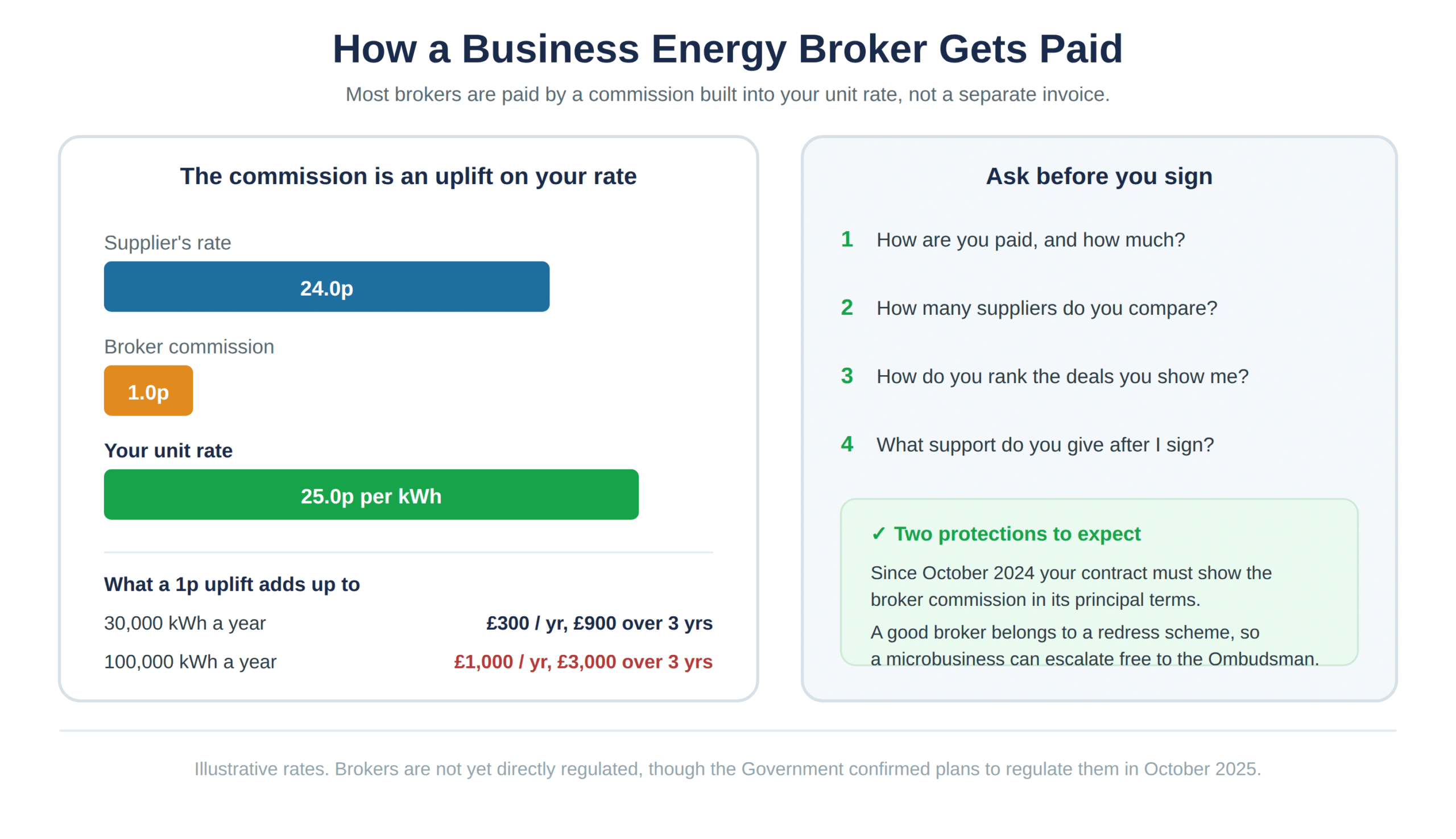
Most brokers are paid through a commission added as an uplift to your unit rate, collected by the supplier rather than invoiced to you. Since October 2024 that commission must be shown in your contract.
Commission as an uplift
Rather than charge you a separate fee, the broker’s payment is usually built into the price per kWh and paid by the supplier. The graphic below shows how the uplift works and what it can add up to.
The disclosure rule
Commission has to be disclosed in your contract’s principal terms. This began for microbusinesses in October 2022 and, as Ofgem confirmed, extended to all non-domestic customers from October 2024.
A small uplift still adds up over a long contract. One penny per kWh on a larger site can total several thousand pounds across a three-year term, so it is worth checking.
Should you use a broker or go direct?
A broker compares the whole market and handles the admin for you, while going direct means one supplier and one set of prices. The right choice depends on your size, time and confidence with energy buying.
Broker versus direct at a glance
Both routes can work. The table below compares them on the points that usually matter most.
| Area | Using a broker | Going direct |
|---|---|---|
| Price comparison | Many suppliers compared at once | You contact each supplier yourself |
| Admin | Broker manages most of it | You manage the whole process |
| Market access | Whole-of-market insight | Limited to one supplier’s products |
| Renewals | Reminders and fresh comparisons | Usually one renewal offer |
| Cost | Commission may be built in | No commission, but rates may not be sharp |
Which suits your business
A very small firm with simple, stable usage can do well going direct. Most businesses use a broker for faster comparisons and support through renewals and contract changes.
How does the broker process work?
The process runs from an initial chat, through a Letter of Authority and supplier quotes, to your switch going live. A broker handles the supplier liaison while you approve the decisions.
From enquiry to go-live
You start by sharing your renewal date and recent bills, along with your MPAN and MPRN. The broker then gathers quotes, presents the best options, and once you choose, arranges the switch to your new supplier.
The Letter of Authority
A Letter of Authority, or LOA, lets the broker request quotes, access your usage data and manage the switch. It does not commit you to a contract, and it should state the sites covered, what is authorised, how long it lasts and how to cancel it.
Are business energy brokers regulated?
Business energy brokers are not yet directly regulated, but suppliers must follow rules on commission disclosure and dispute resolution. The Government confirmed in October 2025 that it plans to bring brokers under Ofgem regulation.
The current position
There is no licensing system for brokers yet. Suppliers must ensure commission is disclosed and that microbusinesses can reach an approved redress scheme, which is why a broker should belong to one such as the Energy Ombudsman scheme.
The planned regulation
In its October 2025 response to the third-party intermediary review, the Government confirmed it intends to appoint Ofgem as the broker regulator. Until that becomes law, you remain responsible for your own checks.
How do you choose a trustworthy broker?
A trustworthy broker is open about commission, gives you the paperwork before you commit, compares a wide panel of suppliers, and supports you after the deal. Watch for pressure selling and hidden uplifts.
Good signs and red flags
Standards vary across the market, so a few checks go a long way. The table below sets out what to look for and what to avoid.
| Good signs | Red flags |
|---|---|
| Explains commission clearly and shows where it sits | Vague or hidden about how it is paid |
| Gives full written quotes and terms up front | Pushes a quick decision with no time to review |
| Compares a broad panel of suppliers | Works from a very limited supplier list |
| Member of a redress scheme, offers ongoing support | No complaints route and little after-sales help |
Questions worth asking
Ask how the broker is paid, which suppliers it compares, how it ranks deals, and what support continues after you sign. A transparent broker will answer all four plainly and point you to your supplier options without pressure.
Do you need a broker or an energy consultant?
A broker is best for sourcing and securing a competitive contract, usually paid by commission. An energy consultant offers wider strategic and efficiency advice, usually for a fee.
The difference
A broker focuses on comparing suppliers and arranging your deal. A consultant works on longer-term goals like cutting consumption, compliance and reporting, and typically charges directly for that advice.
Which one you need
If your priority is arranging or renewing a contract, a broker is the practical choice. Larger organisations that also want to reduce usage may want a consultant alongside, or a broker that quotes business electricity and business gas and reviews efficiency too.