
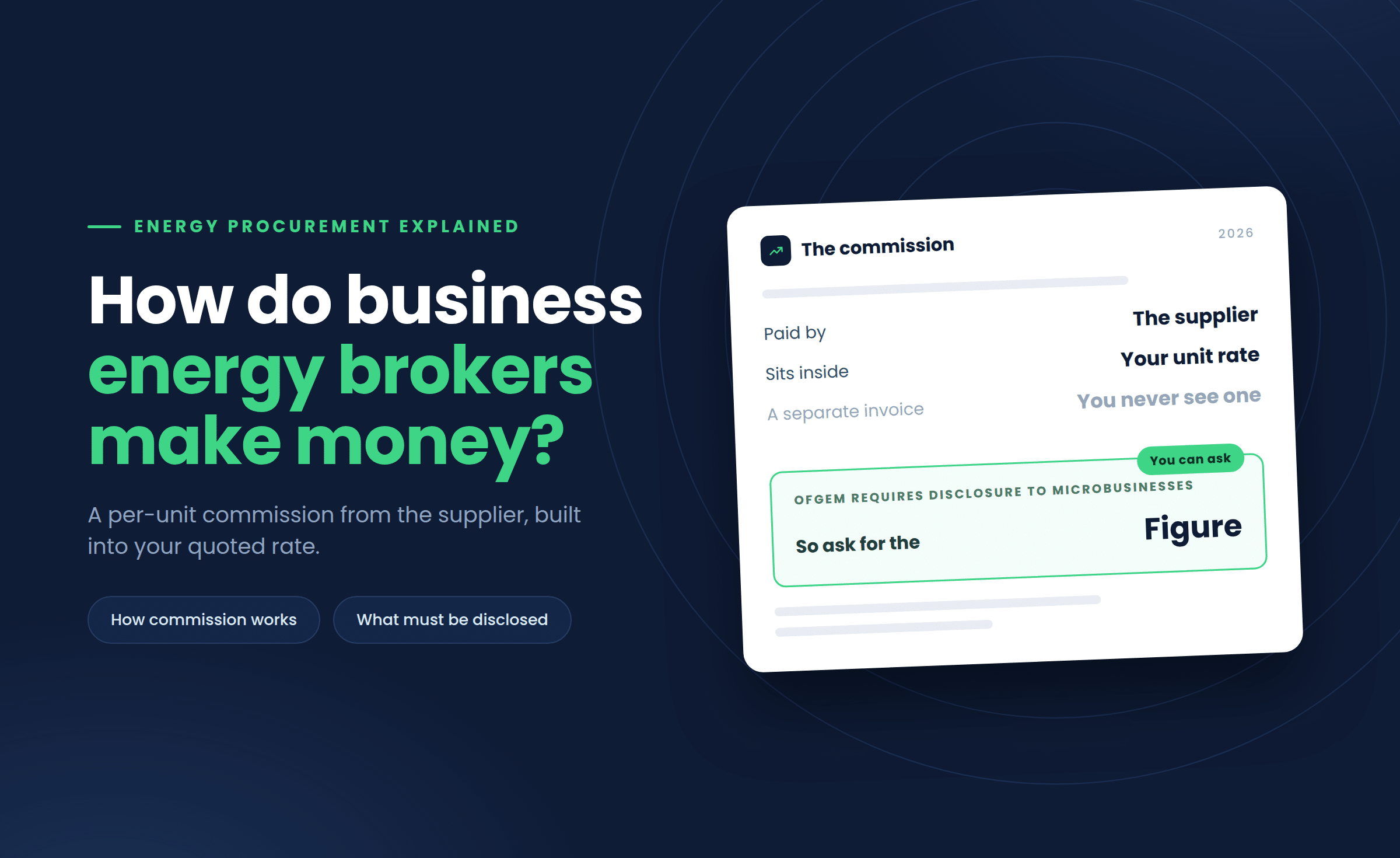
Business energy brokers make money through commission, usually built into the unit rate a supplier charges, which is why using a broker does not typically cost you anything upfront. Since Ofgem tightened its rules, brokers must disclose that commission to microbusiness customers.
It is a fair thing to want to understand. If a service is free to you, it is reasonable to ask who is paying for it and why.
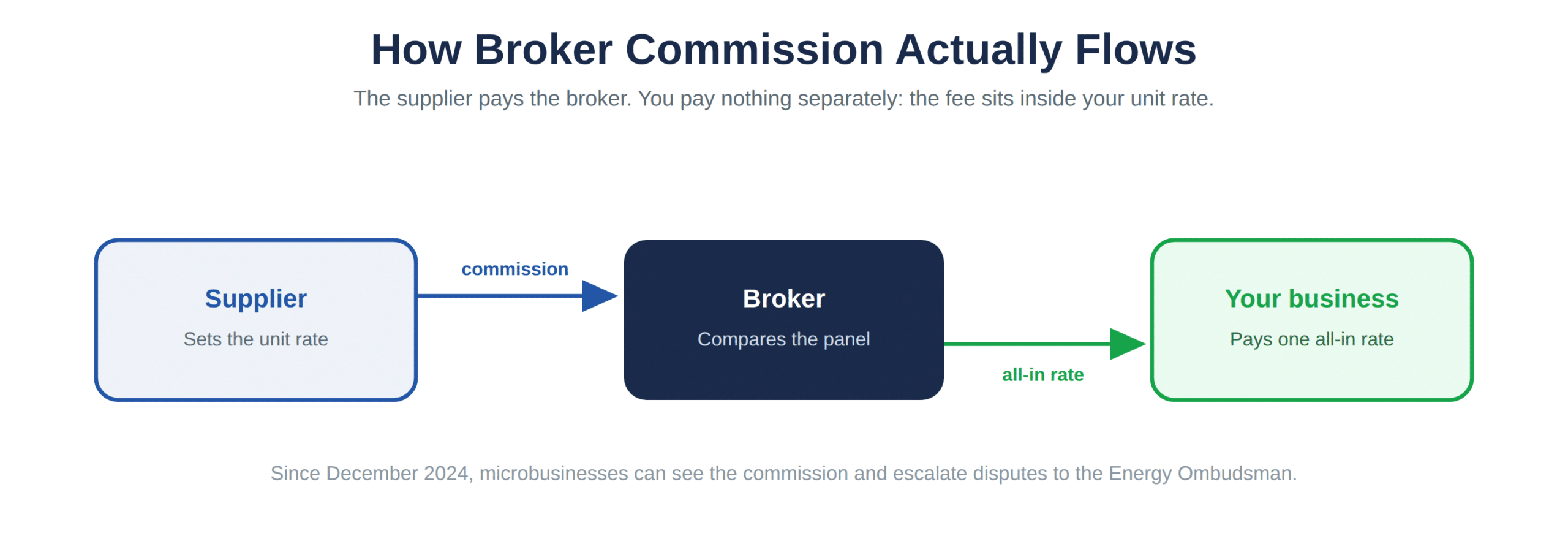
The honest answer is that suppliers pay brokers, not the other way round, and that fee is folded into your unit rate rather than charged as a separate invoice. Utility Saving Expert works this way too.
This guide covers exactly how commission works, what Ofgem now requires, and how to judge whether using a broker is worth it, alongside our wider guide to business energy brokers.
How does broker commission work?
A broker earns a per-unit commission from the supplier once your switch completes, added into your quoted unit rate rather than billed to you separately.
When commission becomes a problem
When a broker introduces a customer and the switch goes ahead, the supplier pays a fee, often expressed in pence per kWh over the contract. That fee is baked into the rate you are quoted, not itemised on your bill.
- How it is quoted: usually pence per kWh, added across the contract term.
- Who pays it: the supplier pays the broker, not your business directly.
- What varies it: the supplier, contract length and broker all affect the size.
This is standard practice and not inherently a problem. It only becomes one when the uplift is excessive or hidden, which is exactly what recent Ofgem rules are designed to stop.
What does Ofgem require brokers to disclose?
Ofgem requires third party intermediaries to disclose their commission to microbusiness customers, and since December 2024 microbusinesses have been able to take unresolved TPI disputes to the Energy Ombudsman.
What a microbusiness counts as
This tightened the rules considerably. Ofgem now requires disclosure, and the Energy Ombudsman hears unresolved microbusiness disputes, as our guide to micro business energy explains.
- Employee count: fewer than 10, or turnover and balance sheet under set thresholds.
- Usage: electricity under 100,000 kWh, or gas under 293,000 kWh a year.
- Entitlements: commission disclosure and Energy Ombudsman access for TPI complaints.
Ofgem’s licence conditions sit alongside the Retail Energy Code, which governs how market participants deal with each other and, indirectly, how transparent the process must be.
Does using a broker make business energy more expensive?
Not necessarily. A broker with panel access to many suppliers can often find a competitive rate that offsets the built-in commission, particularly if you would otherwise have gone to just one or two suppliers directly.
Is going direct cheaper?
The uplift is small relative to the overall unit rate, and a genuinely competitive panel comparison tends to more than make up for it. What matters is whether the broker is comparing widely and disclosing the fee honestly.
A business going direct to a single supplier is not guaranteed a better deal just because there is no broker. Suppliers still price on risk and demand, and going direct means comparing manually across suppliers yourself.
Because a broker is paid only when a switch completes, its incentive is to find a rate that works for you, not to push a single supplier regardless of fit. The honest ones make that alignment obvious.
How do you check if a broker’s deal is fair?
Ask for the commission figure directly, compare the all-in rate against the market average for your usage band, and check the contract length and exit terms before signing.
The fairness checklist
- Ask the figure: what commission is built into the rate.
- Benchmark it: compare the quoted rate against the UK average for your size.
- Check the term: that the contract length suits you, not the broker’s target.
- Confirm recourse: that you can escalate to the Energy Ombudsman as a microbusiness.
A broker who will not answer a direct question about commission is a warning sign. Under current rules that information should be available to a microbusiness on request, and our guide to business energy complaints covers escalation.
What’s the difference between a broker, a TPI and a comparison site?
They are largely the same thing under different names: TPI is Ofgem’s regulatory term, broker is the everyday term, and a comparison site is a broker that runs quotes across a visible panel.
Not the same as a meter operator
Do not confuse a broker or TPI with a Meter Operator, which is a different role entirely, responsible for installing and maintaining meter equipment rather than sourcing your energy contract.
| Term | What it means |
|---|---|
| TPI | Ofgem’s regulatory term for an intermediary |
| Broker | The everyday word for the same role |
| Comparison site | A broker quoting across a visible panel |
| Meter Operator (MOP) | Installs and maintains meters, not contracts |
Utility Saving Expert has compared UK business energy since 2014 across a panel of trusted business energy suppliers, and we are open about earning commission on completed switches. We would rather you know that upfront.