
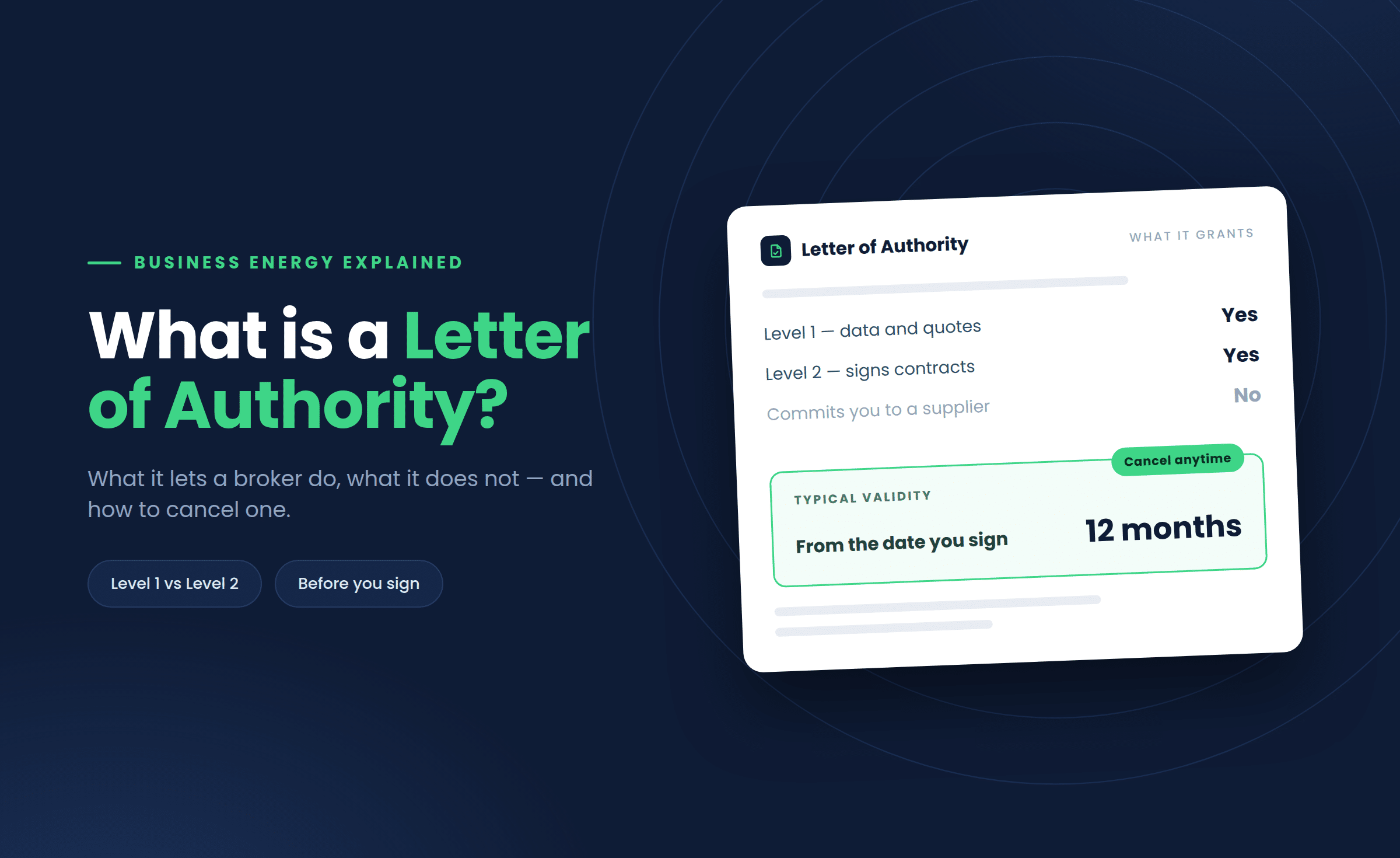
A Letter of Authority, or LOA, is a document that gives a broker permission to act on your behalf with energy suppliers. It lets them access your data and arrange your contract, but a standard LOA does not commit you to anything.
It is the first thing most brokers ask you to sign. This guide explains what an LOA does, the difference between the levels, how to stay safe, and how to cancel one if you need to.
Utility Saving Expert is a broker, so we have set out both the benefits and the risks plainly. When you are ready, you can run a business energy comparison or compare business energy suppliers with our team.
What is a Letter of Authority?
A Letter of Authority is a signed document that authorises a third-party intermediary, usually an energy broker, to deal with your suppliers on your behalf. It is how a supplier confirms the broker has your permission.
What it lets a broker do
An LOA lets a broker request your usage data, obtain quotes and manage the switching process for you. Without one, a supplier will not share your account details with a third party.
What it does not do
A standard LOA does not commit you to any contract or supplier. It also does not let a broker take payments or hand over control of your account, and you still make the final decision.
What is the difference between a Level 1 and Level 2 LOA?
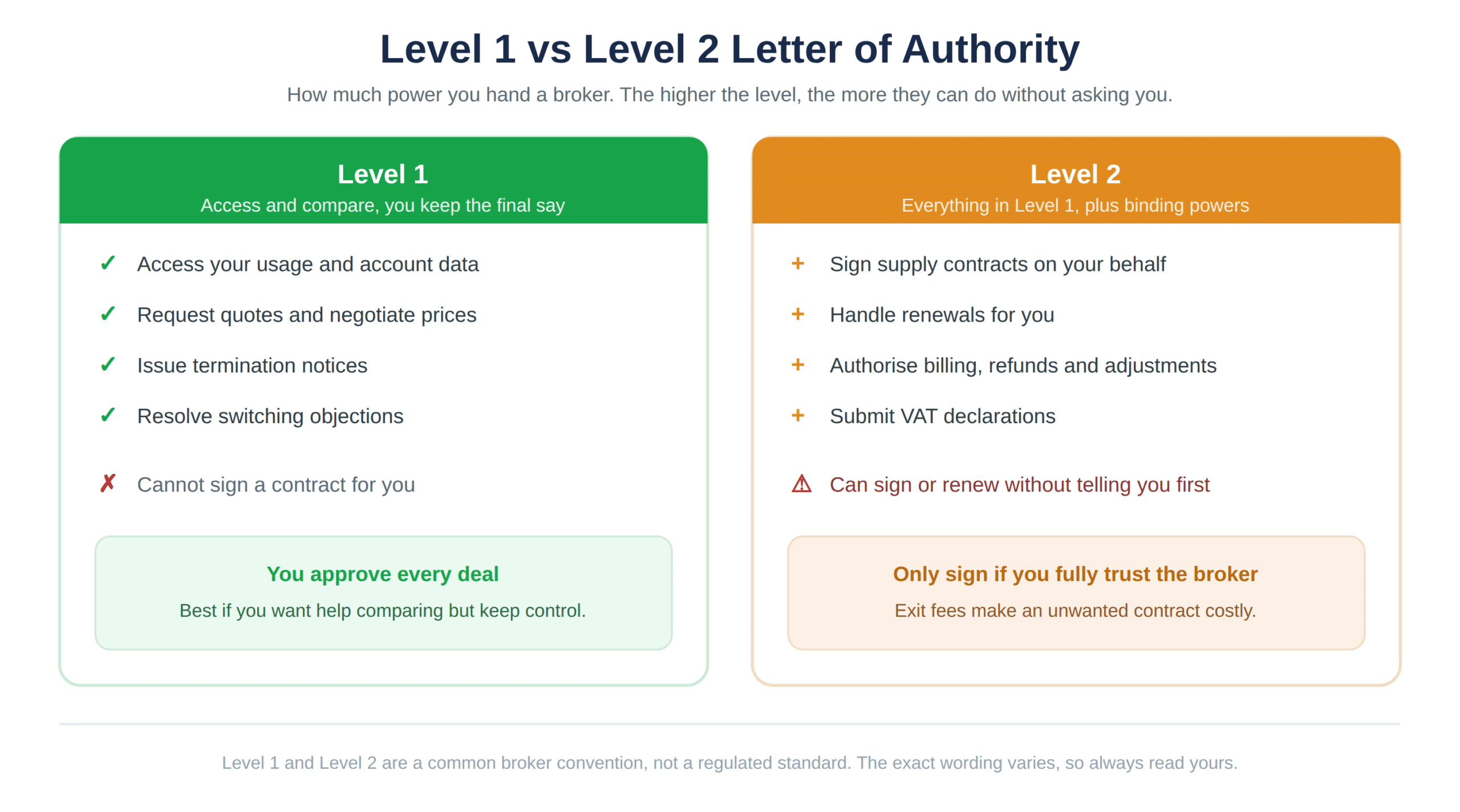
A Level 1 LOA lets a broker access data, get quotes and negotiate, but not sign contracts. A Level 2 LOA adds the power to sign and renew contracts for you, so it hands over far more control.
How the two levels compare
The graphic below sets out what each level lets a broker do, and why the higher level needs more trust.
Why the levels are not a fixed standard
Level 1 and Level 2 are a common broker convention, not a regulated classification. The exact wording and scope vary between brokers, so always read what a specific LOA authorises rather than relying on the label.
The Level 2 risk to know
A Level 2 LOA can let a broker sign or renew a contract without checking with you first. Combined with the high exit fees on business energy, that is a real risk, so only sign one if you fully trust the broker.
Why do brokers ask you to sign an LOA?
Brokers need an LOA because suppliers will not release your account data or deal with a third party without proof of permission. It protects your data and confirms the broker is acting with your consent.
Suppliers must protect your data
Suppliers hold your consumption and contract details, which they must keep private under data protection rules. The LOA is the lawful basis that lets them share that data with your broker.
What the broker can then access
With an LOA in place, a broker can pull your usage history, supply numbers such as your MPAN and MPRN, and contract end dates from suppliers and industry databases. That is what lets them quote accurately.
Who can sign a Letter of Authority?
The person who signs an LOA must have authority to act for the business. That usually means the owner, a partner, or a company director, depending on how the business is set up.
The signatory by business type
Suppliers often check that the signatory holds the right role. The table below shows who can normally sign.
| Business type | Who can usually sign |
|---|---|
| Sole trader | The business owner |
| Partnership | Any partner, ideally with the others’ agreement |
| Limited company | A director, or an authorised senior manager |
| Charity or non-profit | A trustee, chair or senior officer with authority |
Getting the right person to sign
If the wrong person signs, a supplier may reject the LOA and delay your switch. For a bigger commitment like a Level 2 LOA, make sure everyone with a stake agrees first.
How long does an LOA last and can you cancel it?
An LOA usually lasts 12 months, though you can ask for a shorter period. You can cancel it at any time in writing, because the LOA itself does not tie you into a contract.
The validity period
Most LOAs run for 12 months from signing, and some suppliers cap them shorter. If you only want help with one renewal, ask the broker to set a shorter validity so the authority does not linger.
How to cancel one
You can withdraw an LOA whenever you like by telling the broker and supplier in writing. The supplier stops dealing with the broker once it has your confirmation, usually within a few working days.
Is it safe to sign a Letter of Authority?
Yes, signing an LOA is generally safe with a reputable broker, and a standard one does not commit you to anything. The key is to read it, check the scope and duration, and use a broker you trust.
What to check before you sign
A few quick checks protect you from handing over more than you mean to. Run through the points below before signing.
| Check | Why it matters |
|---|---|
| Which level it is | Level 2 lets the broker sign contracts for you |
| What it authorises | Confirms exactly what the broker can and cannot do |
| How long it lasts | A shorter period limits open-ended authority |
| How to cancel it | Lets you withdraw permission if things change |
| Who the broker is | A reputable, redress-scheme member is safer |
The data protection angle
Signing an LOA lets a broker access personal and business data held by your supplier. Choose a broker that handles that data responsibly, and limit the authority to what the job actually needs.
What happens if a broker misuses an LOA?
If a broker acts beyond what you authorised or signs a deal you did not agree to, you can complain and escalate. A microbusiness can take an unresolved dispute to the Energy Ombudsman free of charge.
Known risks to watch for
There is a history of broker mis-selling in the market, which prompted new Ofgem rules to protect businesses. The main risks are a broad LOA being used to sign or auto-renew a contract you did not want.
How to get it put right
Raise it with the broker in writing first. If it is not resolved, and the broker is in a redress scheme, a microbusiness can escalate free to the Energy Ombudsman, one of the protections Ofgem has confirmed for smaller firms.
What does a Letter of Authority look like?
A Letter of Authority names your business and the broker, lists exactly what the broker is authorised to do, and states how long it lasts. A good one is short, specific and easy to read.
What a good LOA states
A clear LOA sets out the sites it covers, the permissions granted, the validity period and how to cancel. Anything vague or open-ended is worth querying before you sign.
A simple template
You can expect an LOA to follow a form like the one below. Wording varies by broker, so read yours in full.
I confirm that [broker name] is authorised to act on behalf of [business name] in relation to the energy supply at [supply address], and I authorise my supplier to share account information with them.
- Permissions granted: access usage and account data, request quotes, issue termination notices, and resolve objections.
- Contract signing: included only if this is a higher-level authority, and stated explicitly.
- Valid for: 12 months from the date of signature, unless cancelled in writing sooner.
Signed by [authorised signatory], [role], [date].