
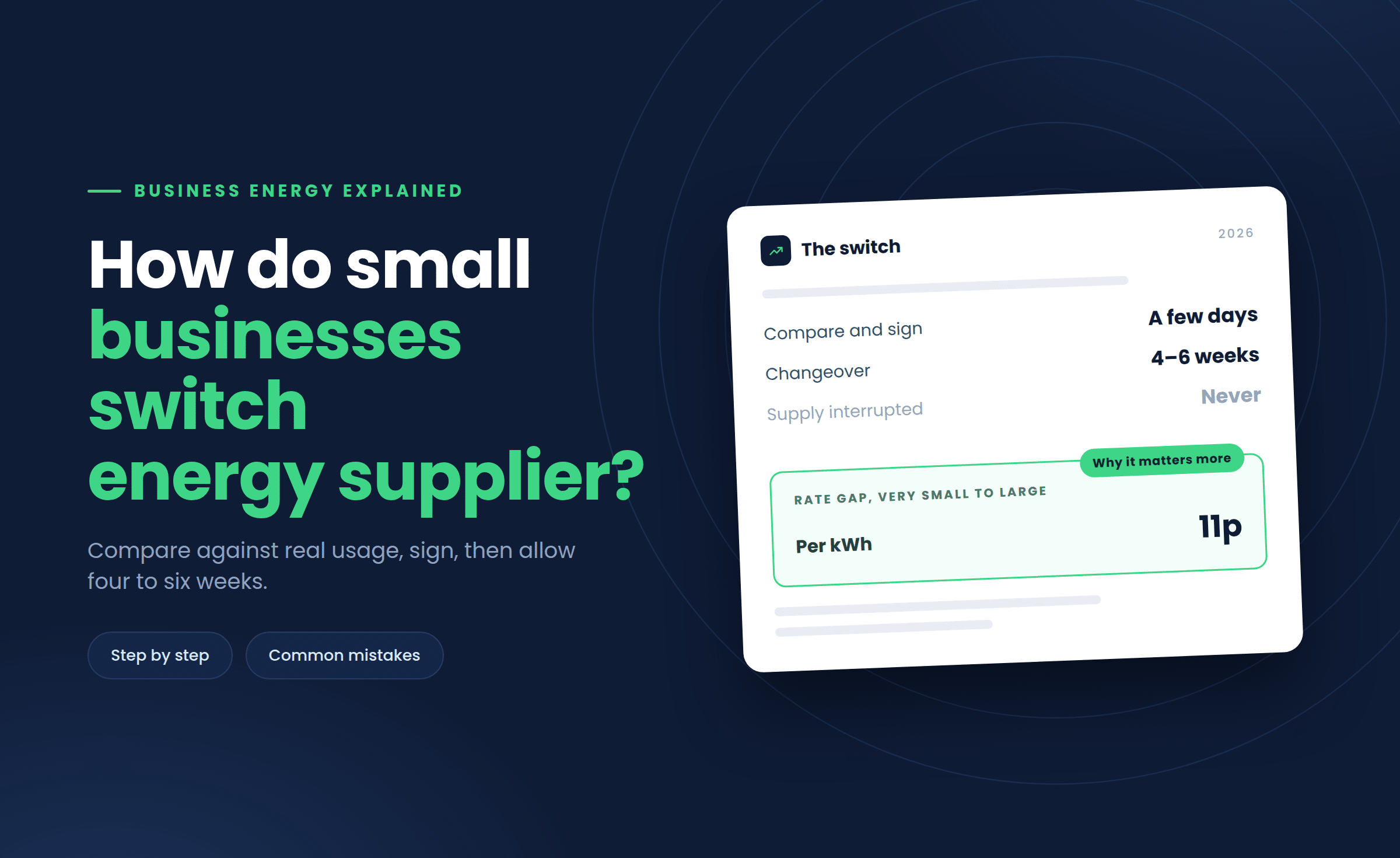
Small businesses switch energy supplier by comparing live quotes against their own usage figures, choosing a new supplier and contract length, then signing, with the changeover completing in around 4 to 6 weeks. The process is much the same as for any business, just usually quicker.
Small business switch questions tend to come with a worry attached: not enough time, not enough jargon knowledge, and no confidence that switching will not cause disruption.
None of those hold up once you have been through it. SME energy switching is largely paperwork and comparison, not negotiation skill or industry contacts.
Who counts as a small business for energy switching?
For energy purposes, a small business typically uses between 20 and 499 MWh of electricity a year, distinct from a micro business, and the line matters because it affects which protections and rates apply.
Small versus micro
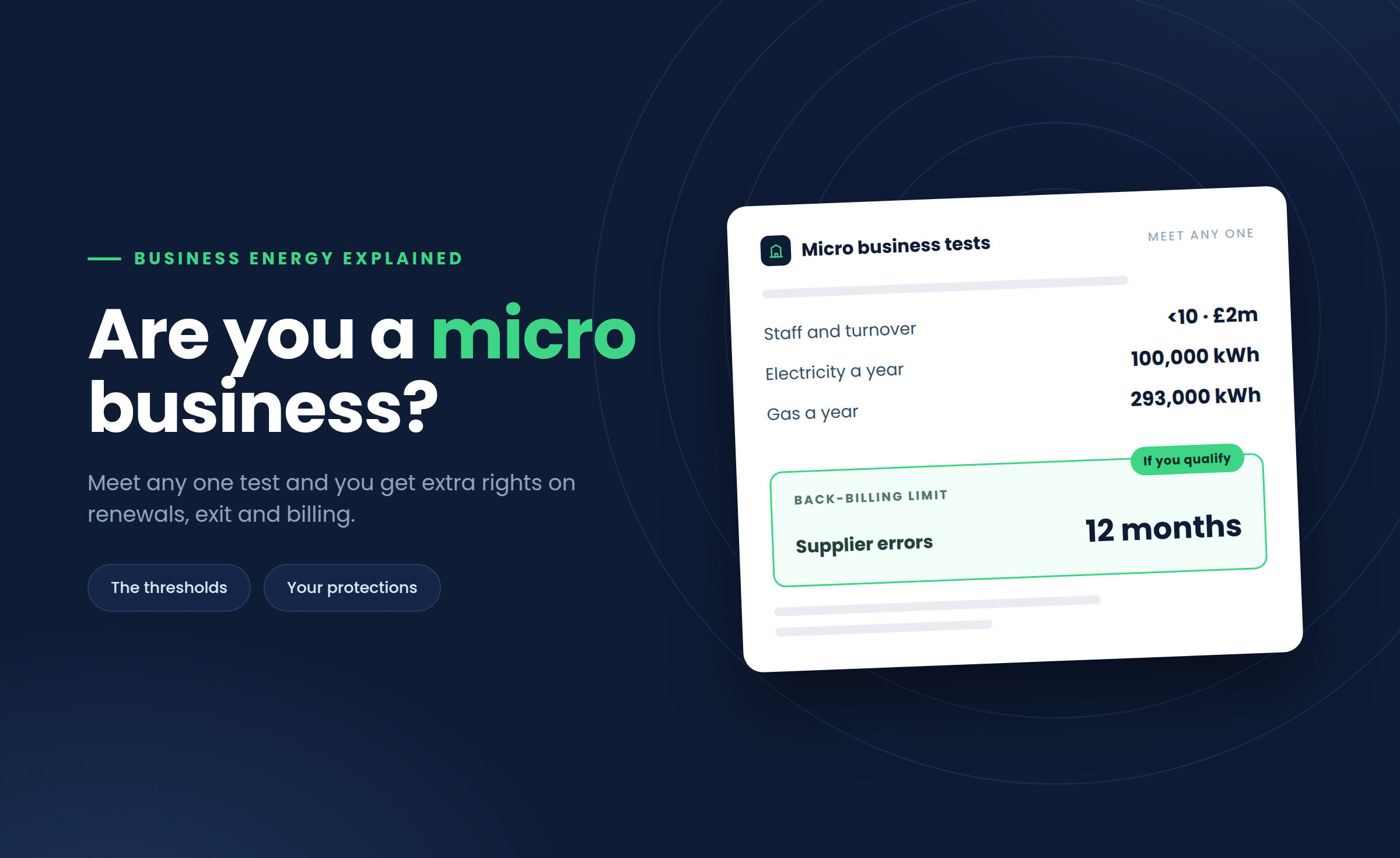
A micro business is usually one with under 10 employees and turnover under £2m, or using no more than 100,000 kWh of electricity a year, and it gets extra protections under the Retail Energy Code.
Most independent shops, salons, cafes, offices and trades businesses fall into the small business band. It is a wide category covering a lot of very different day-to-day energy use.
What do small businesses need before starting a switch?
A recent bill, your MPAN or MPRN, and your current contract end date cover almost everything needed to start, and nothing more technical is required at the comparison stage.
Your switching checklist
- A recent bill: from the last three months, showing usage and rate.
- MPAN and MPRN: your electricity and gas meter references, both on the bill.
- Contract end date: so you know your penalty-free renewal window.
- Your classification: a rough sense of it if you are near the micro business threshold.
- Where to look: our guide on how to read a business energy bill shows where each field sits.
What’s the step-by-step process for a small business?
The process runs in four practical stages: compare quotes using your bill, choose a supplier and contract length that fits your usage, sign the new agreement, and let the changeover run over 4 to 6 weeks.
| Stage | What you do | Typical timeframe |
|---|---|---|
| Compare | Enter usage details and get live quotes across 30+ suppliers | A few minutes |
| Choose | Pick a rate and contract length that suits your renewal date | Same day |
| Sign | Confirm the new contract with your chosen supplier | 1 to 2 days |
| Changeover | New supplier registers the switch and starts billing | 4 to 6 weeks |
If you’re on a rolling or out-of-contract rate
If there is no fixed term to work around, you can start the switch immediately, with no notice period or objection risk. Many small businesses find they have been on an out-of-contract rate longer than expected, so it is worth comparing business electricity quotes straight away.
How is small business switching different from micro or large business switching?
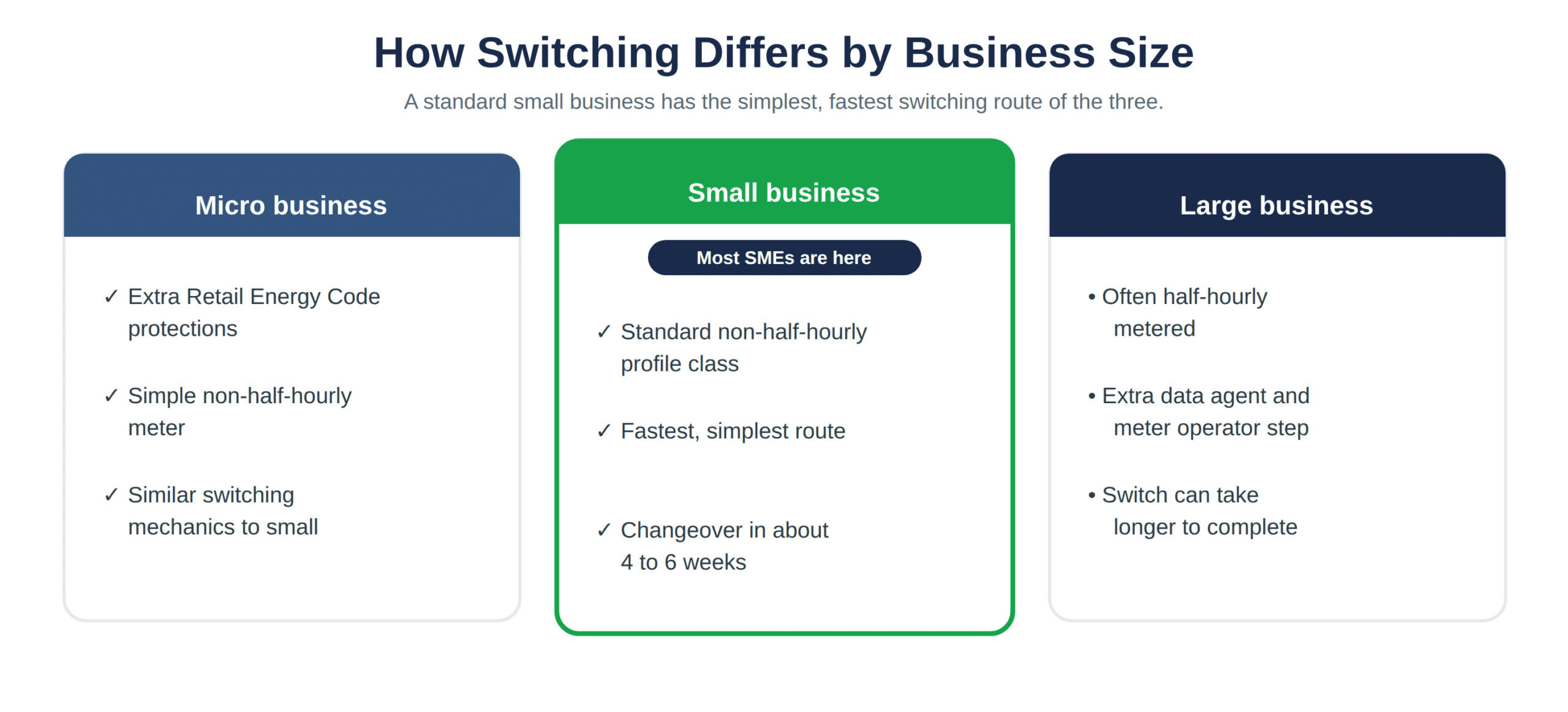
Micro businesses get extra protections under the Retail Energy Code, while large businesses on half-hourly meters go through additional settlement steps, and a standard small business sits in between with the simplest process.
The three switching routes
- Micro business: extra contractual protections, but similar switching mechanics.
- Small business: standard non-half-hourly profile class, the fastest route.
- Large business: often half-hourly, adding a data agent step through Elexon.
Our guide to profile classes covers how your usage band is settled behind the scenes, and why it rarely needs any action from you directly.
What mistakes do small businesses commonly make?
Leaving the switch until after the renewal date, comparing on advertised headline rates rather than actual usage, and missing the Climate Change Levy line on a bill are the three most common mistakes.
Understanding the Climate Change Levy
The Climate Change Levy is a genuine cost on most bills, already factored into house average rates. Businesses sometimes mistake it for an error rather than a standard charge, and some qualify for a reduced rate through a Climate Change Agreement.
The renewal-date mistake is the costliest. Miss it and you drift onto an out-of-contract rate until you act, paying well above a negotiated deal in the meantime.
| Common mistake | The fix |
|---|---|
| Switching after the renewal date | Compare 8 to 12 weeks before your end date |
| Comparing on headline rates | Use your actual usage figures instead |
| Treating the CCL as an error | Know it is a standard charge on most bills |
How much could a small business save by switching?
A small business using around 10,000 kWh electricity and 2,500 kWh gas a year spends roughly £3,290 combined at current averages, and businesses switching through Utility Saving Expert save an average of £1,952 a year.
Where the saving comes from
That saving is largest for businesses that have drifted onto an out-of-contract rate, which runs 40% to 80% above a negotiated deal. Even a business already on a reasonable fixed rate usually finds some improvement at renewal, as our guide on switching to a cheaper plan shows.
The only way to know your own figure precisely is a live comparison with a recent bill, using DESNZ average rates only as a benchmark, since rates vary by region, meter type and supplier. Ofgem’s business energy advice sets out your rights through the switch.