
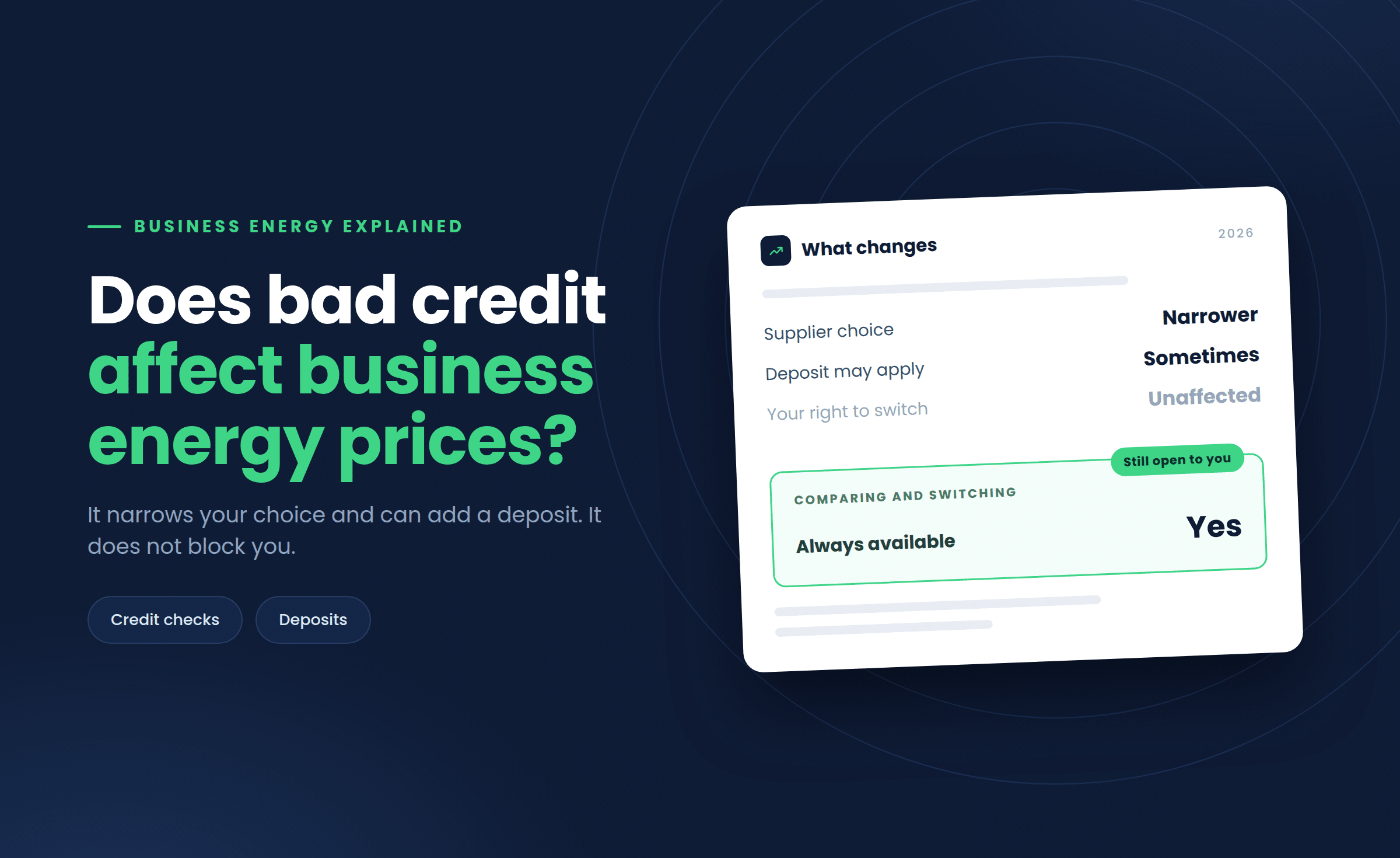
Yes, in most cases. A poor business credit history will not stop you comparing or switching supplier, but it can narrow your choice of suppliers, add a deposit requirement, or push the rate you are offered slightly higher.
Suppliers run a credit check on almost every new account before quoting a final rate. It is a standard part of onboarding, not a punishment aimed at any one business.
What varies is what happens next. A strong position keeps the full range of rates open to you, while a weaker one can mean extra conditions attached to the same deal.
How does a supplier check your business’s credit before quoting?
Most suppliers run an automated check through a business credit reference agency during your application, looking at payment history, any County Court Judgments, and how long the company has been trading.
This happens quickly, usually within the quote or sign-up process rather than as a separate step. Directors of very small or newly formed companies are sometimes asked for a personal credit check too, where the business has no financial history to draw on.
What suppliers are looking for
- Payment history: with previous suppliers, including any missed payments.
- Public records: County Court Judgments, insolvency, and filing history at Companies House.
- Debt levels: existing debt relative to the size of the business.
Does a quote check affect your score?
| Check type | When it happens | Effect on your score |
|---|---|---|
| Quotation (soft search) | When you get quotes | None, it is not visible to lenders |
| Application (hard search) | When you sign up | A small, temporary dip in some cases |
Larger suppliers tend to run an instant automated decision, while smaller panel suppliers sometimes take a more manual look, particularly for higher-usage or half-hourly accounts. None of this is unique to energy: insurers and lenders run broadly similar checks.
What happens if your business fails a supplier’s credit check?
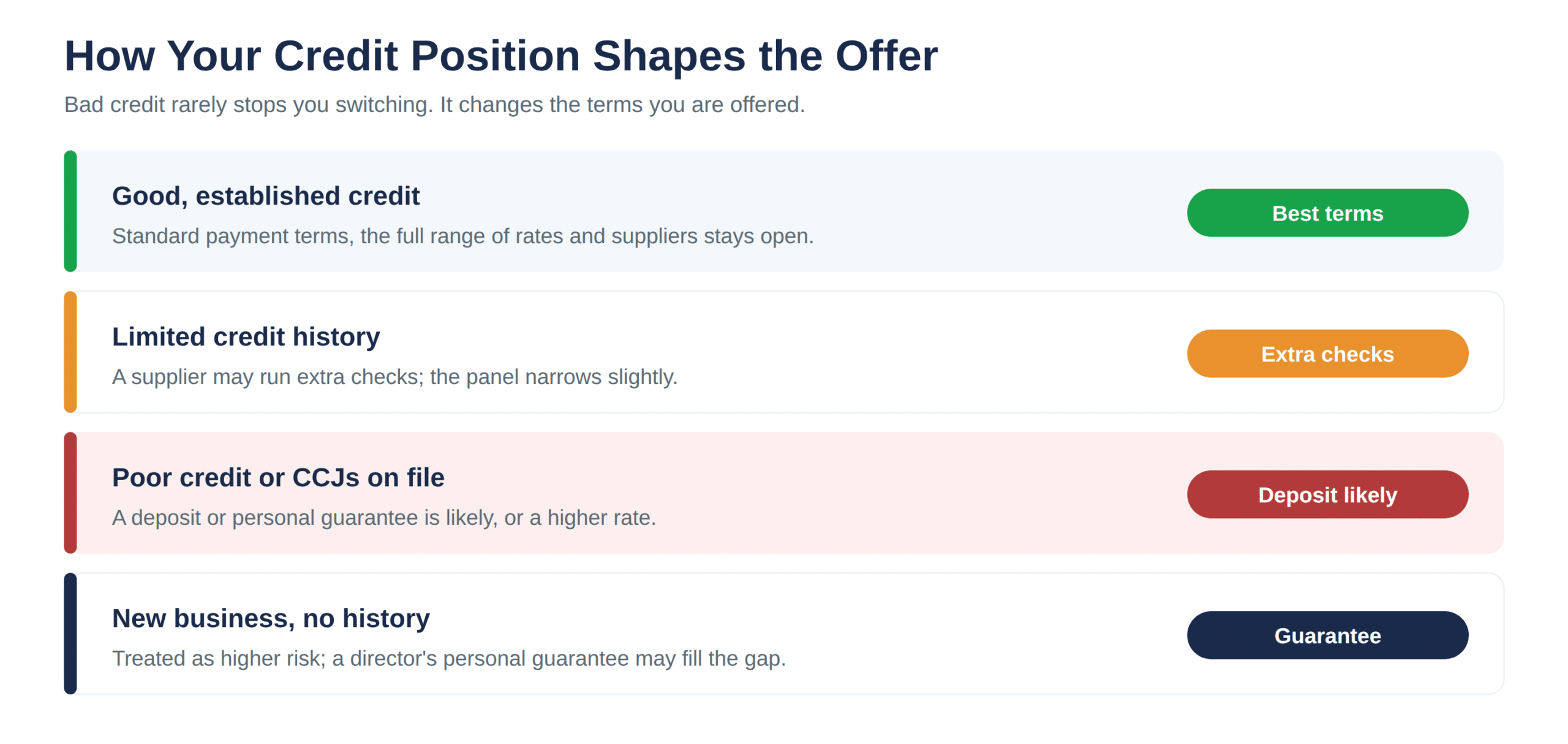
A failed or borderline check rarely means an outright refusal. More often the supplier asks for a security deposit, a personal guarantee from a director, or a prepayment-style arrangement instead.
The trade-off is usually cost
Suppliers still want your business, since turning away paying customers is not good business, so most have a fallback rather than a flat no. The trade-off is cost: a deposit ties up cash, and a personal guarantee puts a director’s own credit on the line if the company does not pay.
Can a business with bad credit still get a competitive rate?
Yes, though the range narrows. Some suppliers specialise in higher-risk accounts and quote close to standard rates in exchange for a deposit, while others decline and leave you to look elsewhere on the panel.
Why comparing matters more, not less
Comparing across a wider panel of business energy suppliers matters more here, not less, rather than accepting the first quote with a condition attached.
UK average business electricity sits around 24.14p/kWh in 2026, from DESNZ data. That is the benchmark to measure any credit-adjusted quote against, not just whichever figure a single supplier offers.
Does a personal guarantee or deposit affect the price you pay?
A personal guarantee itself usually does not change the unit rate directly, but a security deposit sometimes buys a better rate because it reduces the supplier’s risk.
Deposit versus guarantee
Read exactly what is being asked for before assuming either option is your only route. A deposit is refundable and can lower the rate, while a guarantee costs nothing upfront but carries personal liability.
| Option | Upfront cost | Effect on the rate / risk |
|---|---|---|
| Security deposit | Cash upfront, refundable | Can lower the rate, but ties up working capital |
| Personal guarantee | None | Usually rate-neutral, but a director is liable on default |
Neither is automatically the cheaper route. Which works out better depends on your cash position and how far the rate moves in exchange for the deposit.
What can you do to improve your position before you switch?
Tidy company filings, a clean payment record with your current supplier, and comparing well ahead of your renewal date all put you in a stronger position than waiting until you are desperate to switch.
Steps that strengthen your position
- Pay on time: keep current bills up to date in the run-up, even if the relationship is ending.
- File promptly: accounts and confirmation statements on time at Companies House.
- Ask for a reference: a letter of good standing from your current supplier if you have paid reliably.
- Compare early: two to three months before renewal, not after drifting onto an out-of-contract rate.
Ofgem’s business energy advice also sets out your rights if a supplier’s decision seems unfair.